Can Shingrix Reduce Dementia Risk? What Studies Show
Large studies link the Shingrix vaccine to a 17–20% lower dementia risk, but researchers say clinical trials are needed to confirm the finding.
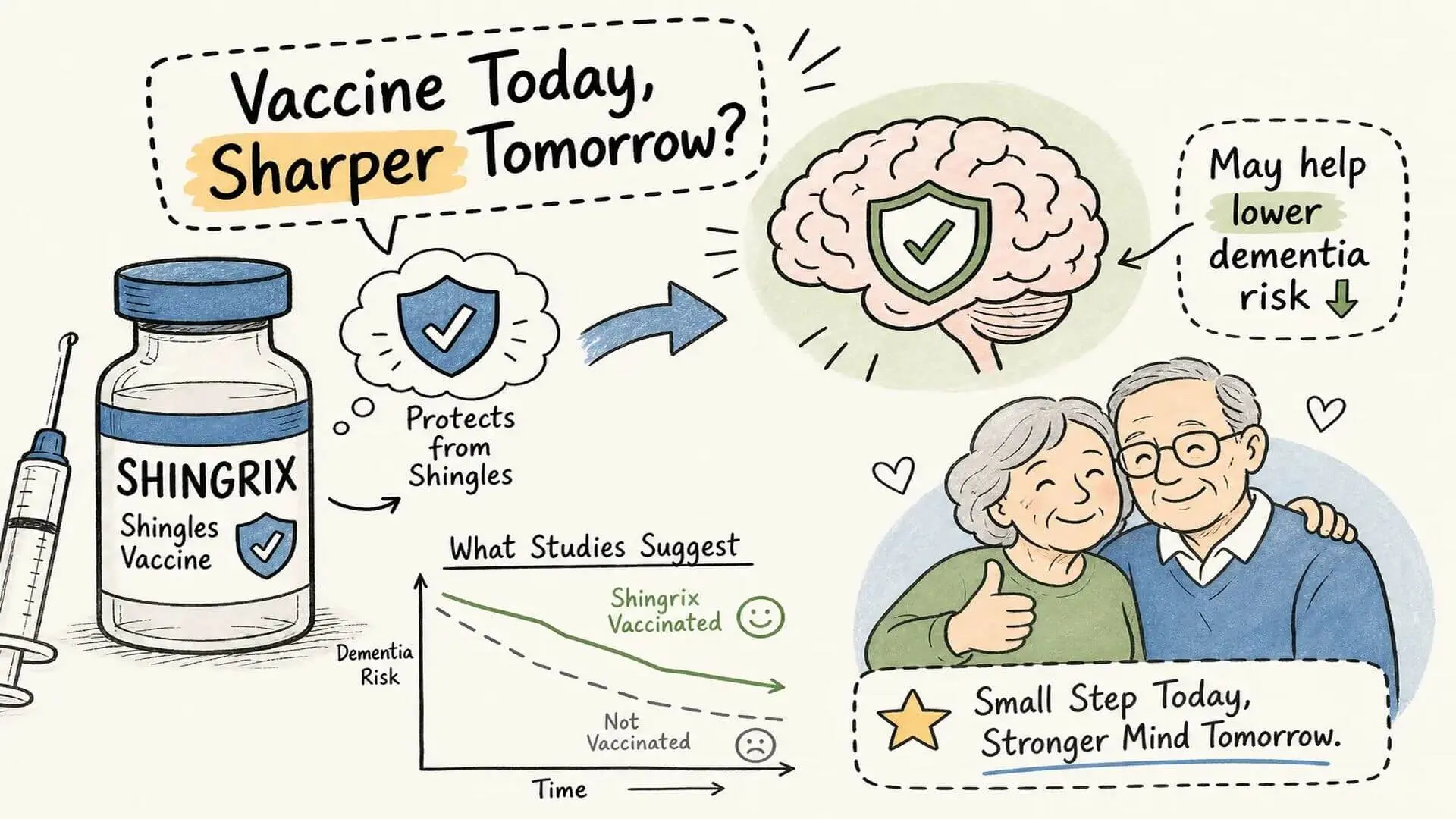
Can the Shingrix vaccine reduce dementia risk? That question has moved from speculative to genuinely pressing as data from multiple large observational datasets point in the same direction. Shingrix, the recombinant zoster vaccine recommended for adults 50 and older, is already one of the more effective vaccines in clinical use, its protection against shingles tops 90% in most age groups. What researchers weren’t expecting was the signal now appearing across independent cohorts: people who receive Shingrix develop dementia at measurably lower rates than those who received the older live shingles vaccine or no shingles vaccine at all.
The obvious question follows immediately: does the vaccine actually cause that protection, or is something else going on? That distinction matters enormously, both for how clinicians counsel patients and for how neuroscientists frame the next round of dementia research. The answer, as of mid-2026, is that the evidence is striking and biologically plausible but not yet causal. Here’s what the data actually show.
At BioScience, we’ve been tracking the intersection of vaccine immunology and neurodegeneration closely. The emerging research around Shingrix is one of the more intellectually interesting threads in Alzheimer’s science right now, and it deserves a clear-eyed look at both what the studies found and where their limits lie.
Can the Shingrix Vaccine Reduce Dementia Risk? Key Evidence
The most cited evidence comes from a matched cohort study published in Nature Medicine in July 2024 by Taquet and colleagues (DOI: 10.1038/s41591-024-03201-5). The study enrolled 207,674 total participants: 103,837 people who received the recombinant zoster vaccine, each matched to a control who received the older live vaccine (Zostavax). Median follow-up was 4.15 years. The result: a 17% lower risk of dementia in the Shingrix group, expressed as a restricted mean time lost (RMTL) ratio of 0.83 (95% CI: 0.80, 0.87). For individuals who did eventually develop dementia, the Shingrix group gained an average of 164 additional diagnosis-free days compared to controls (Taquet et al., Nature Medicine , 2024).
The choice of a vaccinated comparison group matters here. By using live vaccine recipients as controls rather than unvaccinated adults, the study substantially reduces the “healthy user” problem: both groups are adults who sought out a shingles vaccine, suggesting comparable healthcare engagement. That design doesn’t eliminate confounding, but it’s a meaningful methodological step up from unvaccinated comparisons.
A separate 2025 analysis by the same research group, using the TriNetX US electronic health records database, extended the finding in a different direction. This study examined 436,788 adults and compared Shingrix recipients to people who received an influenza vaccine. The result was an 18% lower 18-month dementia risk (RMTL ratio 0.82; 95% CI: 0.74, 0.91). Notably, when researchers combined Shingrix with an AS01-adjuvanted RSV vaccine, they found no additive dementia benefit, a finding the authors interpreted as suggestive evidence pointing toward the AS01 adjuvant system shared by both products, rather than anything VZV-specific, though they emphasized this interpretation remains hypothesis-generating rather than definitive (Taquet et al., TriNetX analysis, 2025). An independent observational study of Welsh older adults using a seven-year follow-up window reported a 20% lower likelihood of dementia after shingles vaccination, consistent with the pattern emerging from US data.
The Biology That Could Explain the Link
Two distinct mechanisms have been proposed, and they’re not mutually exclusive. The first centers on what the varicella zoster virus (VZV) does to the brain when it reactivates. VZV is neurotropic: after an initial chickenpox infection, it takes up residence in nerve tissue and can stay dormant for decades. When it reactivates, usually as shingles, it can trigger a surge in pro-inflammatory cytokines, drive neuroinflammation, and cause cerebrovascular damage that compromises blood flow to brain tissue. These are precisely the mechanisms implicated in Alzheimer’s disease progression.
The more specific biological story involves a secondary cascade. When VZV reactivates in brain tissue, it doesn’t just cause direct damage. Research using human brain tissue models shows that VZV-infected cells containing latent herpes simplex virus type 1 (HSV-1) can trigger HSV-1 reactivation, and it’s this HSV-1 activity that produces the dramatic accumulation of amyloid-beta and phosphorylated tau, the defining pathological hallmarks of Alzheimer’s disease. VZV initiates the cascade; HSV-1 drives the downstream pathology. A vaccine that blocks VZV reactivation could, in theory, interrupt this process entirely before it begins.
The second proposed mechanism may explain why the recombinant zoster vaccine outperforms Zostavax on dementia outcomes even after accounting for its superior protection against shingles itself. Shingrix’s adjuvant system, AS01, contains two active immune-stimulating components: monophosphoryl lipid A (MPL) and QS-21. MPL acts as a selective TLR4 agonist, and some animal model studies suggest TLR4 stimulation may improve Alzheimer’s-related pathology, though direct preclinical data on MPL specifically remain limited and the evidence is inferential at this stage. MPL and QS-21 together activate macrophages and dendritic cells to produce interferon-gamma (IFN-γ). Some laboratory evidence suggests IFN-γ may attenuate amyloid plaque deposition, and correlational data from cognitively unimpaired older adults show a negative association between IFN-γ levels and cognitive decline, though that human data is observational and should not be read as proof of a causal neuroprotective effect. Researchers describe this as a potential “trained immunity” effect, where the adjuvant primes the immune system in a way that may slow neuroinflammatory processes independent of VZV itself.
Why Researchers Aren’t Calling This Settled Science
Every study linking the shingles shot to lower dementia risk to date is observational: matched cohorts, retrospective analyses, natural experiments using policy changes in shingles vaccine eligibility. There are no completed randomized controlled trials with dementia as a primary endpoint. This isn’t a minor caveat. Observational data, however carefully designed, cannot establish causation. Both the research teams involved and GSK, Shingrix’s manufacturer, state this explicitly.
A dedicated RCT (ClinicalTrials.gov identifier NCT07485283), the DAN-ZOSTER trial, is currently underway in Denmark. It will randomize approximately 162,000 adults aged 65 and older to Shingrix or no study vaccination, with incident dementia as one of two dual-primary endpoints and a follow-up window of up to three years for the dementia outcome. Results are not expected until the late 2020s at the earliest.
The most persistent methodological concern in the existing literature is healthy-user bias: vaccinated adults tend to be more health-engaged overall, which independently lowers their risk of many conditions including dementia. Studies attempt to address this by choosing vaccinated comparison groups rather than unvaccinated ones, but residual confounding can’t be fully ruled out. A secondary issue is misclassification: electronic health records and insurance claims databases don’t capture every dementia diagnosis accurately, and gaps in vaccination timing records add noise.
That said, the consistent 17, 20% risk reduction observed across multiple independent datasets with meaningfully different designs strengthens the biological plausibility argument, even without RCT confirmation to anchor it. The 2024 Nature Medicine study (Taquet et al.) reports the 17% figure; the 2025 TriNetX analysis from the same group reports 18%; the Welsh cohort reported 20%. Taken together, these point estimates are close enough to suggest a real signal while remaining modest enough to warrant caution about clinical interpretation.
What Official Guidelines Currently Say
The CDC and ACIP recommend Shingrix for all immunocompetent adults aged 50 and older: two doses administered 2, 6 months apart.
Special populations have additional guidance. Adults aged 19 and older with weakened immune systems, including those with HIV, cancer, or who are on immunosuppressive therapy, are also recommended to receive the vaccine, with the second dose potentially administered as soon as 1, 2 months after the first if completing the series quickly is a clinical priority. Adults who previously received Zostavax (no longer available in the US) are advised to complete a full Shingrix series, with the first dose given at least 2 months after their Zostavax dose. Adults who have already had shingles should receive Shingrix once the acute phase resolves.
No major guideline body, including the CDC, ACIP, the American Academy of Neurology, or the American Geriatrics Society, currently cites dementia prevention as a rationale for Shingrix vaccination. The approved and recommended purpose remains the prevention of herpes zoster and its complications, particularly postherpetic neuralgia: the severe, sometimes disabling nerve pain that follows shingles in a significant proportion of older adults. That gap between emerging observational data and formal guidance reflects exactly the standard the field applies before clinical recommendations change. Consistent RCT data would need to arrive first.
What This Means for Your Vaccination Decision Right Now
If you’re 50 or older and haven’t completed your two-dose Shingrix series, the shingles prevention case alone is sufficient reason to act. The protection against postherpetic neuralgia is well-documented and clinically meaningful: this complication can produce chronic, severe nerve pain lasting months to years, with a frequency that rises sharply with age at infection. The dementia research doesn’t need to be part of that conversation, because the existing indication already supports vaccination.
Where the emerging data becomes more relevant is for adults who have already completed their Shingrix series and are weighing the information, or for clinicians advising patients with family histories of Alzheimer’s disease or other identifiable dementia risk factors. The biological plausibility of a secondary neuroprotective benefit is genuine, even if unconfirmed. Discussing it with your doctor is reasonable, particularly if you received Zostavax years ago and may not have transitioned to the recombinant vaccine.
A few questions worth raising with your clinician:
- Whether you’ve completed the full two-dose Shingrix series (Zostavax recipients are often unaware they need to transition)
- Whether your dosing interval should be shortened if you’re managing an immunocompromising condition
- Whether your personal risk profile makes the emerging dementia data worth factoring into preventive health planning now
The Bottom Line: A Real Signal, an Open Question
Across multiple large observational datasets with different designs and populations, the same pattern keeps appearing: adults who receive the recombinant zoster vaccine develop dementia at lower rates than comparable groups who didn’t. A 17, 18% reduction in dementia incidence is a meaningful number, not statistical noise. The biological mechanisms proposed, VZV cascade interruption and AS01-mediated immunomodulation, are coherent and supported by laboratory evidence, though causality remains unestablished.
The honest answer to whether the Shingrix vaccine can reduce dementia risk is: we don’t know yet, but the signal is worth taking seriously. Causation has not been established, and the RCT needed to establish it is still years from reporting. What’s clear right now is that the recombinant shingles vaccine is already recommended for adults 50 and older on the strength of its shingles protection alone, and the neuroscience developing around the AS01 adjuvant gives researchers a legitimate reason to keep watching this space closely. As DAN-ZOSTER and other trial data arrive, BioScience will cover those findings with the same rigor applied here.
The information on this page is peer reviewed by a qualified editorial review board member. Learn more about us and our editorial process.
Last reviewed on .
Article history
- Latest version
Reference(s)
- Taquet, Maxime., et al. “The recombinant shingles vaccine is associated with lower risk of dementia.” Nature Medicine, vol. 30, no. 10, 2024, doi: 10.1038/s41591-024-03201-5. <https://www.nature.com/articles/s41591-024-03201-5>.
- ClinicalTrials.gov. “Recombinant Herpes Zoster Vaccine for Prevention of Cardiovascular Events and Dementia (DAN-ZOSTER).” ClinicalTrials.gov <https://clinicaltrials.gov/study/NCT07485283>.
- CDC. “Shingles Vaccine Recommendations.” Centers for Disease Control and Prevention <https://www.cdc.gov/shingles/hcp/vaccine-considerations/index.html>.
- CDC. “Clinical Considerations for Shingrix Use in Immunocompromised Adults Aged ≥19 Years.” Centers for Disease Control and Prevention <https://www.cdc.gov/shingles/hcp/vaccine-considerations/immunocompromised-adults.html>.
- Billingsley, Alyssa. “Shingrix Dosage Schedule: Your GoodRx Guide for When to Get the Shingles Vaccine.”, 11 September 2024 GoodRx <https://www.goodrx.com/shingrix/dosage>.
Cite this page:
- Posted by Dayyal Dungrela