New Mathematical Framework Exposes Hidden Pathways Inside Neural Networks
Psychology

New Mathematical Framework Exposes Hidden Pathways Inside Neural Networks

A novel analytical approach tracks full causal chains from input to output, revealing how opposing neural signals cancel each other out.

By Jessica Martin
Published:
Email this Article
New Mathematical Framework Exposes Hidden Pathways Inside Neural Networks
Photo by Steve A Johnson on Unsplash

Neural networks process signals through countless overlapping pathways, making it notoriously difficult to pinpoint exactly how information flows from input to output. A team of researchers has developed a new mathematical framework called Complete Path Contribution, which decomposes network decisions into individual causal pathways and reveals hidden interactions.

Published in arXiv, the study addresses a fundamental blind spot in both artificial intelligence and neuroscience. Traditional interpretability tools typically analyze components in isolation, such as individual artificial neurons or specific layers, or focus solely on pairwise connections. However, these methods fail to capture higher order interactions along full causal chains from input to output, leaving critical questions unanswered about how complex computations actually get constructed.

Unmasking Hidden Conflicts Between Excitatory and Inhibitory Pathways

To understand how complex systems make decisions, the authors analyzed the interplay between excitatory pathways, which drive positive signals, and inhibitory pathways, which suppress them. In both biological brains and deep learning models, cancellation between these opposing forces is widespread. The researchers found that a neuron can appear completely silent or insignificant in its net contribution because massive excitatory and inhibitory signals are actively canceling each other out.
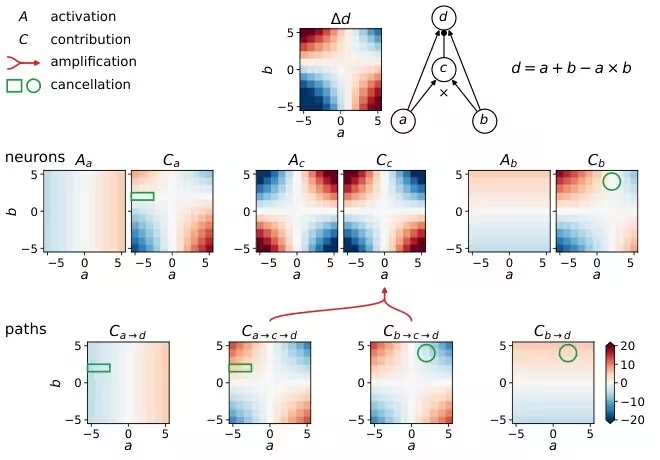
Figure 2: A toy model with two inputs computes d=a+b−a×bd=a+b-a\times b. Each heatmap shows the relevant quantity as a function of inputs. Contributions are computed with a zero baseline, so Δ​d=d\Delta d=d is the output, shown at the top. The middle row shows the activation and contribution of the three neurons. The bottom row shows the contribution of each of the four paths. Due to hierarchical completeness, Ca​d+Ca​c​d=Ca{\mathsfit{C}}_{ad}+{\mathsfit{C}}_{acd}={\mathsfit{C}}_{a}, Ca​c​d+Cb​c​d=Cc{\mathsfit{C}}_{acd}+{\mathsfit{C}}_{bcd}={\mathsfit{C}}_{c}, Cb​c​d+Cb​d=Cb{\mathsfit{C}}_{bcd}+{\mathsfit{C}}_{bd}={\mathsfit{C}}_{b}, and Ca+Cb=Δ​d{\mathsfit{C}}_{a}+{\mathsfit{C}}_{b}=\Delta d. Observe cancellations indicated by the green boxes and green circles, which are not discoverable at the neuron level.
A toy model with two inputs computes d=a+b−a×bd=a+b-a\times b. Each heatmap shows the relevant quantity as a function of inputs. Contributions are computed with a zero baseline, so Δ​d=d\Delta d=d is the output, shown at the top. The middle row shows the activation and contribution of the three neurons. The bottom row shows the contribution of each of the four paths. Due to hierarchical completeness, Ca​d+Ca​c​d=Ca{\mathsfit{C}}_{ad}+{\mathsfit{C}}_{acd}={\mathsfit{C}}_{a}, Ca​c​d+Cb​c​d=Cc{\mathsfit{C}}_{acd}+{\mathsfit{C}}_{bcd}={\mathsfit{C}}_{c}, Cb​c​d+Cb​d=Cb{\mathsfit{C}}_{bcd}+{\mathsfit{C}}_{bd}={\mathsfit{C}}_{b}, and Ca+Cb=Δ​d{\mathsfit{C}}_{a}+{\mathsfit{C}}_{b}=\Delta d. Observe cancellations indicated by the green boxes and green circles, which are not discoverable at the neuron level. Credit: Shenghua Liu et al. / arXiv

By tracking complete paths rather than isolated units, the new method exposes these hidden dynamics. For instance, in image classification tests using multilayer perceptrons, the authors discovered that net contributions often mask intense internal cancellation. While traditional neuron level metrics suggest little activity, path level analysis shows that robust positive and negative signals collide to produce a small residual effect.

Tracing Visual Processing in Artificial Retinal Models

The research team also applied their framework to an interpretable convolutional neural network modeling mouse retinal ganglion cells. When exposed to natural movie stimuli, these retinal models process visual information through specialized parallel channels. Path contribution analysis revealed how specific cell type pathways coordinate excitation and inhibition over time to sharpen firing events and shape receptive fields.

Applying principal component analysis to matrices containing thousands of path contributions showed that a small number of coordinated circuits account for the vast majority of response variance. Furthermore, the analysis demonstrated that distinct cell types, such as ON and OFF ganglion cells, rely on nearly orthogonal circuit motifs to process visual data differently.
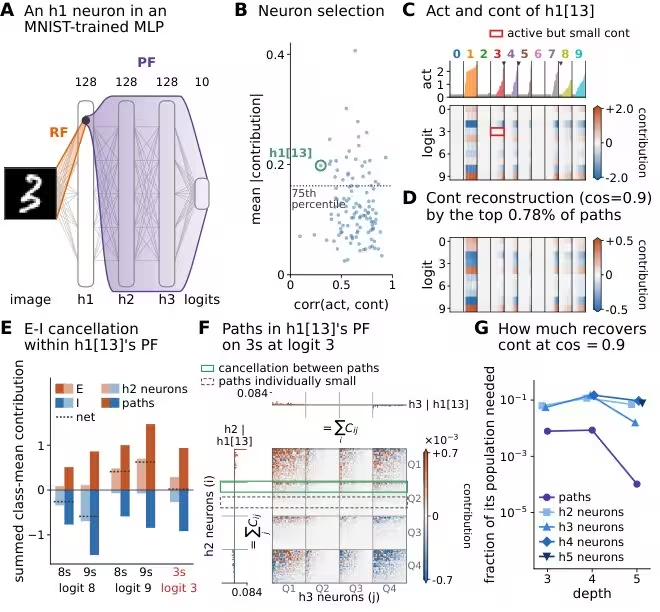
Figure 3: Analysis of pathway interactions in a “silent” neuron’s PF in an MNIST-trained MLP. A silent neuron is one that is active but contributes little to the output. (A) The model: A 3-layer MLP with 128 neurons per layer trained on MNIST. (B) The silent neuron selected by a set of criteria: activity—the neuron is active on at least 30% of the validation set, importance—its mean absolute contribution over the validation set to the correct logit is in the top quartile, and silence—a small correlation between its activation and contribution. (C) The activation and contribution of the selected neuron h1[13] on each of the 100 (input image class, output logit) scenario, over 20 random images of each class. Contribution is computed with a zero baseline at 64 integration steps. h1[13] has an approximately linear PF: one dominant pattern over the logits, scaled by the activation. However, a nonlinear feature is indicated by the scenario in the red box, where on images of 3s it barely contributes at
Analysis of pathway interactions in a “silent” neuron’s PF in an MNIST-trained MLP. A silent neuron is one that is active but contributes little to the output. (A) The model: A 3-layer MLP with 128 neurons per layer trained on MNIST. (B) The silent neuron selected by a set of criteria: activity—the neuron is active on at least 30% of the validation set, importance—its mean absolute contribution over the validation set to the correct logit is in the top quartile, and silence—a small correlation between its activation and contribution. (C) The activation and contribution of the selected neuron h1[13] on each of the 100 (input image class, output logit) scenario, over 20 random images of each class. Contribution is computed with a zero baseline at 64 integration steps. h1[13] has an approximately linear PF: one dominant pattern over the logits, scaled by the activation. However, a nonlinear feature is indicated by the scenario in the red box, where on images of 3s it barely contributes at Credit: Shenghua Liu et al. / arXiv

Overcoming Computational Hurdles with Efficient Algorithms

Analyzing an exponential number of possible paths presents a massive computational challenge. To make path level analysis feasible, the authors devised an efficient best first branch and bound search algorithm. Inspired by the A* pathfinding approach, this algorithm identifies the strongest paths without requiring exhaustive enumeration.

The algorithm operates with an empirical runtime that scales linearly with the number of requested paths rather than exponentially with network depth. Tested on a 12 layer artificial neural network containing more than 10 to the 28th power possible paths, the algorithm successfully isolated top pathways in just minutes on standard hardware. The findings suggest that network computations are remarkably sparse when viewed at the path level, offering a powerful new lens for dissecting both biological and artificial intelligence.

The study was posted to the arXiv preprint server on November 19, 2026.

Fact Checked

This article has been fact checked for accuracy, with information verified against reputable sources. Learn more about us and our editorial process.

Last reviewed on .

Article history

  • Latest version

Reference(s)

  1. Liu, Shenghua. “Revealing Pathway Interactions in Network Computations with Complete Path Contribution.” arXiv.org <http://arxiv.org/abs/2611.26101v1>.

Cite this page:

Martin, Jessica. “New Mathematical Framework Exposes Hidden Pathways Inside Neural Networks.” BioScience. BioScience ISSN 2521-5760, 20 November 2026. <https://www.bioscience.com.pk/en/subject/psychology/revealing-pathway-interactions-in-network-computations-with-complete-path-contribution>. Martin, J. (2026, November 20). “New Mathematical Framework Exposes Hidden Pathways Inside Neural Networks.” BioScience. ISSN 2521-5760. Retrieved November 20, 2026 from https://www.bioscience.com.pk/en/subject/psychology/revealing-pathway-interactions-in-network-computations-with-complete-path-contribution Martin, Jessica. “New Mathematical Framework Exposes Hidden Pathways Inside Neural Networks.” BioScience. ISSN 2521-5760. https://www.bioscience.com.pk/en/subject/psychology/revealing-pathway-interactions-in-network-computations-with-complete-path-contribution (accessed November 20, 2026).
End of the article