El Niño Shuffles Destructive Cyclone Energy Between Two Indian Ocean Basins Without Changing The Total
A 44-year study reveals climate shifts act like an atmospheric see-saw, boosting Arabian Sea storms while starving the Bay of Bengal.
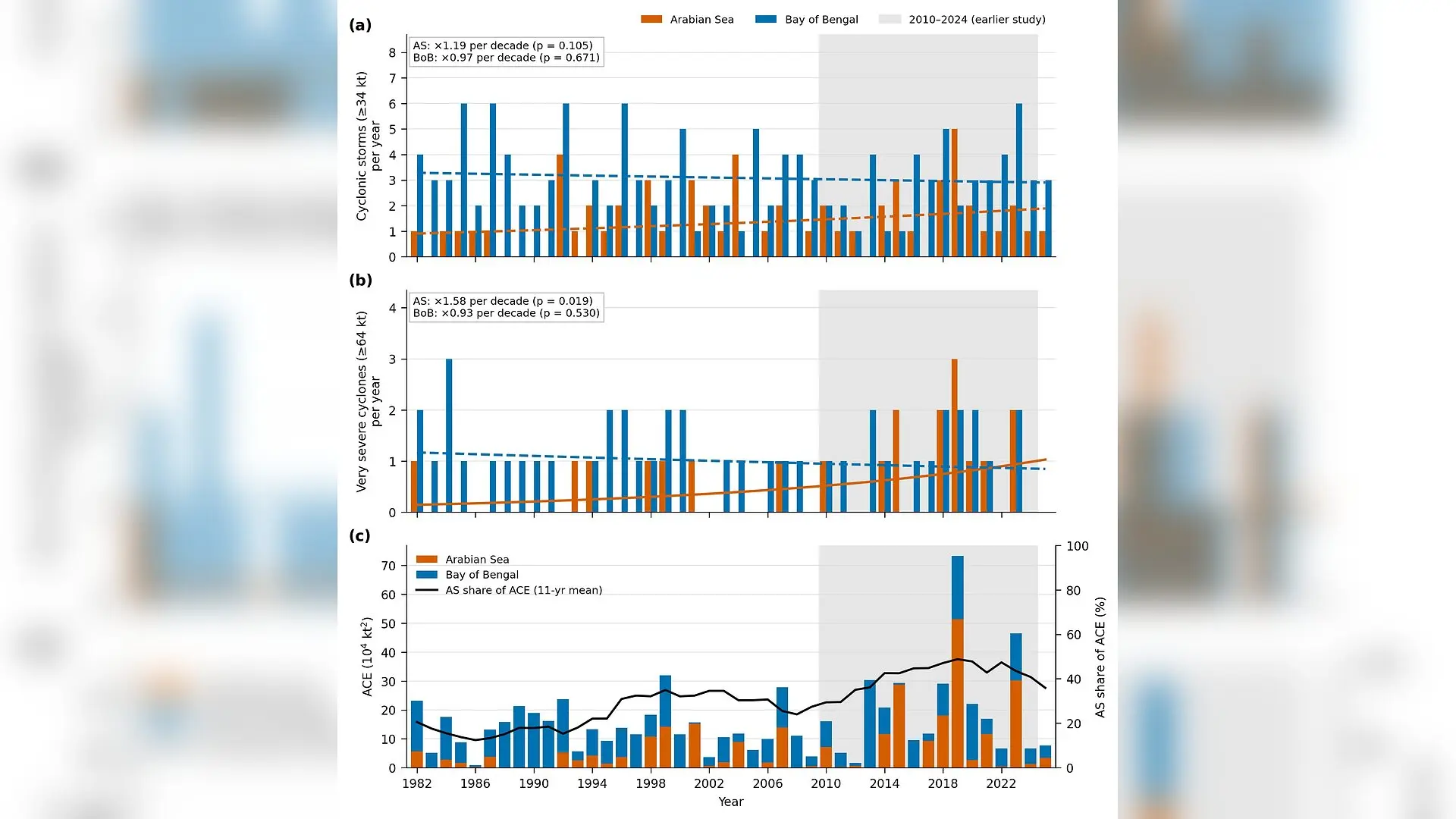
When El Niño warms the tropical Pacific, it does not actually change the total energy of tropical cyclones in the North Indian Ocean. Instead, a comprehensive analysis published in arXiv reveals that the climate phenomenon simply acts like a giant atmospheric see-saw, siphoning destructive storm energy away from the Bay of Bengal and dumping it straight into the Arabian Sea.
The North Indian Ocean is bounded by densely populated and low-lying coastlines spanning from Bangladesh and Myanmar to western India, Oman, and Yemen. Historically, scientists studied the Arabian Sea and the Bay of Bengal separately, assuming their storm activity fluctuated independently or followed a uniform basin-wide rule during major climate shifts. To challenge this view, Prashant Saini and his colleagues at the Indian Institute of Technology Mandi analyzed 416 disturbances recorded between 1982 and 2025.
How Does El Niño Shuffle Cyclone Energy Between Oceans?
The research team built a joint statistical framework to test whether the El Niño-Southern Oscillation alters the entire basin total or merely redistributes energy. For a one-degree Celsius warming in the Niño-3.4 region of the Pacific, accumulated cyclone energy in the Arabian Sea is multiplied by nearly 1.9. Meanwhile, energy in the Bay of Bengal drops by about thirty-seven percent. When added together, the basin-wide total shows no detectable change, confirming a pure redistribution effect.
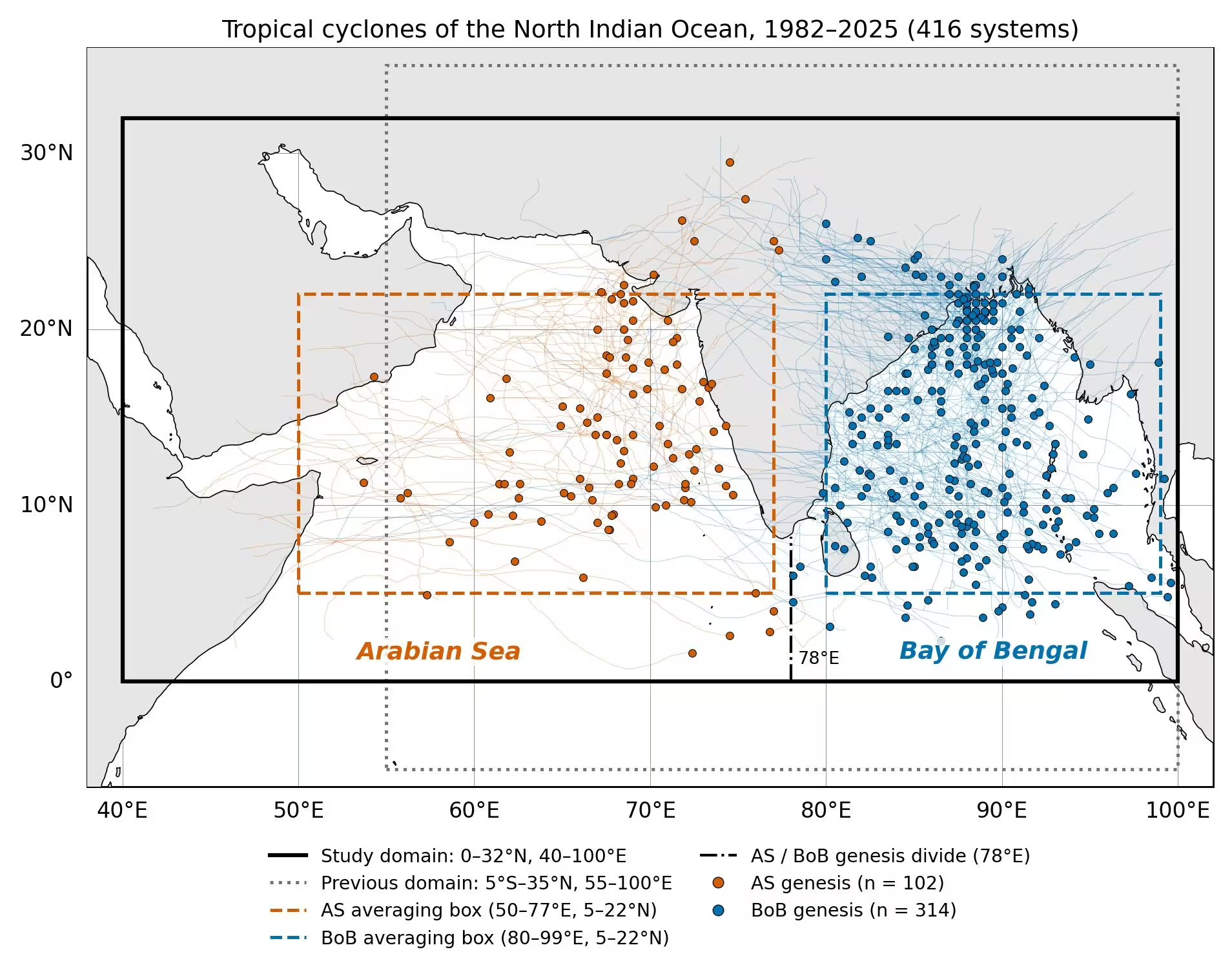
Interestingly, the authors found that climate drivers do not trigger more storms to begin with. The odds that a weak atmospheric disturbance becomes a named cyclonic storm remain virtually unchanged during El Niño years in both bodies of water. Instead, climate shifts exert their power later in a storm lifecycle by controlling how intensely those systems can intensify once they are already spinning.
Why Do the Arabian Sea and the Bay of Bengal React Differently?
The two regional basins respond through entirely different physical mechanisms. In the Arabian Sea, El Niño triggers weaker vertical wind shear, which is the change in wind speed and direction at different heights. This calm vertical structure lets storms stay upright and thrive, while warmer sea surface temperatures provide extra fuel. Consequently, Arabian Sea storms last longer and travel greater distances over open water.
Conversely, the Bay of Bengal suffers from suppressed activity due to low-level circulation changes. Easterly wind anomalies over the equatorial Indian Ocean weaken the low-level spin needed to sustain fierce gales. Storms moving northward into the Bay encounter hostile shear that tears at their structure, cutting their energy short even though local waters remain warm. The researchers also noted that a separate climate driver, the Indian Ocean Dipole, operates independently during the pre-monsoon season to boost Arabian Sea storm severity.
What Does This Mean for Long-Term Trends and Coastal Safety?
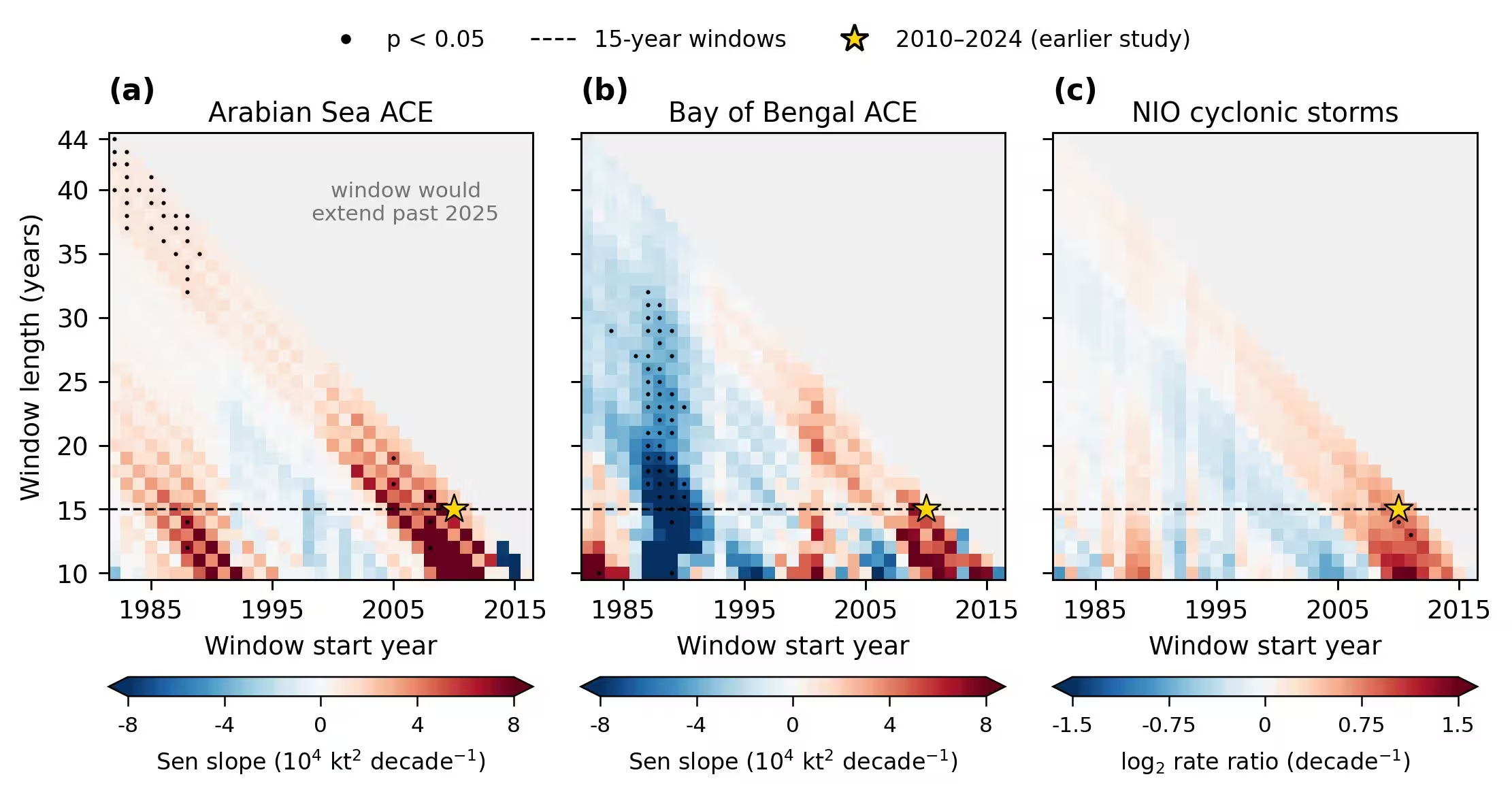
The study highlights a major warning for climate data interpretation. When looking at shorter fifteen-year windows, researchers can easily find conflicting trends that point in opposite directions. The team demonstrated that detecting true long-term changes in Indian Ocean cyclone activity requires at least three decades of continuous, high-quality data.
Furthermore, the relationship between El Niño and regional storms has shifted over time. Between 1982 and 2003, El Niño phases predominantly suppressed Bay of Bengal activity and lowered overall basin energy. After 2004, however, surging energy gains in the Arabian Sea grew large enough to completely balance out Bay of Bengal losses. Because the state of the Pacific Ocean is typically clear by August, forecasters can use these insights to anticipate which regional coastline faces the highest seasonal threat of severe storms.
The study was posted to the arXiv preprint server on November 25, 2026.
This article has been fact checked for accuracy, with information verified against reputable sources. Learn more about us and our editorial process.
Last reviewed on .
Article history
- Latest version
Reference(s)
- Saini, Prashant. “ENSO-linked redistribution of post-monsoon tropical cyclone energy between the Arabian Sea and the Bay of Bengal: 1982--2025.” arXiv.org <http://arxiv.org/abs/2611.34718v1>.
Cite this page:
- Posted by Divya Iyer