Hidden Immune Storms Can Target Just the Brain or Liver Without Fevers
Health

Hidden Immune Storms Can Target Just the Brain or Liver Without Fevers

Tissue-restricted immune hyperactivation can mimic multiple sclerosis or acute liver failure, creating major diagnostic challenges.
By Susan White
Published:
Email this Article
Hidden Immune Storms Can Target Just the Brain or Liver Without Fevers
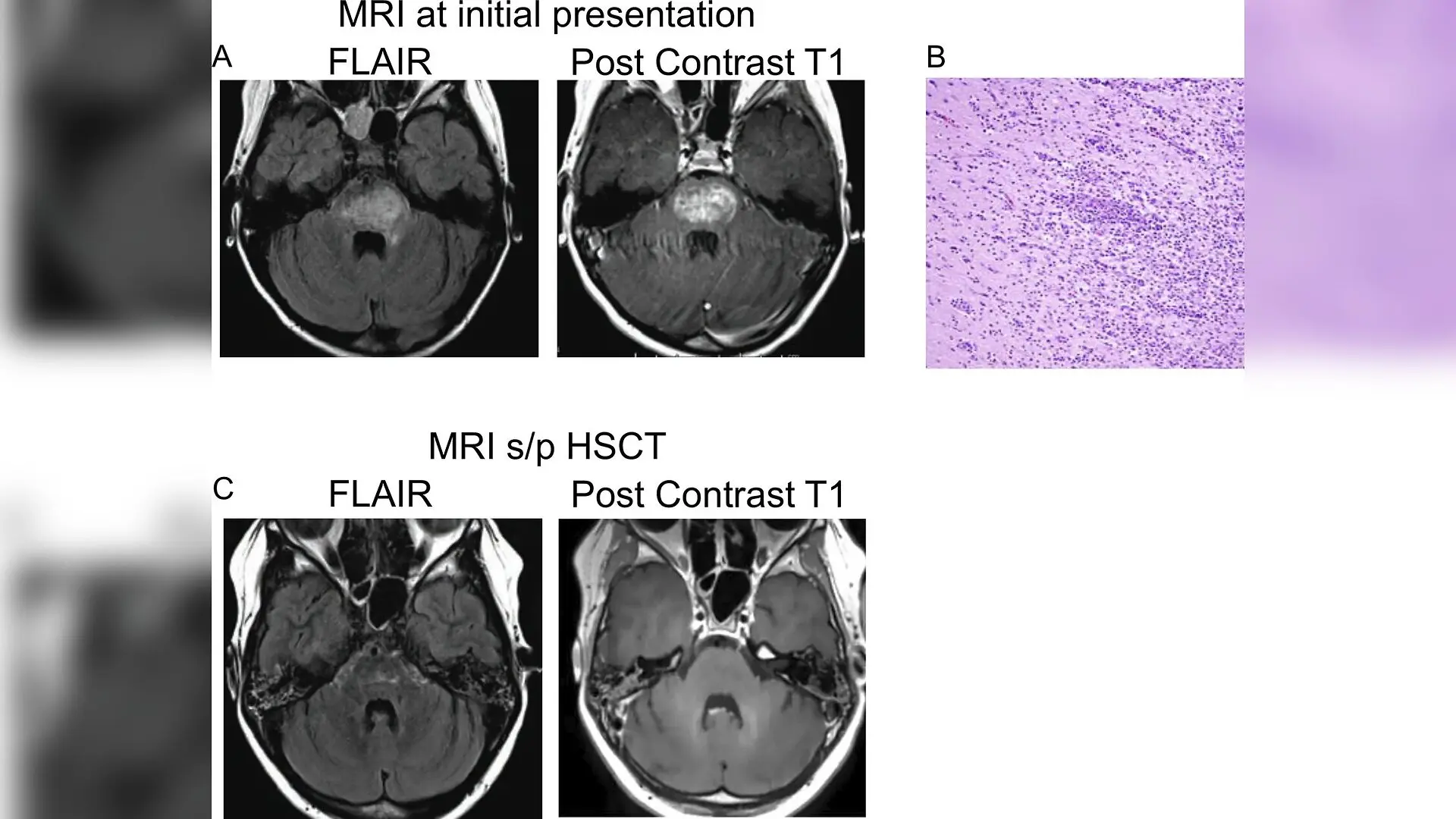
A case of isolated CNS HLH. A previously healthy female presented with mood lability, diplopia, ataxia, right-sided weakness, and new-onset seizures. She had no fevers, splenomegaly, cytopenias, hyperferritinemia, or elevated inflammatory markers. CSF showed a modest pleocytosis (WBC of 12 × 106/L) with a lymphocytic predominance. (A) Initial brain MRI showed multifocal brain lesions and a large, tumor-like lesion in the pons that had heterogenous postcontrast enhancement. There was also curvilinear enhancement reminiscent of CLIPPERS. (B) Histopathology at 40× of frontal lobe brain biopsy that showed a T cell–predominant, chronic inflammatory infiltrate that was dense and diffuse and involved the parenchymal, perivascular, and vascular spaces with small vessel vasculitis. No hemophagocytosis was noted. Five years later, the patient was found to have compound heterozygous variants in UNC13D, and she subsequently underwent a successful 10/10 matched, unrelated donor HSCT with reduced in Tamir Diamond et al. / Journal of human immunity

A life-threatening immune condition known for triggering widespread body-wide inflammation can sometimes target just the brain or liver, leaving ordinary systemic symptoms entirely absent during initial medical evaluations. This localized behavior frequently delays correct diagnoses, turning common childhood neurological and liver conditions into baffling medical mysteries.

Hemophagocytic lymphohistiocytosis is a severe clinical syndrome characterized by extreme immune hyperactivation, where immune effector cells fail to regulate properly, releasing massive waves of inflammatory molecules called a cytokine storm. While classic presentations involve multi-organ failure, fevers, and low blood cell counts, a review published in the Journal of human immunity led by Tamir Diamond and colleagues at the Children’s Hospital of Philadelphia highlights how single-organ manifestations in the central nervous system and liver can dominate the early stages of disease.

Why Does Severe Brain Inflammation Mimic Demyelinating Disorders?

Central nervous system involvement is common in pediatric cases, appearing in about thirty-seven percent of patients enrolled in historical treatment protocols. When the disease restricts itself primarily to the brain, patients often present with irritability, seizures, headaches, and weakness without showing typical markers like fevers or enlarged spleens. Because brain scans reveal multifocal white matter lesions, physicians frequently mistake these presentations for acute disseminated encephalomyelitis, multiple sclerosis, or chronic lymphocytic inflammation with pontine perivascular enhancement responsive to steroids.
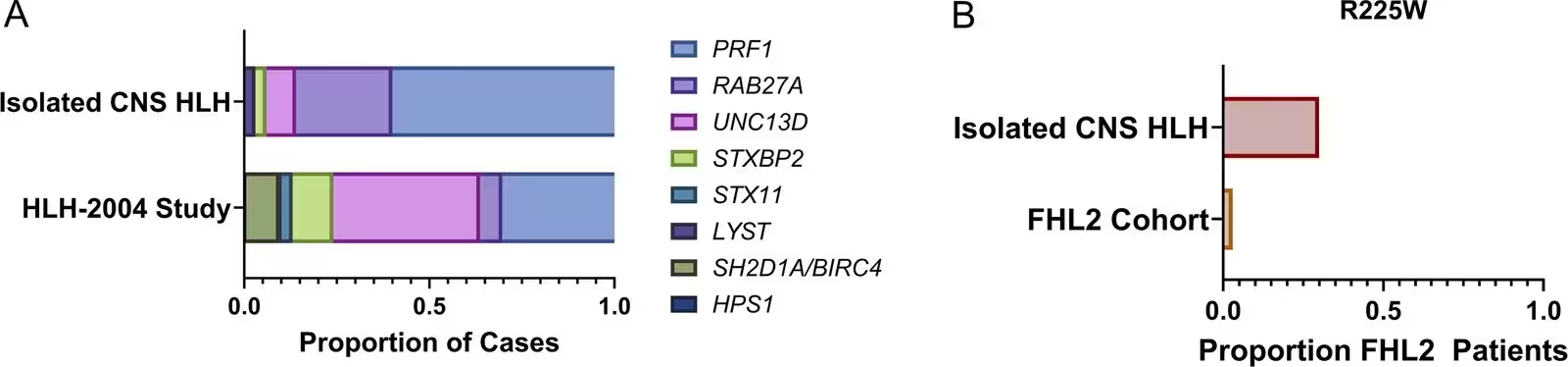
Figure 2: Distribution of gene variants in HLH cohorts. (A) The bar graph shows the proportion of patients with variants in the given gene from two HLH cohorts. The depicted cohorts include a meta-analysis of 38 patients with isolated CNS HLH (37) and a total of 187 patients from the HLH-2004 study with pathogenic mutations in FHL genes (n = 158) or patients with XLP, GS2, CHS, or HPS (n = 29) (34). (B) The bar graph shows the proportion of patients with FHL2 (HLH due to perforin deficiency) carrying at least one copy of the R225W variant in the perforin gene (PRF1). The depicted cohorts include 23 patients with FHL2 and isolated CNS HLH reported by Blincoe et al. (37) and 124 patients with FHL2 reported by Trizzino et al. (55). XLP, X-linked lymphoproliferative disease type 1 and 2 (SH2D1A/BIRC4); GS2, Griscelli’s syndrome type 2 (RAB27A); CHS, Chediak–Higashi syndrome (LYST); HPS, Hermansky–Pudlak syndrome (HPS1).
Distribution of gene variants in HLH cohorts. (A) The bar graph shows the proportion of patients with variants in the given gene from two HLH cohorts. The depicted cohorts include a meta-analysis of 38 patients with isolated CNS HLH (37) and a total of 187 patients from the HLH-2004 study with pathogenic mutations in FHL genes (n = 158) or patients with XLP, GS2, CHS, or HPS (n = 29) (34). (B) The bar graph shows the proportion of patients with FHL2 (HLH due to perforin deficiency) carrying at least one copy of the R225W variant in the perforin gene (PRF1). The depicted cohorts include 23 patients with FHL2 and isolated CNS HLH reported by Blincoe et al. (37) and 124 patients with FHL2 reported by Trizzino et al. (55). XLP, X-linked lymphoproliferative disease type 1 and 2 (SH2D1A/BIRC4); GS2, Griscelli’s syndrome type 2 (RAB27A); CHS, Chediak–Higashi syndrome (LYST); HPS, Hermansky–Pudlak syndrome (HPS1). Credit: Tamir Diamond et al. / Journal of human immunity

Genetic factors appear to play a major role in this neurological vulnerability. Patients with isolated central nervous system disease frequently carry specific mutations in genes related to cell cytotoxicity, such as PRF1 and RAB27A. Notably, a variant designated p.R225W appears in about thirty percent of perforin-deficient cases with isolated brain disease. This specific genetic alteration allows for residual protein expression, which may explain why these individuals develop milder or delayed systemic symptoms while suffering from progressive neurological decline.

How Does Liver Failure Complicate Immune Disorders in Young Children?

Liver dysfunction ranging from mild hepatitis to fulminant acute liver failure is nearly universal in the broader condition, serving as a cardinal feature of both primary and secondary forms. In children under two years of age, primary immune hyperactivation accounts for a significant share of acute liver failure cases, where mortality rates climb considerably higher than other causes of liver injury. Liver biopsies typically reveal dense infiltrates of cytotoxic T cells and macrophages, sometimes showing localized hemophagocytosis where immune cells engulf other blood cells.

Distinguishing immune-driven liver failure from other T cell-mediated forms of hepatitis remains a major clinical challenge. Both conditions share overlapping laboratory abnormalities and histological features, such as elevated liver enzymes and similar immune cell infiltration patterns. However, systemic immune conditions feature drastically higher levels of soluble CD25 and ferritin, alongside underlying genetic mutations that dictate whether a patient requires a stem cell transplant rather than a liver transplant.
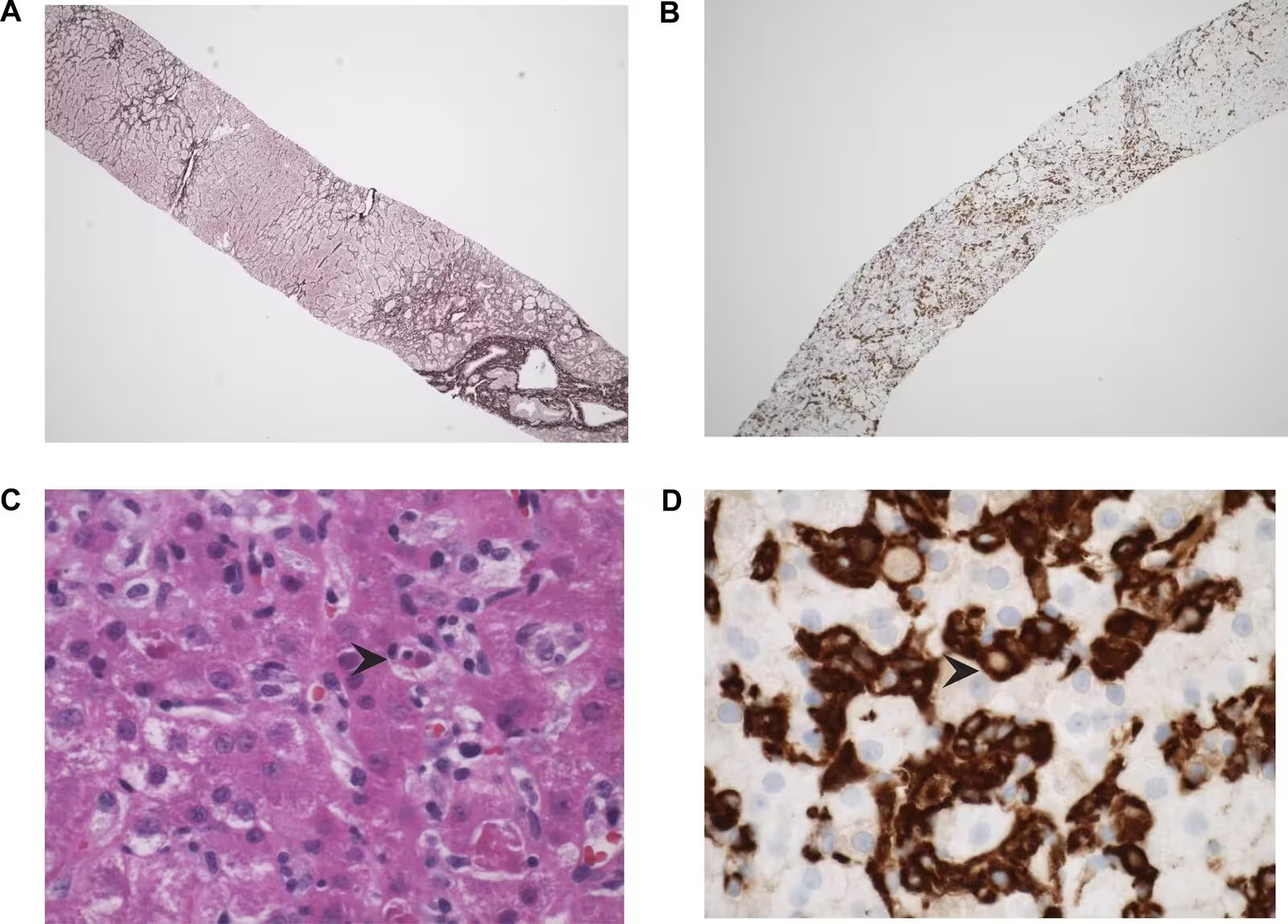
Figure 3: Liver histology in HLH PALF. Needle biopsy images with common characteristics of children with HLH/MAS PALF. (A) 20× cytokeratin stain showing patchy periportal and pericentral parenchymal collapse. (B) 20× CD163 immunohistochemistry stain showing abundant macrophage/histiocyte staining. Both A and B are from a male patient with EBV-HLH-PALF due to XIAP deficiency. (C and D) (C) 60× liver hemophagocytosis by histiocytes/Kupffer cells on H&E and (D) 60× CD163 immunohistochemistry stain (arrowheads). Both C and D are from a female patient with MAS-PALF in setting of systemic JIA. Images courtesy of Pierre A. Russo MD, Department of Pathology, Children’s Hospital of Philadelphia, used in accordance with institutional guidelines. XIAP, X-linked inhibitor of apoptosis protein.
Liver histology in HLH PALF. Needle biopsy images with common characteristics of children with HLH/MAS PALF. (A) 20× cytokeratin stain showing patchy periportal and pericentral parenchymal collapse. (B) 20× CD163 immunohistochemistry stain showing abundant macrophage/histiocyte staining. Both A and B are from a male patient with EBV-HLH-PALF due to XIAP deficiency. (C and D) (C) 60× liver hemophagocytosis by histiocytes/Kupffer cells on H&E and (D) 60× CD163 immunohistochemistry stain (arrowheads). Both C and D are from a female patient with MAS-PALF in setting of systemic JIA. Images courtesy of Pierre A. Russo MD, Department of Pathology, Children’s Hospital of Philadelphia, used in accordance with institutional guidelines. XIAP, X-linked inhibitor of apoptosis protein. Credit: Tamir Diamond et al. / Journal of human immunity

What Are the Treatment Challenges and Emerging Therapies?

Historically, patients with isolated neurological disease faced near-universal mortality before hematopoietic stem cell transplantation became common. Modern therapeutic protocols rely heavily on systemic glucocorticoids, etoposide, and targeted anti-cytokine therapies to calm the immune system prior to curative stem cell procedures. Newer biologic medications like emapalumab, which neutralizes interferon-gamma, and JAK inhibitors offer promising avenues for halting hyperinflammation, though researchers are still evaluating how effectively these large molecules cross the blood-brain barrier during localized flare-ups.

For liver failure presentations, the therapeutic landscape requires careful balancing of drug toxicities against severe hepatic dysfunction. Liver transplantation remains controversial because replacing the organ does not correct the underlying immune system defect, leading to high rates of disease recurrence in the graft. Emerging extracorporeal liver support devices and transgenic xenogeneic pig liver support systems are currently under investigation to bridge patients safely toward definitive immune reconstitution.

The research was published in Journal of human immunity on November 24, 2026.

Fact Checked

This article has been fact checked for accuracy, with information verified against reputable sources. Learn more about us and our editorial process.

Last reviewed on .

Article history

  • Latest version

Reference(s)

  1. Diamond, Tamir., et al. “Two organs, one storm: CNS and hepatic HLH.” Journal of Human Immunity, vol. 3, no. 2, November 24, 2026 Rockefeller University Press, doi: 10.70962/jhi.20250214. <https://doi.org/10.70962/jhi.20250214>.

Cite this page:

White, Susan. “Hidden Immune Storms Can Target Just the Brain or Liver Without Fevers.” BioScience. BioScience ISSN 2521-5760, 26 November 2026. <https://www.bioscience.com.pk/en/subject/health/two-organs-one-storm-cns-and-hepatic-hlh>. White, S. (2026, November 26). “Hidden Immune Storms Can Target Just the Brain or Liver Without Fevers.” BioScience. ISSN 2521-5760. Retrieved November 26, 2026 from https://www.bioscience.com.pk/en/subject/health/two-organs-one-storm-cns-and-hepatic-hlh White, Susan. “Hidden Immune Storms Can Target Just the Brain or Liver Without Fevers.” BioScience. ISSN 2521-5760. https://www.bioscience.com.pk/en/subject/health/two-organs-one-storm-cns-and-hepatic-hlh (accessed November 26, 2026).
End of the article