Air Pollution Exposure Significantly Increases Cataract Risk Through Blood Metabolite Shifts
A prospective study of nearly two hundred thousand adults reveals how fine particulate matter and traffic gases cloud eye lenses over time.
Could breathing polluted city air slowly cloud the lenses of your eyes and impair your vision over time? A large population-based prospective cohort study reveals that long-term exposure to common ambient air pollutants significantly elevates the risk of developing cataracts, with specific blood metabolite shifts partially explaining the biological connection.
Cataracts represent the leading cause of vision impairment and blindness worldwide, posing an escalating public health challenge as populations age. While previous environmental studies pointed toward a potential link between dirty air and cloudy eye lenses, the underlying biological pathways remained poorly understood. To address this knowledge gap, a team of researchers led by scientists from Fudan University investigated data from nearly two hundred thousand adults to track how microscopic air pollutants influence eye health through systemic metabolic changes, with their results published in PLOS One.
How Does Air Pollution Increase Cataract Development Risk in Aging Adults?
The research team analyzed data from 199,528 cataract-free participants enrolled in the UK Biobank prospective cohort study. The participants had an average age of 56 years at baseline and were followed for a median duration of 14.1 years. During this tracking period, investigators identified 17,567 incident cataract cases using hospital records and self-reported medical questionnaires.
Using Land Use Regression models established by European air quality assessments, the authors estimated individual residential exposures to several pollutants for the year 2010. These included fine particulate matter with a diameter under 2.5 micrometers, known as PM 2.5 , coarser particulate matter, nitrogen dioxide, and nitrogen oxides. The team then employed multivariable Cox proportional hazards models to calculate the risk of developing cataracts after adjusting for potential confounding variables such as age, sex, race, socioeconomic deprivation, household income, education level, body mass index, smoking status, diabetes, and outdoor activity time.
Which Specific Air Pollutants Drive the Greatest Threat to Visual Health?
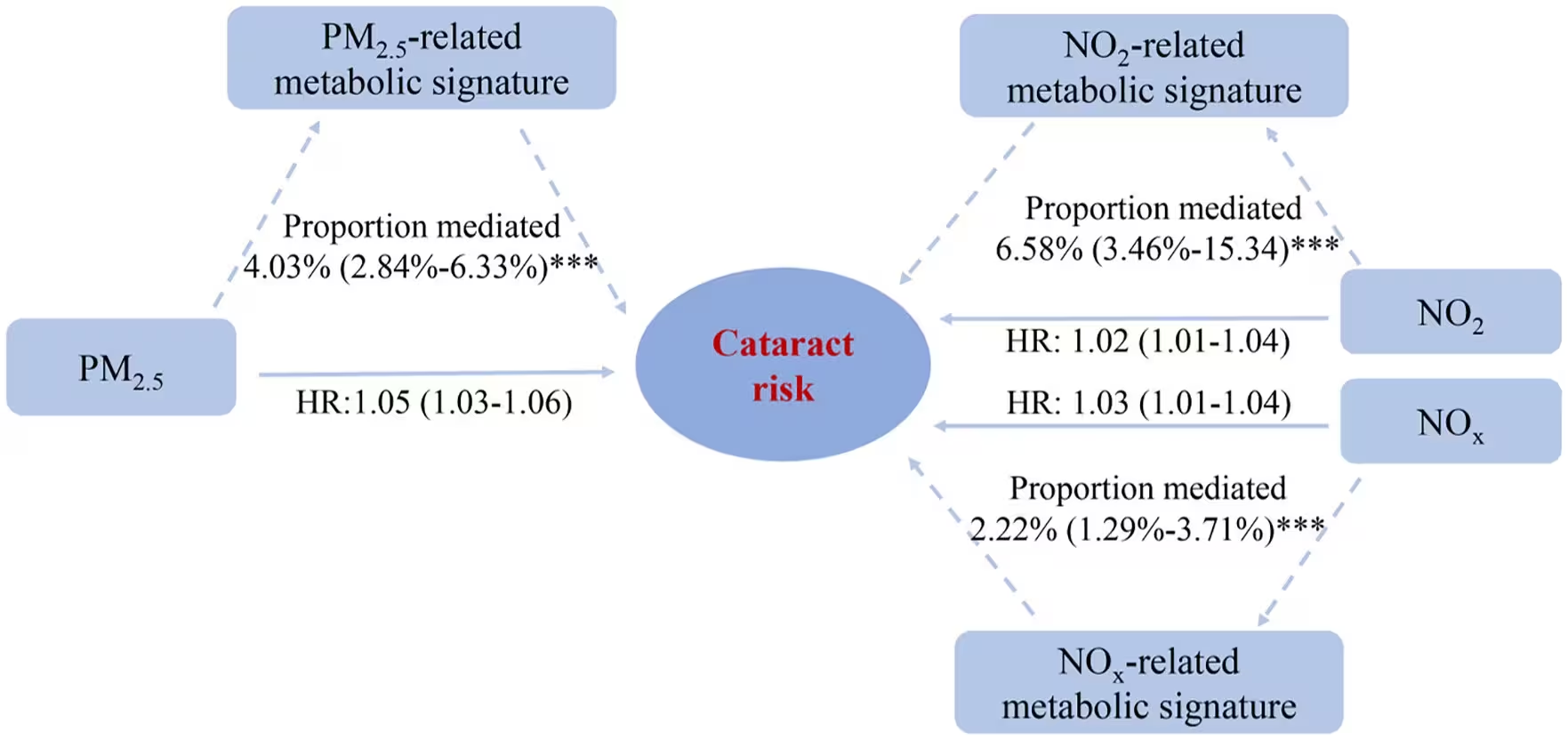
The statistical analysis demonstrated that higher long-term exposure to fine particles and traffic-related gases significantly increases the likelihood of being diagnosed with a cataract. Specifically, every quartile increase in PM 2.5 exposure was associated with a five percent higher risk of incident cataract. Individuals in the highest exposure quartile for PM 2.5 faced a seventeen percent greater risk compared to those in the cleanest quartile.
Similarly, elevated concentrations of nitrogen dioxide and nitrogen oxides were significantly tied to increased cataract susceptibility. However, larger particulate matter classifications, including PM 10 and coarse particulate matter, showed no statistically significant associations with cataract formation. The authors note that fine particles are small enough to penetrate alveolar capillaries in the lungs and enter the bloodstream, triggering widespread systemic reactions that coarser dust particles cannot easily initiate.
What Blood Metabolite Signatures Mediate the Damage Between Environment and Eye Tissues?
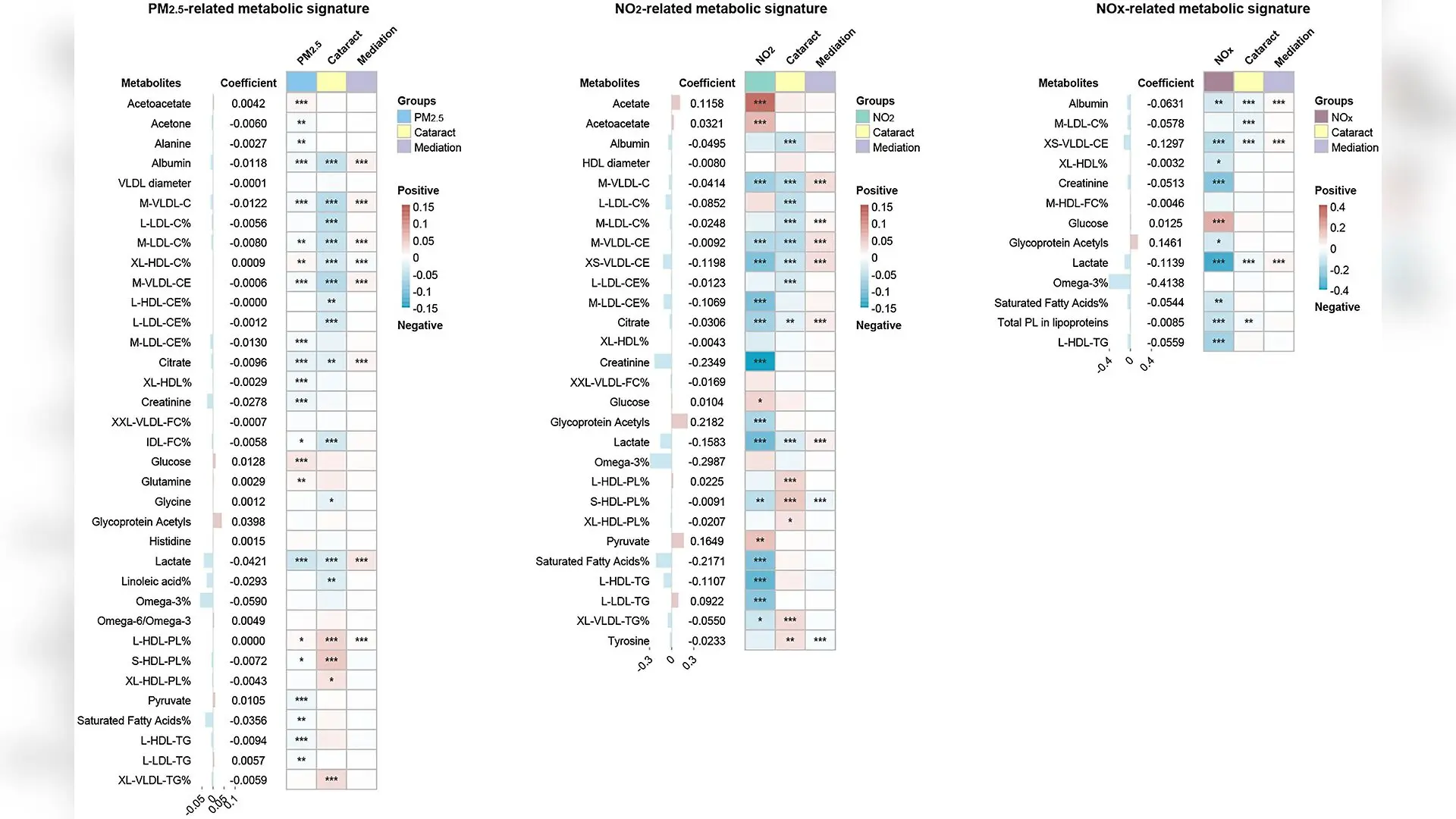
To uncover the molecular mechanisms connecting environmental exposure to eye disease, the investigators utilized high-throughput nuclear magnetic resonance spectroscopy to examine plasma metabolic profiles from blood samples. Using elastic net regression, they identified distinct metabolic signatures associated with air pollution, comprising dozens of lipid subclasses, fatty acids, amino acids, and glycolysis-related molecules.
Mediation analysis revealed that these circulating metabolic signatures act as partial biological intermediaries, accounting for portions of the total effect between air pollution and cataract risk. The estimated mediation proportions were roughly four percent for PM 2.5 , six and a half percent for nitrogen dioxide, and two percent for nitrogen oxides. Key blood metabolites such as lactate, circulating albumin, and specific cholesterol fractions in very-low-density lipoproteins played leading roles in mediating these harmful relationships.
What Are the Primary Limitations and Future Research Directions?
While providing valuable insights into environmental ophthalmology, the study carries several notable limitations. The cohort is predominantly of European white ancestry, which may limit how broadly these findings apply to other global populations. Additionally, the observational design and the time gap between blood sample collection and pollution modeling mean that researchers can establish statistical indirect associations rather than definitive biological causation.
The predictive performance of the derived metabolic signatures was relatively modest, indicating that blood chemistry captures only a fraction of the metabolic variations driven by air pollution. Other biological mechanisms, such as direct ocular oxidative stress and systemic inflammation, likely contribute to the remaining risk. The authors emphasize that further investigation involving diverse ethnic cohorts, detailed cataract subtyping, and mechanistic laboratory validations will be essential to fully clarify how environmental toxins damage eye lenses over time.
The research was published in PLOS One on November 25, 2026.
This article has been fact checked for accuracy, with information verified against reputable sources. Learn more about us and our editorial process.
Last reviewed on .
Article history
- Latest version
Reference(s)
- Qi, Jiao., et al. “Plasma metabolic signature in the association between air pollution and cataract risk: A longitudinal cohort study.” PLOS One, vol. 21, no. 11, November 25, 2026, pp. e0362274 Public Library of Science (PLoS), doi: 10.1371/journal.pone.0362274. <https://doi.org/10.1371/journal.pone.0362274>.
Cite this page:
- Posted by Susan White