Neighborhood Wealth Shapes Afternoon Physical Activity Rhythms in Older Adults
A new study reveals that census tract socioeconomic status influences daily movement timing, while proximity to parks and transit shows little measurable link.
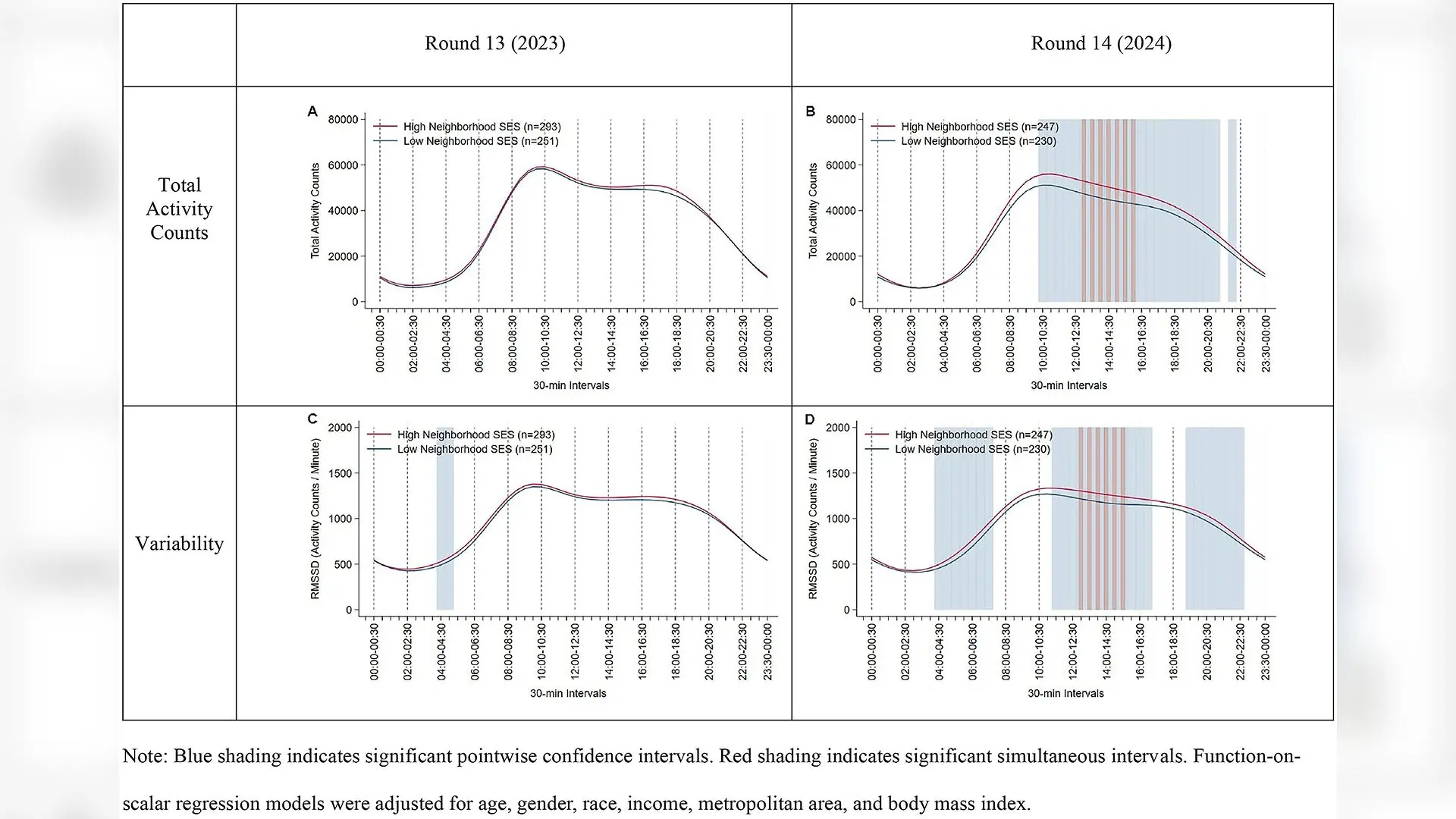
Do older adults living in wealthier neighborhoods move more throughout the day, and does having a park nearby actually change daily movement habits? A cross-sectional study examining hundreds of Medicare beneficiaries reveals that neighborhood wealth shapes the timing and variability of daily physical activity, while proximity to parks, transit stops, and exercise facilities shows little measurable link to overall daily movement patterns.
How Does Neighborhood Wealth Influence Daily Movement Patterns in Later Life?
Maintaining physical activity as people age helps avoid disease and optimize functioning, yet less than thirty percent of older adults meet standard physical activity recommendations. Traditional health studies usually measure physical activity by taking a single total sum of movement across multiple days. However, this total summary approach misses important details about within-day rhythm consistency, known as intra-day variability, which reflects the complexity and variety of daily activities. Abnormal variability or timing of physical activity is associated with adverse health outcomes, including chronic disease burden, mobility limitations, cognitive impairment, and frailty.
To investigate whether broader socioeconomic factors and physical environment features alter these daily movement rhythms, Francesca R. Marino and colleagues at Johns Hopkins University analyzed data from the National Health and Aging Trends Study, which is an ongoing panel study of Medicare beneficiaries aged sixty-five and older living in the contiguous United States. The research team utilized data from Rounds thirteen and fourteen, collected in 2023 and 2024, including between four hundred seventy-seven and five hundred forty-four participants who provided valid accelerometry data. The complete details and supplementary statistics are published in PLOS Aging and Health.
What Did Continuous Wrist Monitoring Reveal About Daily Activity Timing?
Participants wore a triaxial accelerometer on their non-dominant wrist twenty-four hours a day for seven consecutive days in their free-living environments. Acceleration was recorded at sixty-four observations per second, and researchers processed the minute-level data to evaluate both the total amount of activity and the intra-day variability across thirty-minute time blocks. The primary exposure variable was neighborhood socioeconomic status, derived from United States Census data at each participant’s census tract using metrics such as median household income, housing values, education levels, and professional employment proportions. Researchers also evaluated four built environment characteristics from the National Neighborhood Data Archive, including walkability, greenspace availability, density of physical activity facilities, and public transit stops.
Using function-on-scalar regression models adjusted for age, gender, race, income, rural-urban residence, and body mass index, the authors evaluated time-of-day differences in physical activity. Under conservative simultaneous confidence intervals in 2024, participants living in higher-wealth neighborhoods exhibited both a higher total amount of activity from 12:30 PM to 4:00 PM and higher activity variability from 12:30 PM to 3:30 PM compared to those in lower-wealth neighborhoods. Conversely, specific physical environment features such as walkability, park access, gym facilities, and public transit stops showed no statistically significant associations with activity amount or variability under the primary conservative testing criteria in either study year.
What Are the Limitations of These Observational Findings?
The authors note several important limitations to keep in mind when interpreting these results. Because the study design is cross-sectional, researchers cannot establish causality between neighborhood characteristics and individual physical activity behaviors. Furthermore, neighborhoods were defined using census tracts, which may not match an individual person’s personal perception of their neighborhood or capture physical activity taking place outside those boundaries. The study also relied on the mere presence of environmental features rather than measuring other critical components of accessibility, such as affordability, personal safety, or accommodation. Finally, small differences observed between 2023 and 2024 might be influenced by participant aging and attrition, and the unweighted statistical models limit the generalizability of the findings to the broader national population.
The research was published in PLOS Aging and Health on November 25, 2026.
This article has been fact checked for accuracy, with information verified against reputable sources. Learn more about us and our editorial process.
Last reviewed on .
Article history
- Latest version
Reference(s)
- Marino, Francesca R.., et al. “Neighborhood context and daily activity: Exploring intra-day amount and variability of physical activity among older adults.” PLOS Aging and Health, vol. 1, no. 5, November 25, 2026, pp. e0000056 Public Library of Science (PLoS), doi: 10.1371/journal.page.0000056. <https://doi.org/10.1371/journal.page.0000056>.
Cite this page:
- Posted by Sana Malik