Social Media Platform Study Links X, Facebook, and TikTok to Suicidal Ideation in Japan
A large survey of nearly 20,000 participants reveals that mental health associations vary dramatically across different digital applications.
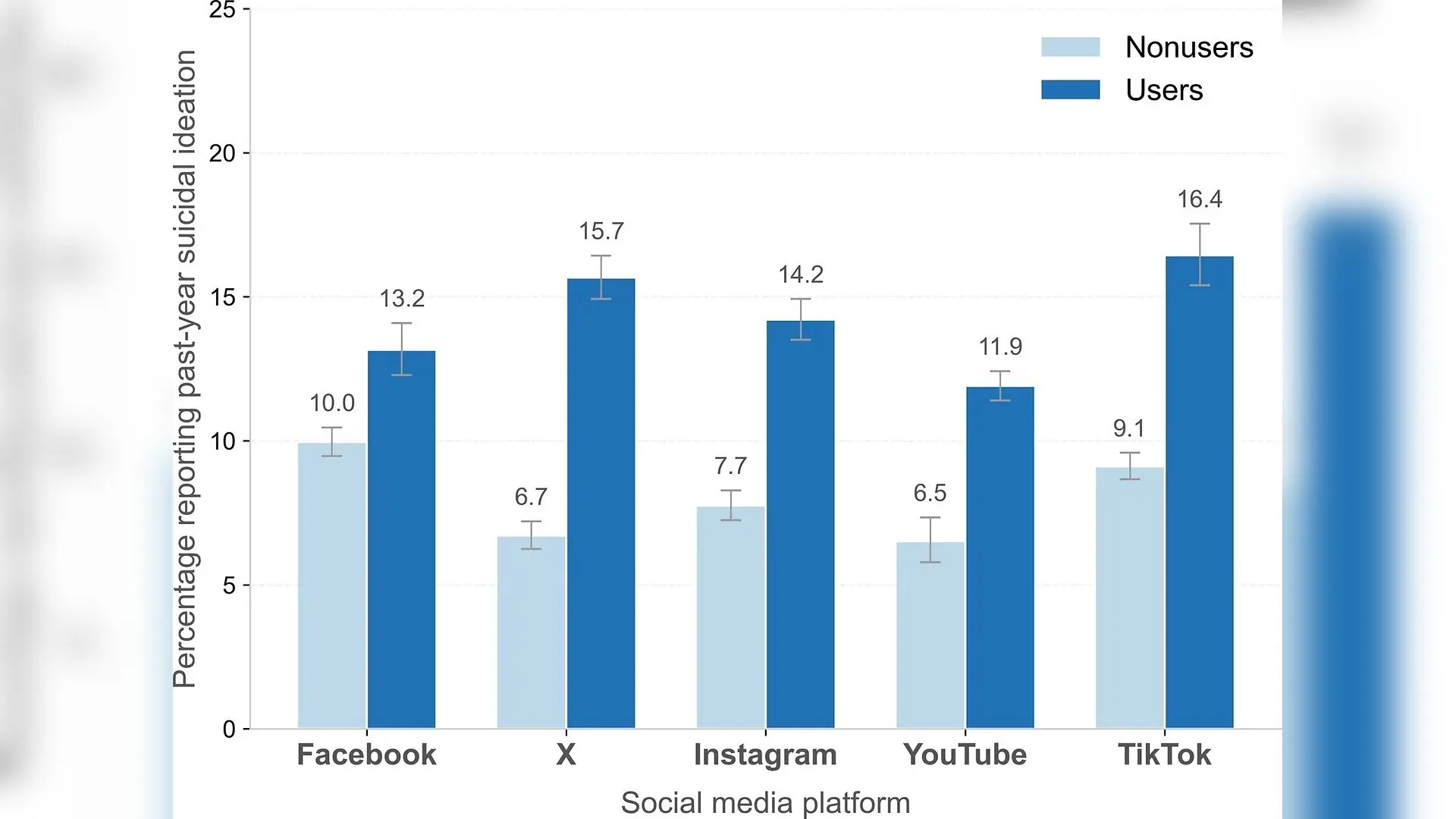
Young adults in Japan who use X, Facebook, or TikTok face different statistical odds of experiencing thoughts of self-harm compared to nonusers, while other popular apps show no such link. Researchers analyzed data from 19,542 participants to uncover how specific digital platforms relate to mental health distress.
Which Social Media Apps Showed Statistical Links to Suicidal Ideation?
The nationwide cross-sectional study investigated how platform-specific digital habits relate to retrospectively reported past-year suicidal ideation, defined as thoughts of wanting to die. Overall, 10.8 percent of the respondents reported experiencing suicidal ideation within the previous year. The authors gathered responses by linking two large nationwide internet initiatives: the Japan COVID-19 and Society Internet Survey and the Japan Society and New Tobacco Internet Survey, which together surveyed individuals aged 15 to 84 years.
After adjusting for confounding factors such as age, sex, marital status, employment status, personality traits like neuroticism, and adverse childhood experiences, the patterns varied dramatically by platform. The work, published in the Journal of Medical Internet Research in November 2026, demonstrated that active use of X (formerly known as Twitter), Facebook, and TikTok remained significantly associated with higher odds of reporting suicidal ideation. Specifically, users of X had an adjusted odds ratio of 1.44, Facebook users showed an odds ratio of 1.33, and TikTok users also registered an odds ratio of 1.33.
In contrast, two other major digital networks showed no significant association after researchers controlled for covariates and simultaneous platform use. Neither Instagram nor YouTube maintained a statistically meaningful link to suicidal thoughts in the fully adjusted multivariable models.
How Do Platform Design and User Demographics Shape Mental Health Risks?
The researchers noted that different online environments possess unique algorithmic structures, communication styles, and user demographics that may drive these contrasting results. X relies on a text-based format and high levels of user anonymity, which can facilitate the verbalization of distress, exposure to harmful content, and the formation of insular online echo chambers. Meanwhile, Facebook often triggers status-driven social comparisons, and TikTok utilizes an endless scrolling interface paired with aggressive recommendation algorithms.
Exploratory stratified analyses further revealed that the association between X and suicidal ideation remained consistent across participants younger than 45 years, affecting both young men and young women. For Facebook and TikTok, statistically higher odds appeared particularly pronounced among male participants. Interestingly, adults aged 60 years or older showed no significant association between any specific social media platform and suicidal thoughts.
What Are the Study Limits and Implications for Future Prevention Work?
Because the investigation relied on a cross-sectional design where social media habits were measured approximately one month after the recall period for suicidal ideation concluded, the authors emphasized that the findings are strictly associational. The data do not establish a causal direction or prove that social media use directly triggers mental health crises. It remains possible that individuals experiencing severe emotional distress actively seek out certain platforms to connect with peers, find empathy, or escape difficult realities.
Additional limitations include the reliance on a single-item self-report questionnaire rather than a comprehensive clinical diagnostic scale, as well as an inability to measure the exact daily time spent or active versus passive engagement styles. The research team suggests that because digital networks are deeply embedded in modern society, broad avoidance is impractical. Instead, public health strategies should acknowledge platform-specific risks and utilize high-impact networks as targeted channels for disseminating digital mental health resources and crisis support.
The research was published in Journal of medical Internet research on November 16, 2026.
This article has been fact checked for accuracy, with information verified against reputable sources. Learn more about us and our editorial process.
Last reviewed on .
Article history
- Latest version
Reference(s)
- Taniguchi, Yusei., et al. “The Association Between Platform-Specific Social Media Use and Suicidal Ideation in Japan: Cross-Sectional Web-Based Survey Study.” Journal of Medical Internet Research, vol. 28, November 16, 2026, pp. e103235-e103235. JMIR Publications Inc., doi: 10.2196/103235. <https://doi.org/10.2196/103235>.
- Posted by David Anderson