Scientists Discover Hidden Survival Mechanism That Keeps Cells Alive Against All Odds
Scientists have discovered a hidden mechanism allowing mammalian cells to produce cysteine, potentially revealing how cancer cells survive treatment stress.
Researchers at Montana State University have uncovered a previously unknown metabolic pathway that allows mammalian cells to synthesize cysteine, a vital amino acid, even when conventional production systems are completely disabled. The findings, detailed in Nature Chemical Biology, overturn long-held biological dogmas regarding the essential requirements for cellular survival.
Cysteine is fundamental to life, playing a critical role in protein synthesis, the creation of disulfide bonds that stabilize protein structures, and the defense against cellular damage. For decades, the prevailing scientific consensus maintained that cells were strictly dependent on two specific enzymatic systems—thioredoxin reductase and glutathione reductase—to convert oxidized cystine into functional cysteine. In simpler organisms like yeast and bacteria, the absence of these enzymes is typically fatal.
Defying Biological Expectations
The breakthrough originated from an unexpected observation in 2014, when researchers studying genetically modified mice noticed that liver cells lacking both primary reductase systems remained viable. This contradiction to established theory prompted a multi-year investigation led by Ed Schmidt, a professor of genetics and development at Montana State University. By collaborating with Peter Nagy’s team at the Hungarian National Institute of Oncology, the researchers successfully mapped the chemical process responsible for this cellular resilience.
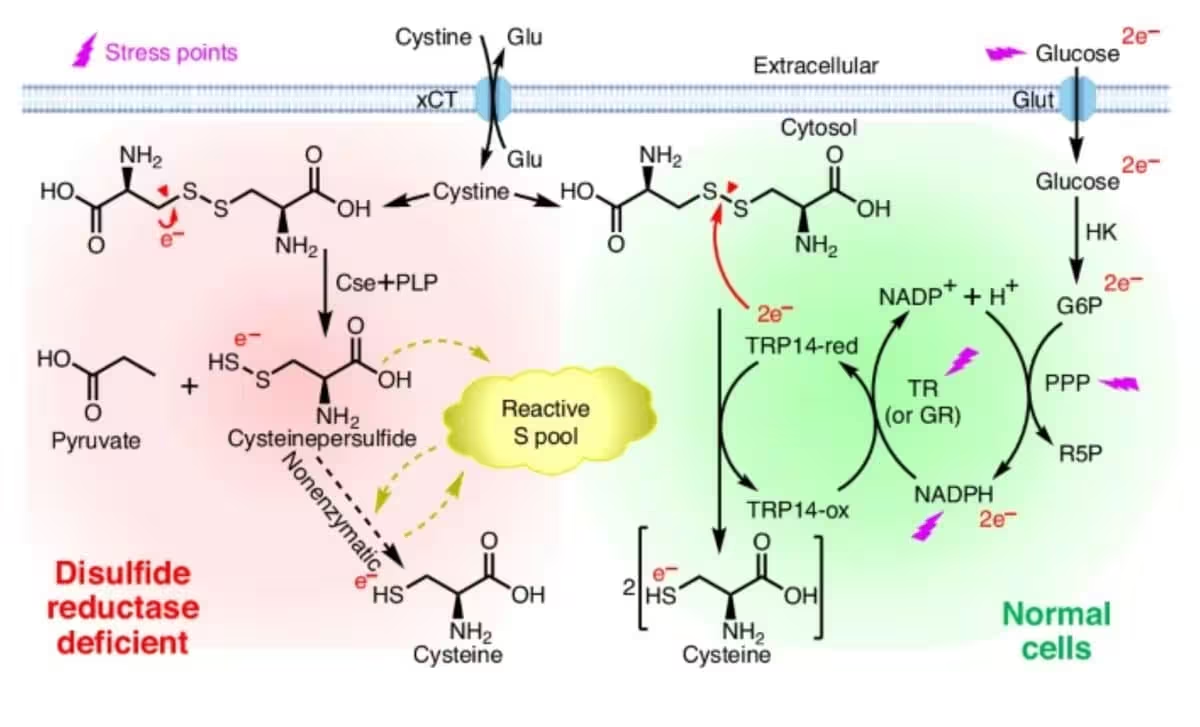
The study reveals that when standard pathways fail, cells deploy an alternative mechanism that utilizes pyridoxal phosphate to cleave the carbon-sulfur bond within cystine. This reaction produces cysteine persulfide, which is subsequently processed into the usable cysteine required for survival. This backup system appears to be regulated by levels of sulfur metabolites, functioning as a fail-safe mechanism triggered by increased concentrations of cytosolic cystine.
Implications for Oncology and Cellular Evolution
Beyond its fundamental biological significance, the discovery offers new avenues for cancer research. Malignant cells are notorious for their ability to withstand the harsh conditions induced by chemotherapy, radiation, and immunotherapy. Scientists suspect that this redundant cysteine-production pathway may serve as a protective shield, allowing tumors to survive treatment-related stress.
While the findings do not immediately translate into a clinical treatment, they provide a target for future therapeutic strategies. By selectively disrupting this protective pathway, researchers hope to render cancer cells more susceptible to existing medical interventions. Furthermore, the research team hypothesizes that this mechanism may have emerged early in the evolution of multicellular life, serving as an adaptive response to environmental toxins and metabolic challenges. Ongoing studies aim to further map the prevalence and function of this pathway across diverse biological conditions.
This article has been fact checked for accuracy, with information verified against reputable sources. Learn more about us and our editorial process.
Last reviewed on .
Article history
- Latest version
Cite this page:
- Posted by Elizabeth Taylor