Decades of Malaria Treatment in Senegal Leave Zero Room for Sensitive Parasites
A genomic and laboratory analysis of over 2,000 infections reveals how drug pressure shaped resistant strains while exposing crucial fitness trade-offs.

A sweeping genetic analysis of more than two thousand malaria infections collected across Senegal between 2006 and 2022 has revealed how decades of antimalarial treatments have reshaped the parasite population. Researchers tracked 2,805 monogenomic malaria infections, meaning infections driven by a single genetic strain, and found that fully drug-sensitive parasites have become virtually extinct in the region, accounting for less than one percent of all cases.
Tracking Two Decades of Parasite Evolution
The study, published in PLOS Pathogens, provides a detailed look at how Plasmodium falciparum, the parasite responsible for the deadliest form of malaria, adapts to public health interventions. Senegal has rolled out successive treatment and prevention policies over the last twenty years, including sulfadoxine-pyrimethamine combined with amodiaquine for seasonal chemoprevention in children, and artemisinin-based combination therapies as frontline treatments. These drug programs have exerted immense evolutionary pressure on the local parasite population.
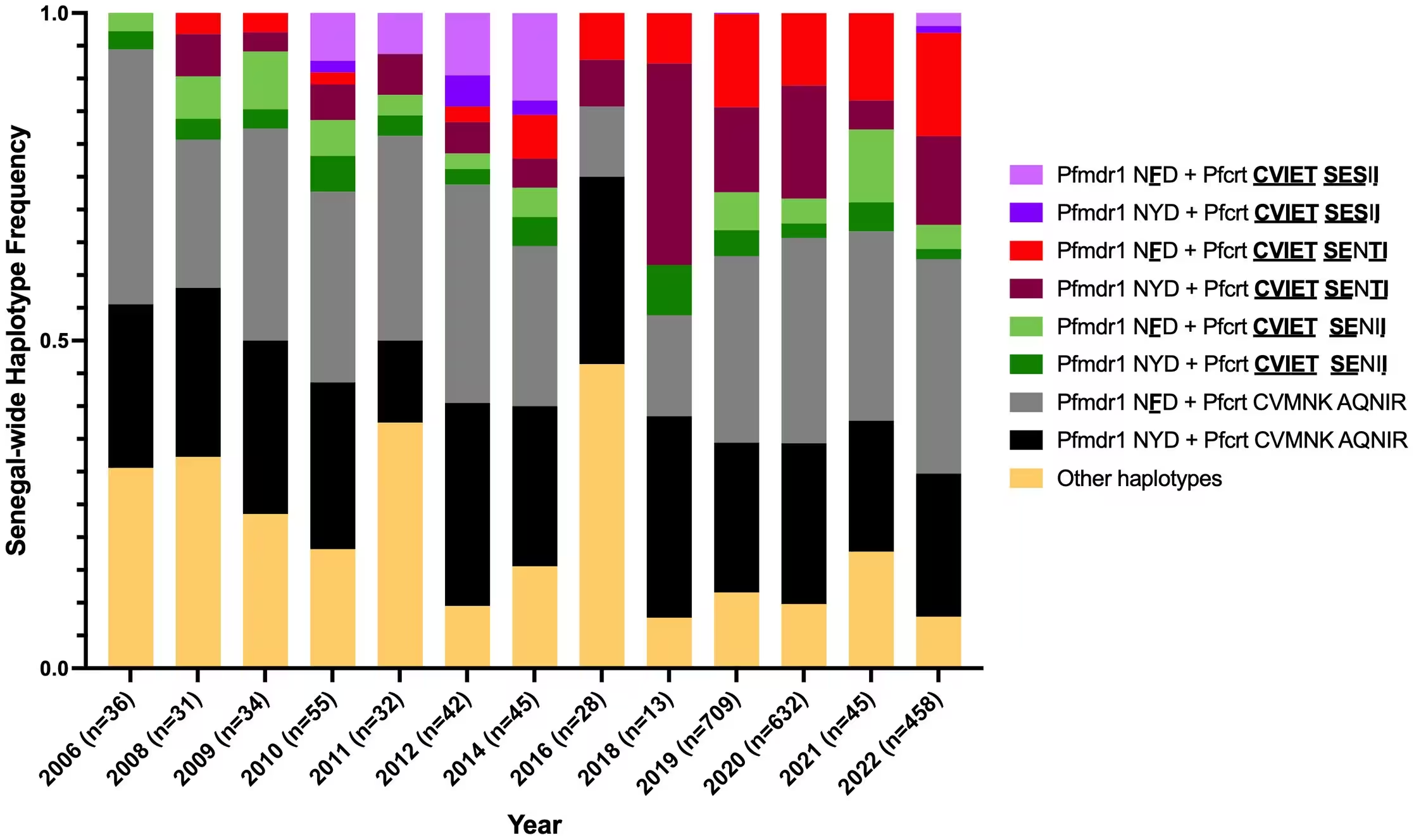
To understand the functional consequences of these genetic shifts, the research team successfully adapted 33 clinical parasite isolates to laboratory culture. These isolates represented 26 distinct combined resistance haplotypes, which together accounted for nearly 64 percent of all infections in the genomic dataset. By measuring drug susceptibility and running pairwise competitive growth assays, the authors could connect specific genetic combinations directly to how well the parasites survived drug exposure and competed against one another.
Mutations That Drive Drug Resistance and Fitness Costs
The laboratory tests confirmed that mutations in the Pfcrt gene, traditionally linked to chloroquine resistance, also reduce susceptibility to monodesthyl-amodiaquine, the active breakdown product of amodiaquine. Specifically, parasites carrying the Pfcrt CVIET genetic background combined with additional mutations known as N326S or I356T showed significantly higher half-maximal effective concentration values, indicating reduced drug susceptibility. The Pfdhfr triple mutant haplotype drove high levels of resistance to pyrimethamine, while Pfdhps A437G mutations increased resistance to sulfadoxine.
However, carrying these resistance mutations comes with a biological price. Competitive fitness modeling using a Bradley-Terry statistical approach revealed that the chloroquine-resistance-associated Pfcrt CVIET background imposes a severe growth cost on the parasite in the absence of drugs. Interestingly, this fitness penalty was partially offset when the parasites also carried the Y184F mutation in the Pfmdr1 gene, helping explain how certain resistant strains manage to persist in the population even when drug pressure fluctuates.
Geographic Differences and Future Prevention Strategies
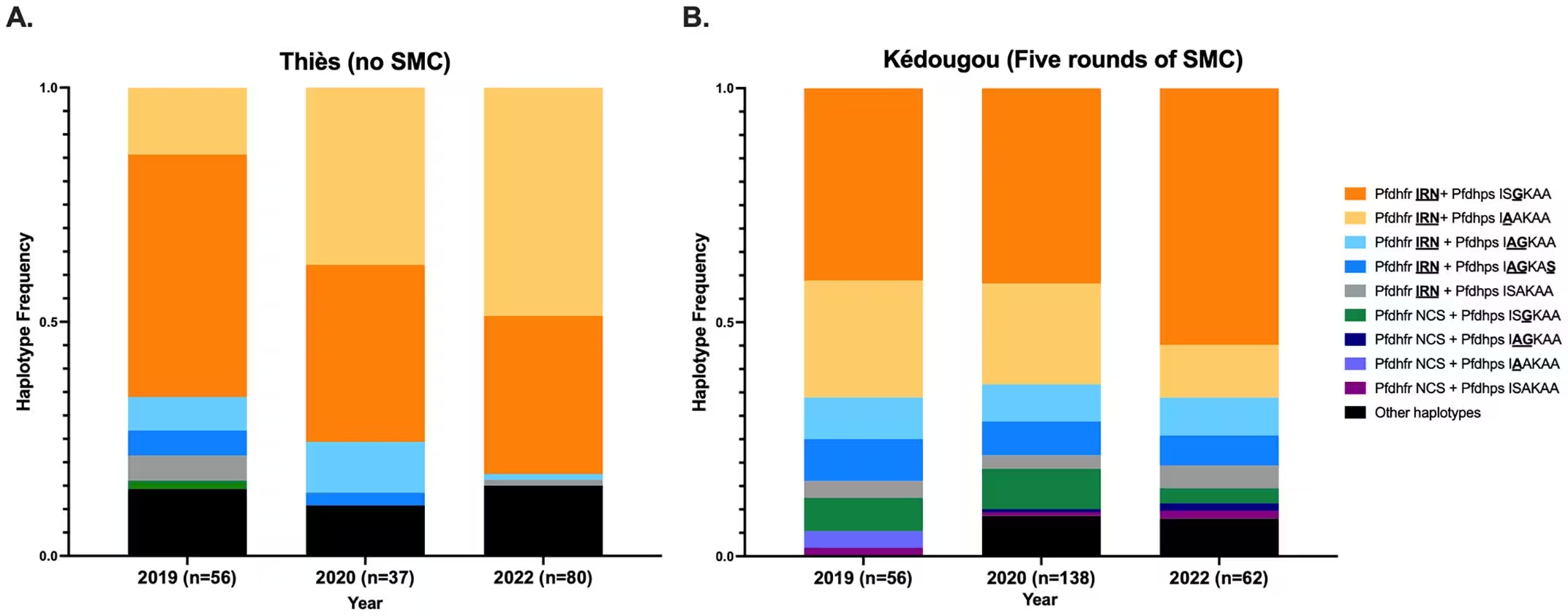
The genomic data also highlighted geographic divergence within Senegal. While triple mutants in Pfdhfr became nearly fixed nationwide by 2018, mutations in the Pfdhps gene varied between sites. In Thiès, a low-transmission region where seasonal chemoprevention is not used, one specific haplotype predominated, whereas a different haplotype dominated in Kédougou, a high-transmission area receiving multiple monthly rounds of preventive treatment.
Crucially, the study found limited evidence in Senegal for the high-level artemisinin resistance markers or severe antifolate resistance mutations that have emerged in parts of East Africa and Southeast Asia. The authors note that while high frequencies of moderate resistance markers do not automatically render preventive treatments useless, continuous monitoring is vital. Combining genomic surveillance with laboratory phenotyping ensures public health officials can spot dangerous genetic combinations before they compromise malaria control efforts.
The research was published in PLOS Pathogens on November 19, 2026.
This article has been fact checked for accuracy, with information verified against reputable sources. Learn more about us and our editorial process.
Last reviewed on .
Article history
- Latest version
Reference(s)
- Brenneman, Katelyn Vendrely., et al. “Genotype-phenotype investigation of evolving mutations associated with antimalarial resistance among Senegalese Plasmodium falciparum malaria parasites.” PLOS Pathogens, vol. 22, no. 11, November 19, 2026, pp. e1014822 Public Library of Science (PLoS), doi: 10.1371/journal.ppat.1014822. <https://doi.org/10.1371/journal.ppat.1014822>.
Cite this page:
- Posted by Elizabeth Taylor