New Framework Translates Genomic Uncertainty Into Disease Phenotypes
By coupling sequence predictions with calibrated uncertainty metrics, a new computational model maps gene variants to biological phenotypes while adapting its hypothesis breadth.

When studying the genetic underpinnings of complex traits, researchers often face a disconnect between molecular sequence data and downstream biological outcomes. A team of scientists has introduced a computational framework that translates genomic sequence predictions and their associated uncertainties into explicit probability distributions over graph-supported phenotype hypotheses, without requiring patient-level training supervision.
The study, published in arXiv by Huixin Zhan and Jason H. Moore, addresses a fundamental limitation in computational biology. While modern genomic sequence models provide reliable variant-level effect scores, translating those molecular findings into disease phenotypes requires managing uncertainty throughout the reasoning process. A confident genetic prediction should support a concentrated set of biological outcomes, whereas uncertain evidence calls for a broader, more conservative distribution of probabilities.
Connecting Molecular Sequence Predictions to Biomedical Knowledge Graphs
To bridge this gap, the authors developed an uncertainty-conditioned path-energy framework. Given a query gene, a sequence prediction score, and a calibrated predictive uncertainty metric, the system uses an interpretable learned utility function to score admissible gene-disease-phenotype routes. Query uncertainty dynamically controls the target temperature of the resulting probability distribution.
This mathematical formulation ensures that the quality of upstream genomic evidence dictates the breadth of downstream hypotheses. The researchers tested their approach using two large biomedical knowledge networks, AlzKB and Hetionet, which contain hundreds of thousands of nodes and millions of relational edges connecting genes, diseases, and symptoms.
Evaluating Sampler Fidelity and Hypothesis Breadth
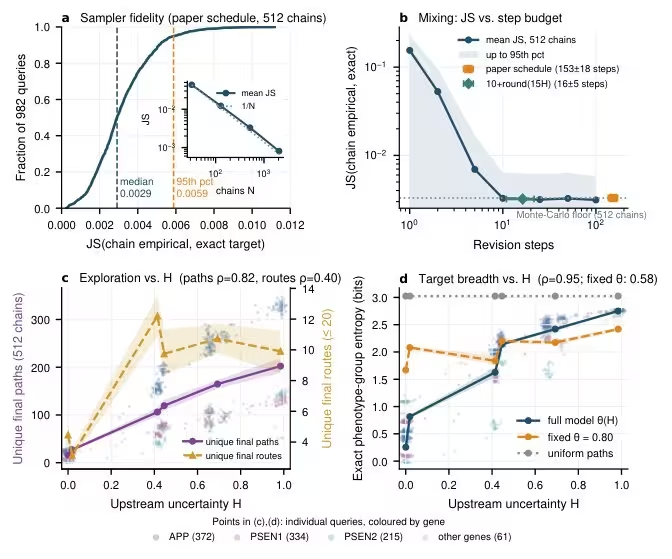
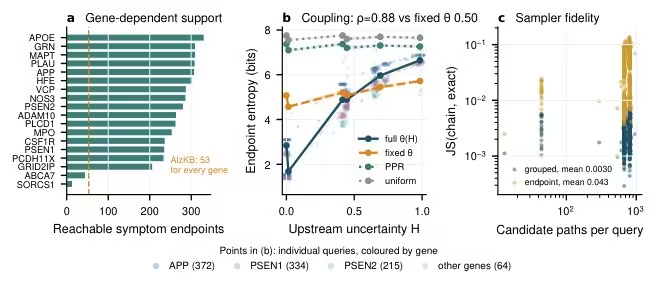
To sample from the complex probability distributions over enumerable candidate paths, the authors implemented a Hastings-corrected Metropolis revision operator. Across 982 real clinical variant queries from the AlzKB database, the sampled phenotype-group distributions matched the exact target with a mean Jensen-Shannon divergence of just 0.0031. Convergence was rapid, reaching stable performance within ten revision steps.
The analysis revealed a strong positive relationship between upstream genomic uncertainty and downstream hypothesis breadth. As predictive uncertainty increased from the lowest to the highest quartile, phenotype-group entropy expanded from 0.585 to 2.631 bits. In contrast, the probability assigned to the top-ranked phenotype group dropped from 0.864 to 0.357, confirming that the model appropriately broadens its predictions when underlying sequence evidence is less certain.
Testing Masked Association Recovery Across Networks
To evaluate predictive generalization, the research team conducted masked-edge experiments on the Hetionet knowledge graph by hiding 20% of the disease-symptom edges. The model had to recover these hidden associations using multi-step gene relays. Across the evaluated gene-held-out splits, the framework achieved a mean recall@10 of 0.206, outperforming baseline triple scorers and standard knowledge graph embedding models such as DistMult on a majority of tested graph masks.
Additional controls and ablations demonstrated that this recovery capability depends heavily on how the model allocates probability mass across biological routes, rather than relying solely on distributional breadth. The authors note that while the framework shows robust performance across multiple graph topologies, certain performance advantages were concentrated within a small subset of genes carrying a high volume of variants, indicating that further evaluation across broader genomic datasets will be necessary.
The study was posted to the arXiv preprint server on November 19, 2026.
This article has been fact checked for accuracy, with information verified against reputable sources. Learn more about us and our editorial process.
Last reviewed on .
Article history
- Latest version
Reference(s)
- Zhan, Huixin. “From Sequence Uncertainty to Phenotype Hypotheses: Uncertainty-Conditioned Inference over Biomedical Knowledge Graphs.” arXiv.org <http://arxiv.org/abs/2611.25422v1>.
Cite this page:
- Posted by Faisal Qureshi