Mother and Daughter Develop Rare Brain Inflammation From Ovarian Tumors
An unusual parent-child diagnosis of a rare autoimmune brain disorder prompts new questions about family susceptibility and tumor biology.

A mother and her daughter developed a rare brain-inflaming condition triggered by ovarian growths eight years apart, prompting researchers to investigate whether family genetics can influence the disorder. Anti-N-methyl-D-aspartate receptor (NMDAR) encephalitis occurs when the body’s immune system mistakenly attacks receptors in the brain, causing psychiatric symptoms, seizures, and memory changes.
How Did the Mother and Daughter Experience the Condition?
The mother developed symptoms at 29 years of age, experiencing insomnia, abnormal behavior, and generalized seizures before doctors found a mature teratoma, which is a type of tumor containing different types of body tissues. Eight years later, her 12-year-old daughter suffered an upper respiratory tract infection followed by emotional outbursts, behavioral shifts, seizures, and impaired consciousness. Medical teams removed an immature teratoma from the daughter just eight days after her symptoms began. Both patients tested positive for the damaging antibodies in their cerebrospinal fluid, and laboratory examinations revealed that the neural tissue inside both of their tumors expressed the specific protein target that triggers the neurological attack.
Detailed findings from the investigation were published in Neurology(R) neuroimmunology & neuroinflammation, outlining the clinical courses and laboratory workups of the family. While nearly all documented cases of this specific syndrome affect unrelated individuals sporadically, occurrences linking close relatives remain exceptionally rare.
What Did Genetic and Pathological Tests Reveal?
To understand why both relatives developed the identical complication, the study authors performed advanced genetic sequencing and human leukocyte antigen typing on peripheral blood samples. They found no significant disease-related variants or known high-risk immune genes shared between the two patients. Furthermore, comprehensive whole-exome sequencing did not uncover any identifiable mutations responsible for the familial pattern.
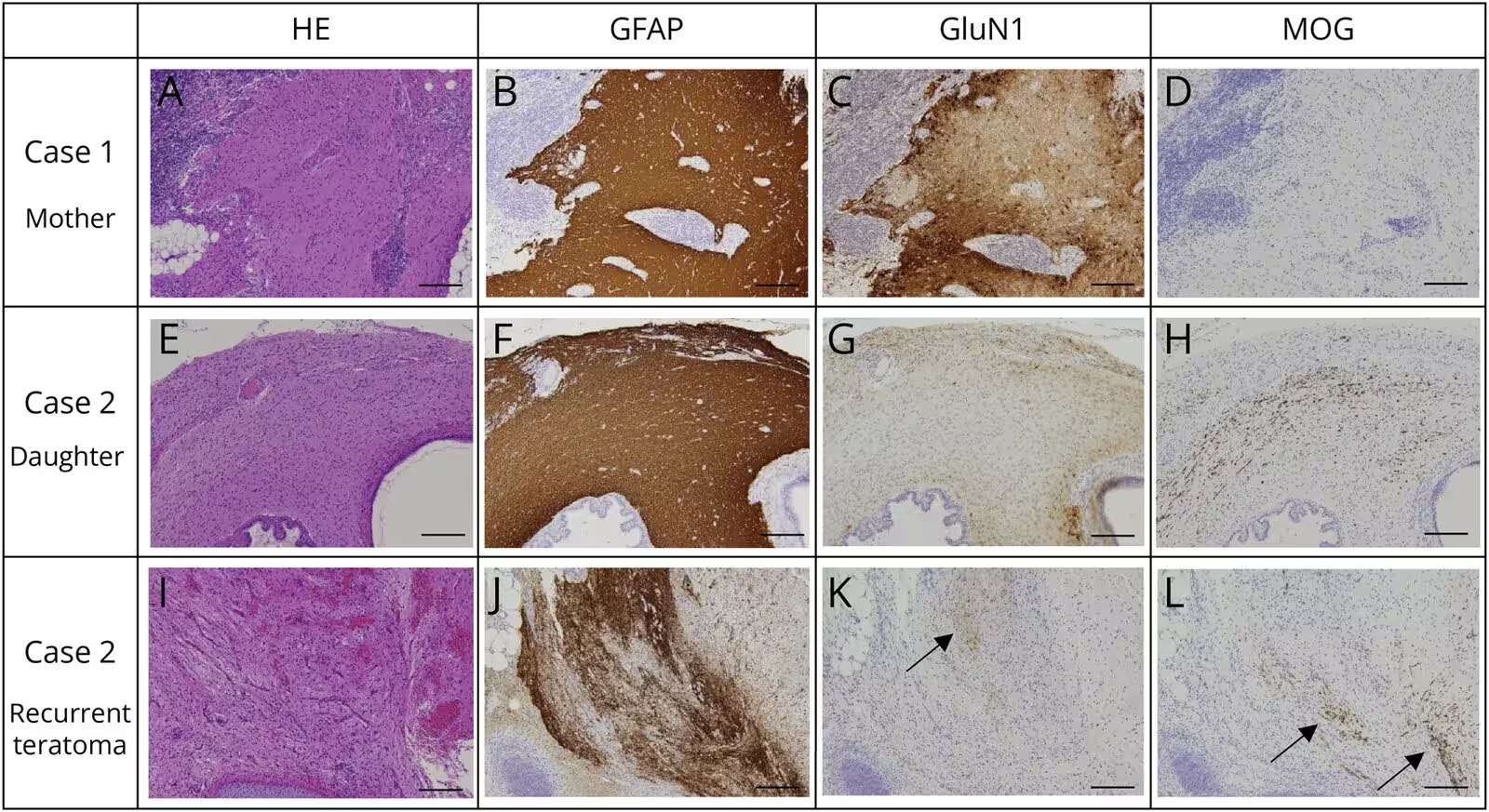
Pathological evaluations of the surgically removed tumors showed that the neural tissues inside the growths reacted positively to antibodies targeting brain receptors. Interestingly, when tumors grew back years later in both patients, subsequent examinations showed either no neural tissue or a significantly reduced neural component alongside weaker immune reactivity, and neither recurrence triggered a relapse of the brain inflammation.
What Are the Limits of the Study and Next Steps?
Because the report centers on just two related individuals, experts emphasize that the findings cannot yet prove a direct hereditary link for the condition. The authors note that identifying whether familial ovarian growths with neural tissue expression truly raise the risk of brain inflammation will require tracking more family cases and conducting broader molecular studies.
For now, the successful treatments highlight the importance of prompt tumor removal and immunotherapy. Both relatives recovered well after receiving intensive medical care and tumor surgery, returning to work and school without long-term neurological setbacks despite their severe initial hospitalizations.
The research was published in Neurology(R) neuroimmunology & neuroinflammation on November 16, 2026.
This article has been fact checked for accuracy, with information verified against reputable sources. Learn more about us and our editorial process.
Last reviewed on .
Article history
- Latest version
Reference(s)
- Maeda, Kenichi., et al. “Familial Ovarian Teratoma With Neural Tissue Expression and Anti-NMDAR Encephalitis.” Neurology Neuroimmunology & Neuroinflammation, vol. 14, no. 1, January 1, 2027 Ovid Technologies (Wolters Kluwer Health), doi: 10.1212/NXI.0000000000200685. <https://doi.org/10.1212/NXI.0000000000200685>.
Cite this page:
- Posted by Elizabeth Taylor