Jumping Genes Actively Shape Brain Complexity by Splice Splicing Into Neural Transcripts
A quantitative analysis resolves a scientific controversy over mobile DNA sequences in the Drosophila brain, showing they act as functional exons.

Jumping genes once dismissed as genomic junk are actively woven into the functional machinery of brain cells, helping expand the molecular diversity of neurons and glia. A quantitative analysis reveals that transposable elements, which are mobile DNA sequences capable of moving around genomes, are frequently incorporated as alternative exons into mature messenger RNA transcripts within the brain of the fruit fly Drosophila melanogaster.
Malak Choucri, Tina Rainey, and Christoph Daniel Treiber from the University of Oxford revisited previous scientific debates surrounding how these mobile elements integrate into neural transcripts. Their study, published in eLife, addresses why separate research teams reached conflicting conclusions about whether transposable elements actually splice into host genes or simply represent sequencing artifacts.
How Genomic Jumping Elements Become Part of Neural Transcripts
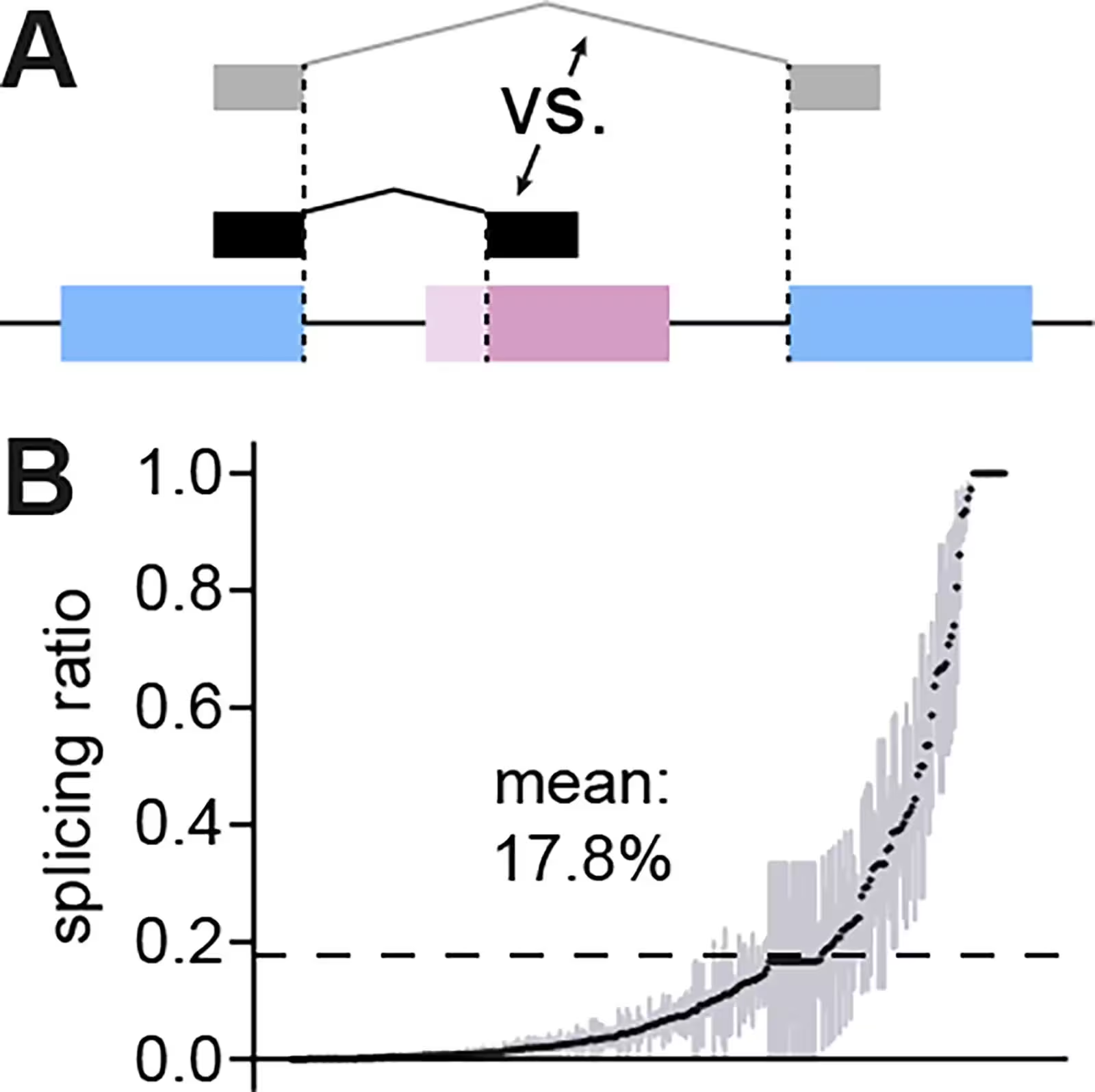
To measure how often mobile DNA sequences are recruited as functional building blocks, the investigators updated a specialized computational tool called TEChim. By analyzing high-coverage RNA sequencing data from the midbrains of Drosophila flies, the team tracked 264 previously identified gene pairs containing transposable element insertions, yielding a total of 456 individual splice junctions.
The results show that inclusion rates span nearly the entire dynamic range from the detection limit up to 100 percent. The median junction exhibits a splice ratio of 3 percent, while a full quarter of the analyzed junctions exceed 15 percent inclusion. These values remained highly consistent across biological replicates, indicating that transposable element exonization is a stable biochemical property of specific gene pairs rather than random transcriptional noise.
Why Previous Re-analyses Failed to Detect Splicing Events
The new work also untangles a scientific controversy sparked by a separate 2024 paper that applied a tool named TIDAL to the Oxford group’s published data and failed to find the reported splice junctions. Choucri and colleagues demonstrated that computational and experimental limitations account for those negative results.
Software such as TIDAL clusters split reads within narrow genomic windows, meaning that genuine splice junctions located outside those tight boundaries are automatically filtered out. In contrast, the TEChim pipeline reconstructs full-length fragments from overlapping reads, maps them to a repeat-masked reference genome, and resolves breakpoints with precise base-pair accuracy.
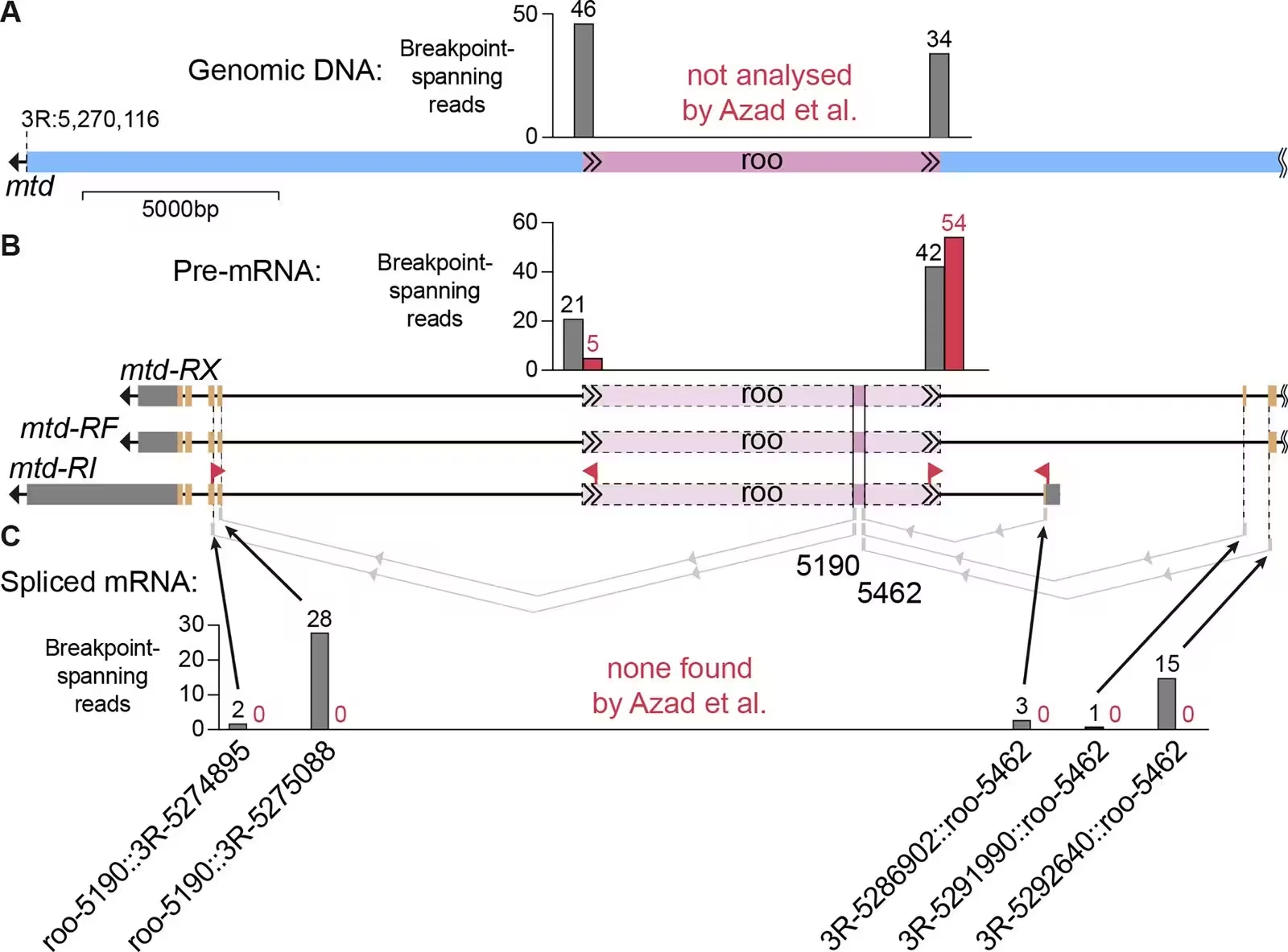
The authors also pointed out that attempts to validate the findings using reverse transcription polymerase chain reaction assays were hindered by mismatched fly strains. Transposable element landscapes vary significantly between laboratory stocks. When the Oxford team used genotype-matched Canton-S flies and carefully designed primers that spanned specific splice sites, they successfully amplified and validated the expected chimeric transcripts, confirming the results with Sanger sequencing.
What These Chimeric Transcripts Mean for Brain Complexity
Alternative splicing is vital for creating the structural and functional diversity required by complex nervous systems. When mobile DNA sequences insert themselves into introns, they can introduce cryptic splice sites that alter coding sequences, truncate transcripts, or modify untranslated regions that dictate RNA stability and protein localization.
Because alternative splicing is strongly cell-type specific, incorporating transposable element segments offers a flexible mechanism to generate distinct protein variants across various neural populations. However, the researchers emphasize important limitations to their current work. The investigation focused on bulk midbrain tissue from a single genetic background, meaning many rare or cell-type specific insertions likely remain below the current detection threshold. Furthermore, while the data prove that chimeric transcripts are abundant and stable, future studies combining single-cell sequencing and functional assays will be necessary to determine how these hybrid molecules influence neuronal physiology and animal behavior.
The research was published in eLife on November 17, 2026.
This article has been fact checked for accuracy, with information verified against reputable sources. Learn more about us and our editorial process.
Last reviewed on .
Article history
- Latest version
Reference(s)
- Choucri, Malak., et al. “Transposons contribute to splice-isoform diversity in the Drosophila brain.” eLife, vol. 15, November 17, 2026 eLife Sciences Publications, Ltd, doi: 10.7554/eLife.110625. <https://doi.org/10.7554/eLife.110625>.
Cite this page:
- Posted by Faisal Qureshi