Spider Mites Evolve Fungal Genes to Eat Toxic Green Tea
A horizontally transferred fungal gene and two key amino acid changes allow specialized pests to break down potent plant defenses.

A tiny agricultural pest has evolved a way to feast on green tea plants by deploying a detoxifying enzyme acquired from fungi millions of years ago. Researchers found that while generalist spider mites are quickly poisoned and repelled by tea leaves, certain populations of the Kanzawa spider mite thrive on the crop by turning on a specific gene when they feed.
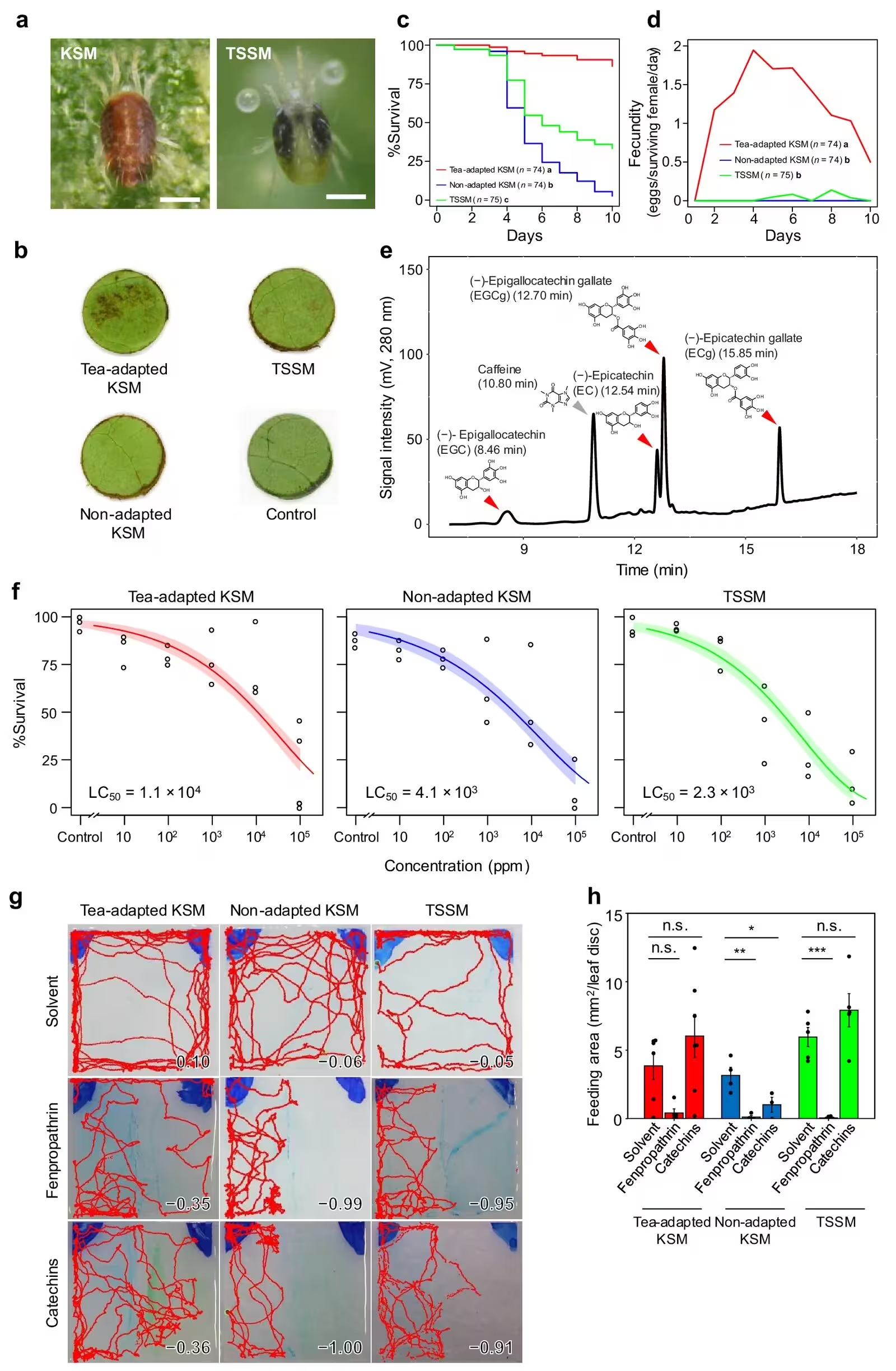
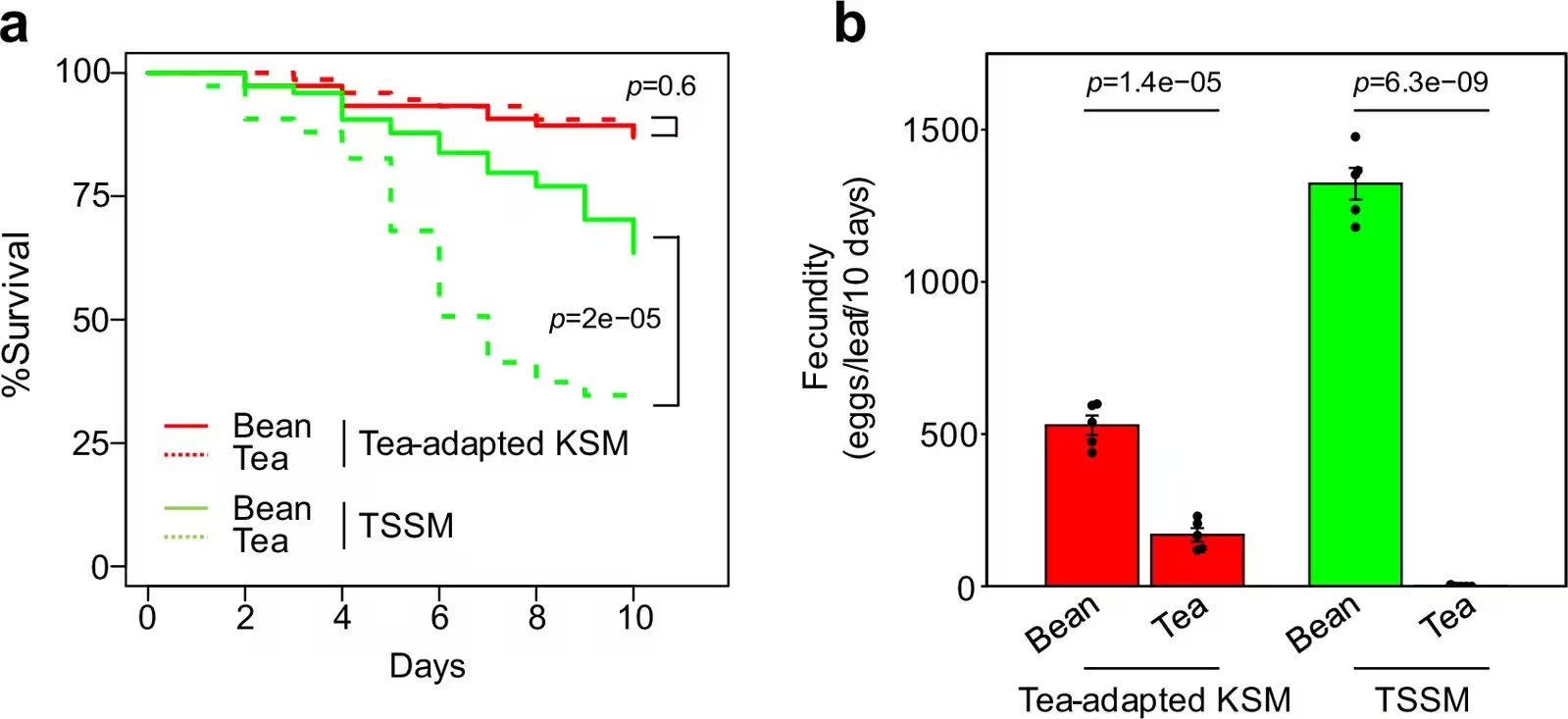
Green tea plants rely on chemical compounds called catechins to defend themselves against hungry insects and herbivores. These antioxidant molecules make up roughly 8.4 percent of the dry mass of a tea leaf and act as potent deterrents. When non-adapted mites encounter catechins, the compounds cause contact irritation, stop feeding, and act as a lethal poison. However, tea-adapted populations of the Kanzawa spider mite, scientifically known as Tetranychus kanzawai, suffer no such ill effects and can lay up to two eggs per day on tea foliage.
To unravel how these mites achieve this feat, an international team of scientists conducted behavioral trials, genetic sequencing, and biochemical experiments. The findings were published in eLife. The research revealed a two-step evolutionary strategy involving both changes to protein structure and a massive surge in gene activity.
The core of the detoxification system relies on an enzyme called an intradiol ring-cleavage dioxygenase, specifically designated as DOG15. While animals rarely possess enzymes to break down complex plant chemicals, spider mites in the distant past incorporated several genes from fungi into their own genomes through horizontal gene transfer. The study showed that when tea-adapted mites begin feeding on tea leaves, they crank up production of the DOG15 enzyme, resulting in mRNA and protein levels up to 31 times higher than those found in non-adapted relatives.
How Two Amino Acid Changes Supercharge Mite Defense
Beyond simply producing more of the enzyme, tea-adapted mites possess a uniquely refined version of it. By comparing the genetic sequences of different mite populations, the authors identified two key amino acid substitutions in the Kanzawa spider mite enzyme compared to the version found in the two-spotted spider mite, a related generalist pest. One of these substitutions sits right next to the active site where the enzyme binds to iron and breaks down target molecules.
Laboratory tests using recombinant proteins expressed in bacteria demonstrated that the Kanzawa spider mite enzyme cleaves green tea catechins much more efficiently than the equivalent protein from generalist mites. When the team used RNA interference, a laboratory technique that temporarily silences specific genes, to block DOG15 production in tea-adapted mites, the insects suffered a significant drop in survival on tea leaves. This proves that high expression of the fungal-derived gene is strictly required for the pests to tolerate their bitter diet.
Unresolved Questions and Future Pest Control Approaches
Despite these clear mechanistic insights, several mysteries remain regarding how these mites conquer tea plantations. Non-adapted mites actively flee from green tea catechins using specialized sensory organs on their legs and mouthparts, but tea-adapted individuals completely ignore these warning signals. The molecular identity of the sensory receptors that allow tea-adapted mites to shrug off the chemical repellency remains unknown.
Furthermore, the exact metabolic breakdown products created when DOG15 chops up catechins have not yet been fully characterized, though researchers presume they are less toxic than the original plant compounds. Additional genes, including other detoxification families like cytochrome P450s and transport proteins, also showed elevated activity in the transcriptome and proteome analyses, suggesting that full adaptation to tea might involve multiple cooperating systems.
Understanding how herbivorous pests rapidly co-opt microbial genes to overcome plant defenses provides valuable insights into agricultural coevolution. As researchers continue to map these biochemical pathways, the findings could eventually help agricultural scientists develop more selective pest control strategies to protect commercial tea crops without relying on broad-spectrum chemical insecticides.
The research was published in eLife on November 17, 2026.
This article has been fact checked for accuracy, with information verified against reputable sources. Learn more about us and our editorial process.
Last reviewed on .
Article history
- Latest version
Reference(s)
- Takeda, Naoki., et al. “Adaptation of an herbivorous arthropod to green tea plants by overcoming catechin defenses.” eLife, vol. 15, November 17, 2026 eLife Sciences Publications, Ltd, doi: 10.7554/eLife.110082. <https://doi.org/10.7554/eLife.110082>.
Cite this page:
- Posted by Elizabeth Taylor