Researchers Discover Mice Lacking Dock7 Gene Segments Do Not Show Increased Seizure Susceptibility
Targeted deletions in exons 3 and 4 of Dock7 failed to trigger heightened seizure vulnerability in a repeated chemical exposure study.

Researchers at the University of New England have found that mice lacking exons 3 and 4 in the Dock7 gene do not show heightened seizure susceptibility or increased excitability when tested with a chemical seizure-triggering agent.
Epilepsy affects about 1% of the population in the United States, representing one of the most common neurological conditions. While treatments typically focus on suppressing active seizures, scientists still lack a full understanding of the genetic drivers behind epileptogenesis, the gradual process by which a normal brain develops epilepsy. Human genetic studies have previously linked mutations in the DOCK7 gene to severe early childhood epileptic encephalopathies, which are disorders causing frequent seizures and severe cognitive and behavioral impairments. To test whether partial loss of this gene directly causes seizure vulnerability, Russell Ferland and colleagues examined laboratory mice engineered with specific genetic deletions, utilizing a repeated chemical vapor exposure model published in Epilepsia Open.
How Did Mice React to Repeated Chemical Seizure Testing?
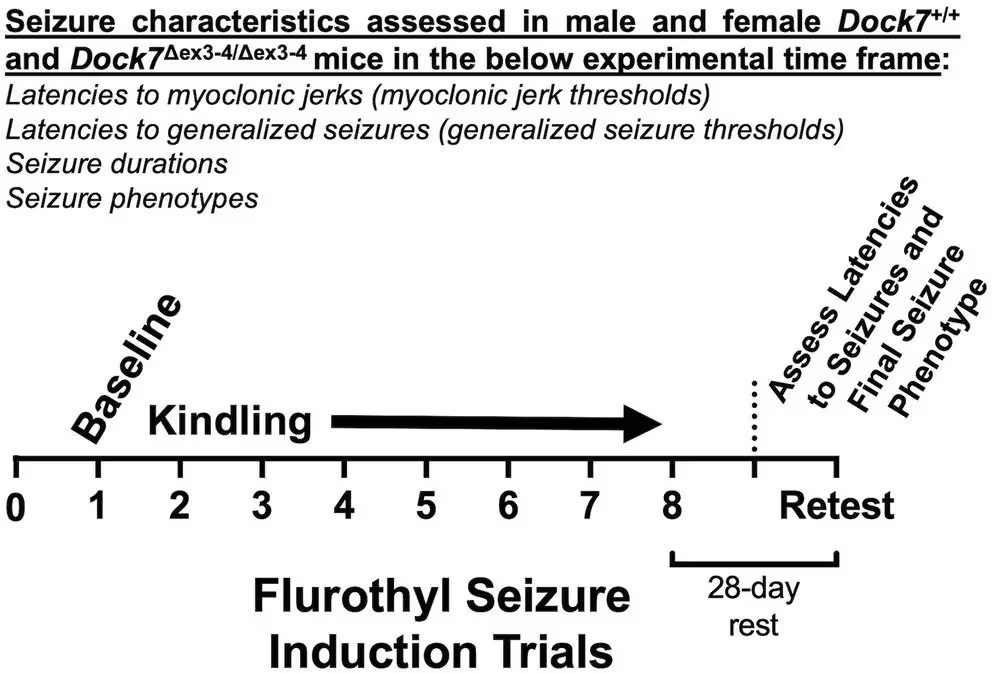
The team subjected male and female mice to eight daily exposures of a volatile chemical called flurothyl inside a closed chamber. This setup allowed researchers to measure the time it took for animals to experience involuntary muscle contractions, known as myoclonic jerks, and subsequent generalized seizures. Both normal wild-type mice and Dock7 deletion mice experienced the expected kindling effect, meaning their seizure thresholds decreased and they required less chemical exposure to trigger a seizure over the eight trials.
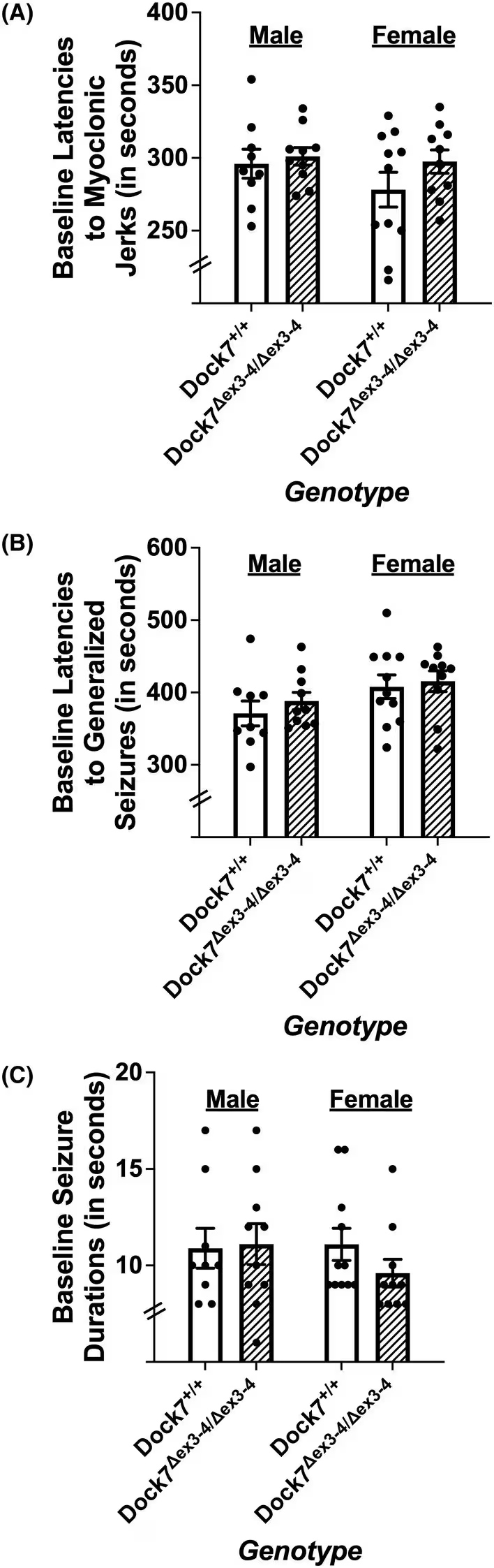
Surprisingly, male mice missing exons 3 and 4 actually exhibited slightly longer latencies to both myoclonic jerks and generalized seizures compared to control males across the testing period. Female mice with the deletion showed no significant differences in baseline seizure thresholds compared to standard controls. However, mutant females did display longer generalized seizure durations across trials 3 through 8, hinting at a potential sex-specific effect on how seizures are maintained or terminated.
What Happened After a Twenty-Eight-Day Rest Period?
Following the initial eight-day induction phase, the animals rested for 28 days without any further chemical exposure before undergoing a final retest trial. During this retest, normal female mice showed increased latencies to myoclonic jerks and generalized seizures, whereas the genetically altered females maintained their previous response times. Across all experimental groups, a significant majority of the animals developed more severe seizures that propagated from the forebrain into the brainstem network.
Specifically, 78% of control males and 70% of mutant males displayed these advanced forebrain-to-brainstem seizure phenotypes during the retest. Among females, 46% of normal mice and 60% of deletion mice exhibited the same severe progression. The proportion of animals developing this heightened seizure severity did not differ significantly between the genetic groups, indicating that the progression is likely independent of Dock7 function in this specific model.
Why Do Mouse Results Differ From Human Genetic Data?
The lack of heightened seizure susceptibility in the mutant mice contrasts with the severe epilepsy seen in humans carrying DOCK7 mutations. The study authors note that their genetically modified animals retain partial protein expression rather than being complete null mutants, meaning some residual protein activity may compensate for the loss of exons 3 and 4. Additionally, the mice used in the experiments were 7 to 8 weeks old, and testing different age groups or utilizing continuous brain wave monitoring could reveal latent neurological differences.
The research was published in Epilepsia open on November 26, 2026.
This article has been fact checked for accuracy, with information verified against reputable sources. Learn more about us and our editorial process.
Last reviewed on .
Article history
- Latest version
Reference(s)
- Ferland, Russell J.., et al. “Analysis of flurothyl‐induced seizures and epileptogenesis in mice with targeted deletions of exons 3 and 4 in Dock7.” Epilepsia Open, November 26, 2026 Wiley, doi: 10.1002/epi4.70383. <https://doi.org/10.1002/epi4.70383>.
Cite this page:
- Posted by Elizabeth Taylor