Nanyang Normal University Researchers Boost Hydrogen Peroxide Production 16-Fold With Methylated Frameworks
Adding methyl groups to porous catalysts forces a structural shift that accelerates charge separation and optimizes oxygen binding.
Researchers at Nanyang Normal University engineered a new class of porous material that produces hydrogen peroxide at a rate of 13,562 micromoles per gram per hour under visible light. The breakthrough addresses a long-standing chemical bottleneck by simultaneously adjusting how molecular layers stack and how oxygen binds to the catalyst surface.
Hydrogen peroxide is a versatile green oxidant used widely in water purification, chemical synthesis, and industrial bleaching. Traditional manufacturing relies on the energy-intensive anthraquinone process, which requires complex operating procedures and generates considerable environmental concerns. Scientists have increasingly turned to photocatalysis, using sunlight to drive chemical reactions under mild ambient conditions. Among various candidates, porous crystalline networks known as covalent organic frameworks, or COFs, offer modular structures and tailorable properties that make them promising solar-driven catalysts.
However, ordinary covalent organic frameworks struggle with inefficient charge separation and sluggish oxygen activation. In particular, one-dimensional variants suffer from poor interlayer stacking, where adjacent sheets slip out of alignment and hinder the smooth flow of electrical charge carriers. Solving this problem required a strategy to control both the structural stacking and the precise molecular geometry of oxygen adsorption simultaneously.
How Methyl Groups Rewrite Molecular Stacking Rules
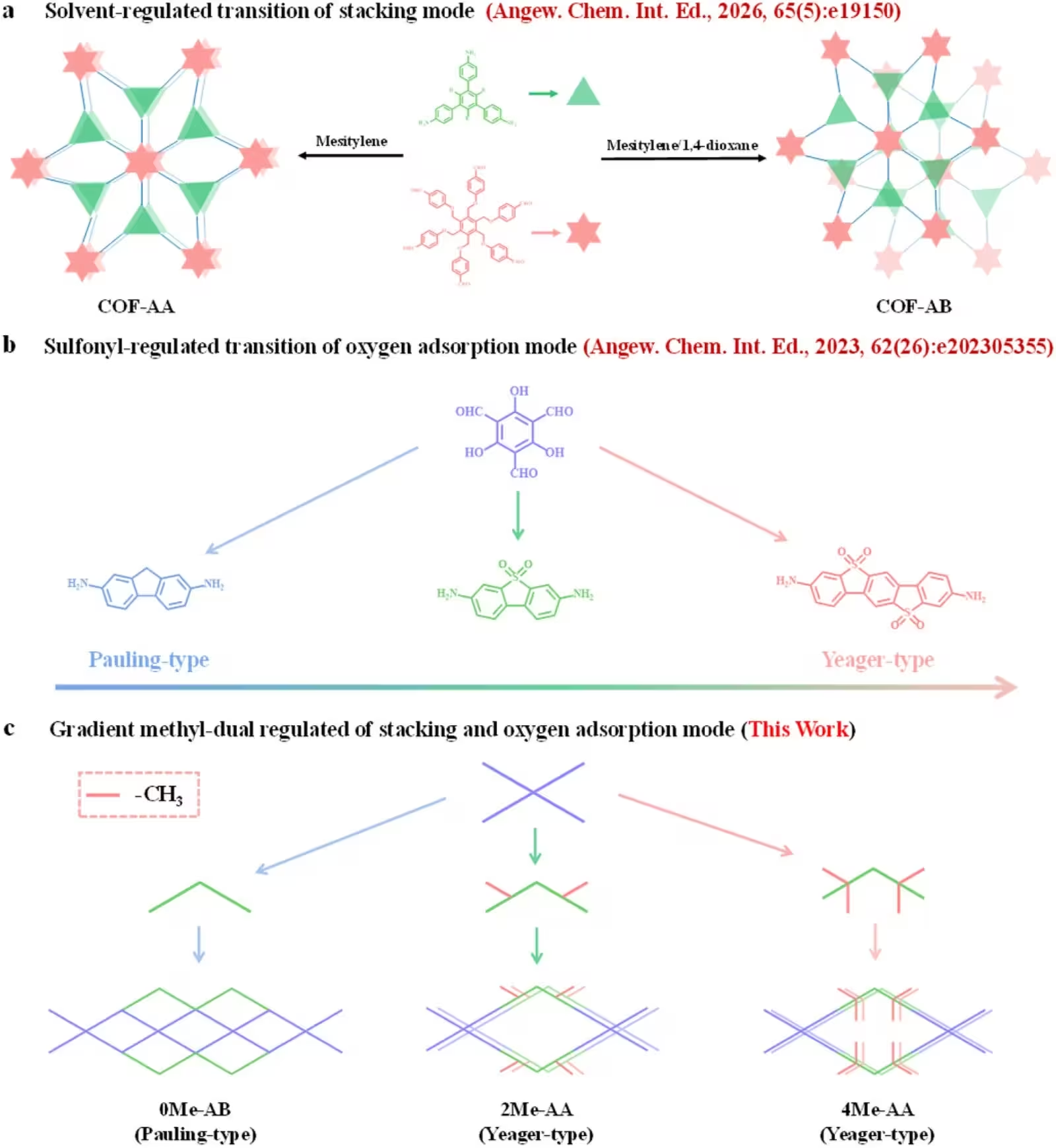
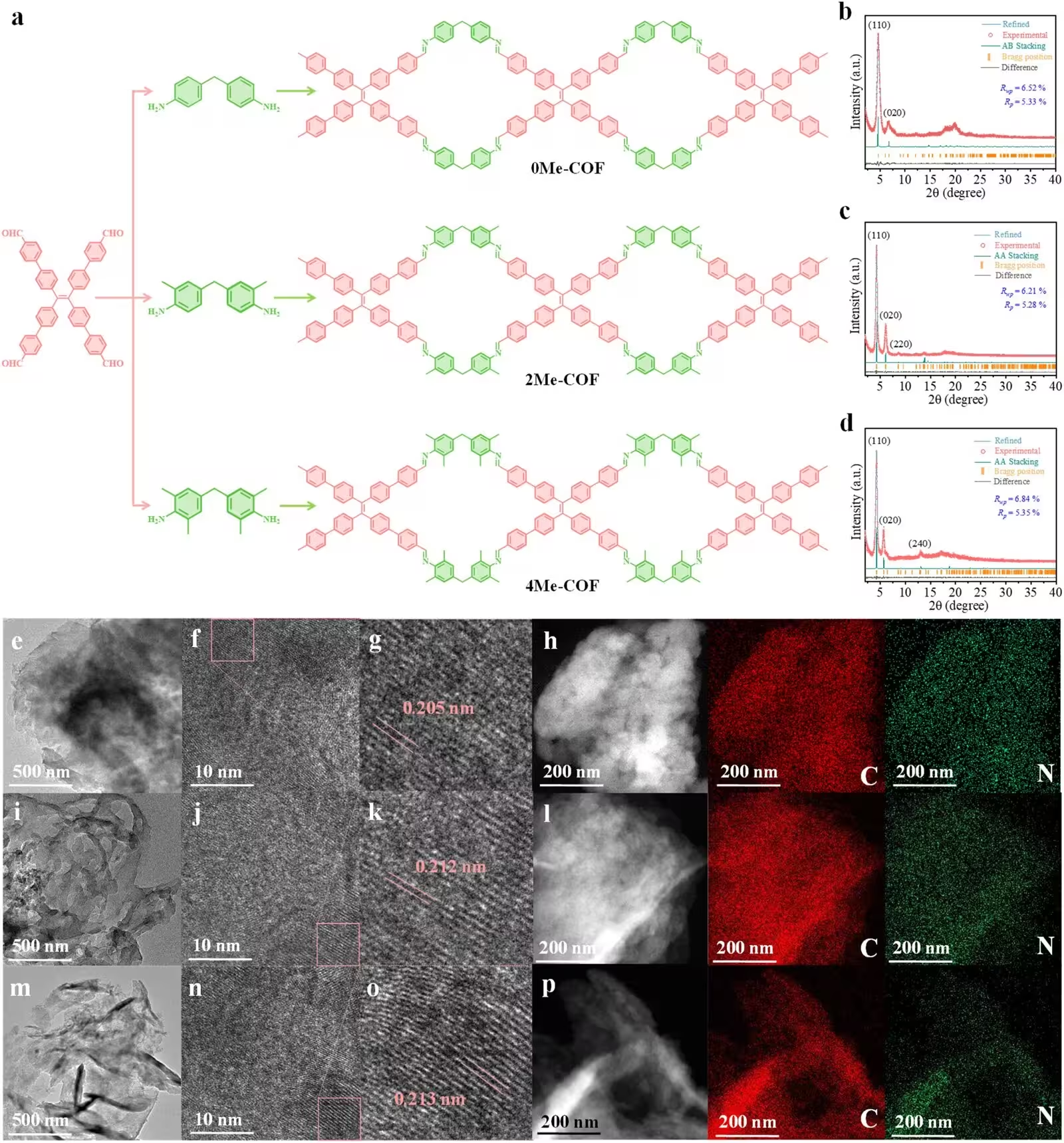
Led by first author Zhuwei Li and colleagues, the research team published in Chemical Science a gradient methyl functionalization strategy to modify one-dimensional covalent organic frameworks. By gradually introducing methyl chemical groups into the framework synthesis, the team constructed three distinct materials designated as 0Me-COF, 2Me-COF, and 4Me-COF, representing increasing levels of methylation. Structural simulations and powder X-ray diffraction analyses revealed that adding these methyl groups suppressed unwanted interlayer slipping and forced a structural transformation from a staggered AB stacking arrangement into a more orderly AA stacking configuration.
This structural upgrade had a dramatic effect on electronic behavior and light absorption. As the degree of methyl functionalization increased, the optical band gap narrowed from 2.04 electron volts down to 1.65 electron volts. This shift enhanced visible light harvesting across the solar spectrum. Spectroscopic tests showed that the most heavily methylated material, designated as 4Me-COF, exhibited a significantly diminished photoluminescence intensity alongside a prolonged charge carrier lifetime of 113.68 picoseconds. These metrics indicate that electron-hole recombination was heavily suppressed, allowing electrical charges to migrate rapidly across the material interface.
Why Oxygen Adsorption Modes Control Reaction Selectivity
Beyond electrical transport, the geometry of oxygen attachment dictates whether a catalyst successfully produces hydrogen peroxide or gets trapped in unwanted chemical side reactions. Conventional materials promote a Pauling-type adsorption mode, where oxygen molecules bind end-on and tend to generate reactive superoxide intermediates that lower overall reaction selectivity. Using electron spin resonance and time-resolved infrared spectroscopy, the authors tracked how methyl engineering alters this fundamental interaction.
The gradual addition of methyl groups shifted oxygen adsorption away from the Pauling configuration and toward a side-on Yeager-type configuration. In this optimized geometry, oxygen molecules adsorb directly onto specific imine nitrogen and benzene ring carbon sites. This arrangement facilitates a concerted two-electron and two-proton transfer pathway to form hydrogen peroxide directly without creating unwanted superoxide build-up. Isotope-labeling tests using oxygen-18 confirmed that the resulting hydrogen peroxide originated entirely from the oxygen reduction reaction rather than from water oxidation.
What Performance Metrics Reveal About Catalytic Longevity
Under standard testing conditions in an oxygen-saturated aqueous solution containing benzyl alcohol as a sacrificial electron donor, 4Me-COF achieved a hydrogen peroxide production rate of 13,562 micromoles per gram per hour. This performance represents a 16.7-fold improvement over the unmethylated 0Me-COF baseline and a 2.8-fold increase over the intermediately methylated 2Me-COF variant. Control experiments confirmed that both light irradiation and the presence of the catalyst were strictly necessary for the reaction to proceed.
The material also demonstrated exceptional operational durability throughout testing. During continuous visible light irradiation, the framework maintained a nearly linear accumulation of hydrogen peroxide for 6 hours without apparent deactivation. Furthermore, recycling experiments showed no significant loss of catalytic activity after 15 consecutive reaction cycles. The apparent quantum yield reached a maximum value of 19.4 percent at a wavelength of 420 nanometers, closely mirroring the optical absorption profile of the framework and confirming that the reaction is driven directly by photoinduced charge generation.
The research was published in Chemical science on November 25, 2026.
This article has been fact checked for accuracy, with information verified against reputable sources. Learn more about us and our editorial process.
Last reviewed on .
Article history
- Latest version
Reference(s)
- Li, Zhuwei., et al. “Dual modulation of stacking and oxygen adsorption in 1D-COFs via gradient methyl functionalization for enhanced photocatalytic H 2 O 2 synthesis.” Chemical Science, January 1, 2026 Royal Society of Chemistry (RSC), doi: 10.1039/d6sc07849d. <https://doi.org/10.1039/d6sc07849d>.
Cite this page:
- Posted by Raj Joshi