Nanomilled Nitric Oxide Formulation Achieves Full Drug Loading
New liquid suspensions of S-nitrosoglutathione crystals bypass carrier matrices to provide stable, long-term antimicrobial release for medical devices.

A new liquid formulation of nitric oxide donors created by milling S-nitrosoglutathione crystals into hundreds-of-nanometer sizes within biocompatible alkanediols achieves a theoretical drug loading of 100 percent while maintaining long-term chemical stability. Researchers sought to overcome the rapid decomposition and low carrier capacity that traditionally plague liquid nitric oxide delivery systems by suspending undissolved donor crystals directly in viscous, low-toxicity nonsolvents without any inactive polymer matrices or surfactants.
Overcoming Chemical Instability in Liquid Drug Delivery
Nitric oxide is an endogenous gasotransmitter that plays critical physiological roles, including vasodilation, neurotransmission, immune modulation, and the regulation of wound healing. Because it is a highly reactive free radical gas with a very short half-life under physiological conditions, direct storage and delivery remain nearly impossible outside of gaseous inhalation therapy. Consequently, biomedical engineers rely on donor compounds that generate nitric oxide upon specific triggers such as moisture, heat, or contact with biological media.
Traditional liquid formulations usually suffer from poor solution stability, undergoing rapid first-order decay that produces an initial burst release followed by exponential depletion. Alternative colloidal suspensions involving silica nanoparticles, polymer microparticles, micelles, or liposomes often exhibit low active-drug loading because a large fraction of the particle mass consists of an inert carrier matrix rather than the active donor itself. To address these limitations, the research team developed a nonsolvent wet media milling technique, which was published in the Journal of materials chemistry. B by scientists Sayaji More, Wuwei Li, Sujan Budhathoki, and Xuewei Wang.
Scaling Down Crystals Through Refrigerated Wet Media Milling
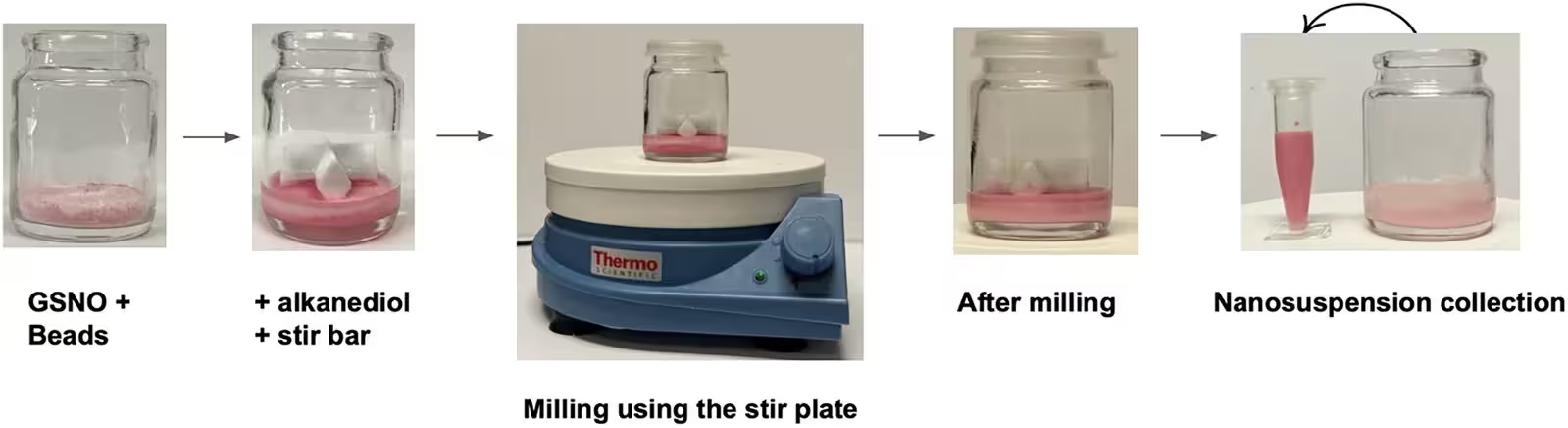
The investigators selected S-nitrosoglutathione as the active agent because it is an endogenous S-nitrosothiol naturally present in the human body, carrying lower toxicity concerns than synthetic alternatives. As-synthesized S-nitrosoglutathione powder typically consists of large particles measuring over ten micrometers across. To reduce this size, the team suspended 100 milligrams of the donor in 1.5 milliliters of chilled liquid alkanediols, such as 1,2-propanediol, alongside eleven grams of yttria-stabilized zirconia milling beads inside a refrigerated setup maintained at four degrees Celsius.
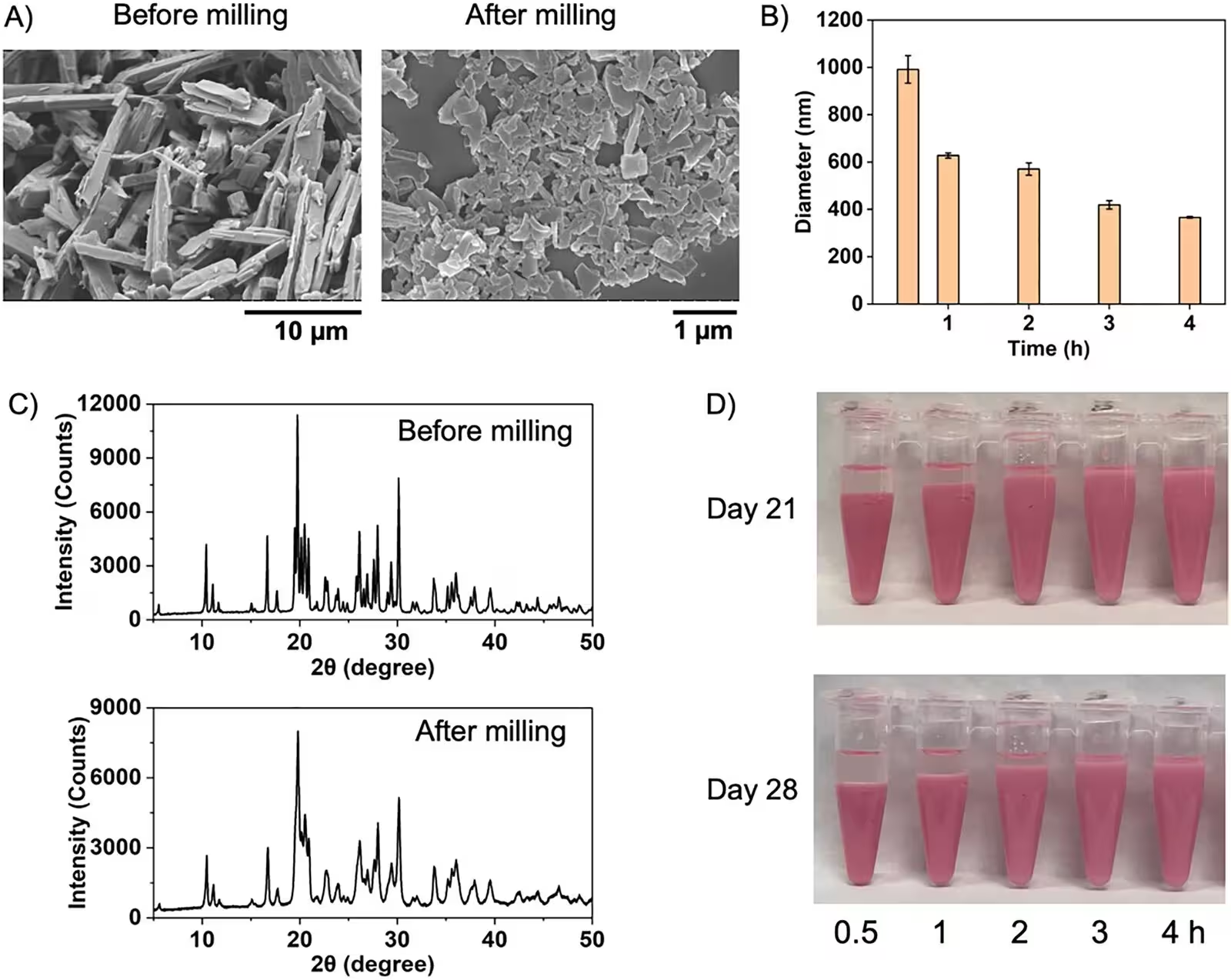
Stirring the mixture magnetically at 500 revolutions per minute for durations ranging from half an hour to four hours generated hydrodynamic particle diameters that decreased from roughly 1,000 nanometers down to approximately 350 nanometers. Powder X-ray diffraction analysis confirmed that the core crystalline phase of the drug remained intact without undergoing full amorphization or solvent-mediated polymorphic transitions during mechanical processing. Because no carrier matrix or surfactant was required, the resulting nanosuspensions achieved an equivalent concentration of 156 millimolar, or 53 milligrams per milliliter, providing an exceptionally high payload compared to traditional polymeric formulations.
Viscous Nonsolvents Protect Against Premature Decomposition
Dissolved nitric oxide donors are notoriously susceptible to trace metal impurities, light, heat, and intermolecular radical-mediated autocatalysis. In contrast, S-nitrosoglutathione maintained in a solid nanocrystalline state within viscous alkanediol nonsolvents exhibited remarkable chemical stability during accelerated storage trials. When stored at room temperature or four degrees Celsius, samples suspended in 1,2-propanediol retained their original pink color and chemical integrity for over 70 days. Formulations prepared in higher-viscosity media such as 1,3-butanediol, 1,5-pentanediol, and polyethylene glycol 200 displayed even greater colloidal stability, showing negligible sedimentation after 15 days at 37 degrees Celsius.
The researchers discovered that release kinetics could be conveniently tuned by introducing small amounts of aqueous phosphate buffer to the alkanediol nanosuspensions. Adding ten to twenty percent buffer initiated controlled dissolution, which accelerated donor decomposition and allowed investigators to tailor the lifetime of the formulation from several days to multiple months depending on clinical requirements.
Combating Bacterial Biofilms in Catheters and Wound Care
To evaluate the biological efficacy of the new platform, the team tested the nanosuspensions against pathogenic bacterial strains including Staphylococcus aureus, methicillin-resistant Staphylococcus aureus, Escherichia coli, and Pseudomonas aeruginosa using agar well diffusion assays. The nanocrystal formulations produced substantial zones of inhibition across all tested strains, outperforming drug-free alkanediol controls. Furthermore, in a simplified three-day central venous catheter model, filling catheter lumens with the S-nitrosoglutathione nanosuspension reduced biofilm bacterial counts by 2.1 to 4.7 orders of magnitude compared to negative controls, demonstrating that continuous nitric oxide generation can effectively suppress device-associated infections and thrombosis.
The research was published in Journal of materials chemistry. B on November 13, 2026.
This article has been fact checked for accuracy, with information verified against reputable sources. Learn more about us and our editorial process.
Last reviewed on .
Article history
- Latest version
Reference(s)
- More, Sayaji., et al. “S -Nitrosoglutathione nanosuspension in alkanediols for controlled release of nitric oxide.” Journal of Materials Chemistry B, January 1, 2026 Royal Society of Chemistry (RSC), doi: 10.1039/d6tb01273f. <https://doi.org/10.1039/d6tb01273f>.
Cite this page:
- Posted by Raj Joshi