Forest Legacies Dictate Future Ecosystem Services More Than Management Choices
A 120-year simulation of a mountain landscape reveals strict trade-offs between timber production and biodiversity, showing that win-win outcomes are limited.

Decades of intensive forestry in a Central European mountain region reveal that managing forests for multiple benefits like timber and wildlife is tightly locked into historical age structures rather than short-term management choices. Researchers analyzing a 120-year landscape model found that roughly half of the variation in forest ecosystem services stems from past management legacies and tree age distribution. The study, published in PLOS One, shows that attempting to maximize everything at once hits hard limits imposed by the current state of the landscape.
How Past Management Controls Future Ecosystem Health
Forests provide numerous services, from timber and clean drinking water to recreational spaces and rich habitats for biodiversity. However, intensive forestry practices over the past century have frequently created even-aged, structurally uniform stands that favor single species like Norway spruce while reducing overall ecological resilience. To understand how future management and climate pressures might alter this balance, Róbert Sedmák and colleagues simulated 1,980 unique scenarios across a 21,255-hectare study area in central Slovakia called Podpoľanie. This mountainous region features elevations ranging from 360 to 1,458 meters, where state-owned forests, communal lands, and conservation areas intersect.
The research team combined an individual-tree growth simulator known as Sibyla with multicriteria evaluation methods. They tracked four core indicators over a 120-year projection horizon: total harvested wood volume, a relative stand density index for soil and water regulation, a composite aesthetic index for recreation, and a structural diversity index for biodiversity. By running decadal simulations that factored in ownership types, management behaviors, vegetation shifts, species conversions, and five levels of climate-driven disturbances, the authors measured which factors exert the strongest influence on the landscape.
The Dominance of Structural Inertia Over Short-Term Choices
The statistical variance decomposition revealed that historical management zoning and forest age-class distribution explain between 40 and 60 percent of total variability in ecosystem services and biodiversity. In contrast, simulated changes in owner behavior, species conversion efforts, and climate disturbances accounted for only minor shares of the observed variation. For wood production, management zoning and age distribution played equal, medium-strength roles. Soil and water regulation and recreation were overwhelmingly driven by age-class distribution, while biodiversity depended primarily on forest management zoning.
Disturbances and temporal progression showed surprisingly weak direct effects on overall landscape variability within the examined timeframe. The authors note that ecosystems exhibit high structural inertia. Because forest stands grow slowly and hold large amounts of standing volume, altering landscape-scale trends requires decades of concerted structural change rather than sudden shifts in management strategy.
Unavoidable Trade-Offs and the Limits of Win-Win Solutions
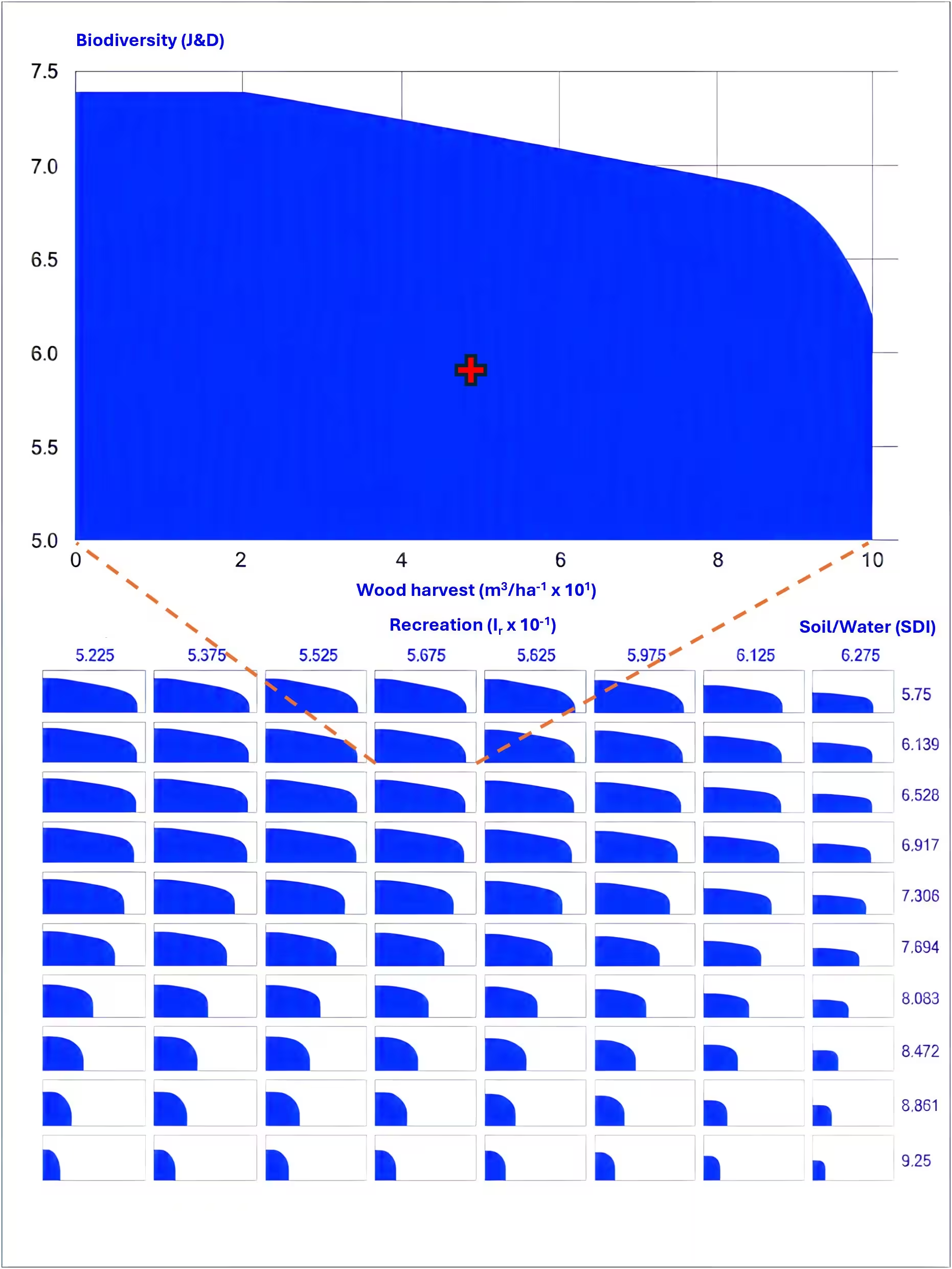
Using four-dimensional interactive decision maps and Edgeworth-Pareto hulls, the team mapped out Pareto frontiers to expose the exact trade-offs between competing objectives. A sharp trade-off emerged between biodiversity and wood production, where higher harvest intensities predictably caused structural homogenization and lower biodiversity scores. Similarly, denser forest stands improved soil protection and water regulation but reduced biodiversity and aesthetic recreation values because uniform, crowded canopies lack vertical and horizontal complexity.
The analysis also demonstrated that total ecosystem service bundles exhibit remarkably low variability across scenarios, staying within a narrow band of 0.75 to 0.81. This stability indicates that win-win outcomes where all services improve simultaneously are largely restricted to landscapes currently stuck in suboptimal states. Once a forest system approaches its multicriteria optimum along the Pareto frontier, further gains in one service inevitably require sacrifices in another.
Important Constraints and Context for Future Policy
These findings carry direct implications for European environmental frameworks that aim to balance biodiversity conservation, climate adaptation, and resource provision. The authors caution that their projections relied on a single moderate climate trajectory and specific indicator definitions, meaning absolute numbers could shift under more extreme climate pathways. Ultimately, the study underscores that meeting modern sustainability goals requires realistic expectations, long-term spatial planning, and deliberate structural restructuring rather than expecting quick fixes from short-term management tweaks.
The research was published in PLOS One on November 16, 2026.
This article has been fact checked for accuracy, with information verified against reputable sources. Learn more about us and our editorial process.
Last reviewed on .
Article history
- Latest version
Reference(s)
- Sedmák, Róbert. “Quantifying biodiversity and ecosystem service trade-offs to inform forest landscape management under changing conditions.” PLOS ONE, vol. 21, no. 11, pp. e0359884, doi: 10.1371/journal.pone.0359884. <https://doi.org/10.1371/journal.pone.0359884>.
Cite this page:
- Posted by William Moore