Researchers Reveal Wildlife And Environmental Reservoirs Fuel Leprosy Transmission, And Why Animal Hosts Challenge Global Eradication Efforts
New findings show wild armadillos, rodents, and ticks carry leprosy bacteria, demanding a One Health approach to stop persistent infections.

Researchers led by Nicole Rodrigues Araujo at Fundação Oswaldo Cruz, known as Fiocruz, have revealed that tackling leprosy requires looking far beyond human patients, as approximately 200,000 new cases continue to emerge globally each year. Despite decades of focused medical treatment, the persistent transmission rates suggest that wild animals and environmental sources play a critical, underappreciated role in maintaining the disease.
How Did Ancient Pathogens Shape Modern Endemic Risks?
Leprosy is caused by slow-growing bacteria, primarily Mycobacterium leprae and the second causative agent, Mycobacterium lepromatosis, which was only identified in 2008. Genomic analyses indicate that Mycobacterium lepromatosis infected individuals in Chile approximately 4,000 years ago, demonstrating an ancient presence on the American continent. Although multidrug therapy has successfully treated millions, about 82% of global cases recorded in 2023 were concentrated in just three countries, namely India, Brazil, and Indonesia, where rural and indigenous communities face higher exposure risks.
What Role Do Armadillos and Other Wildlife Play?
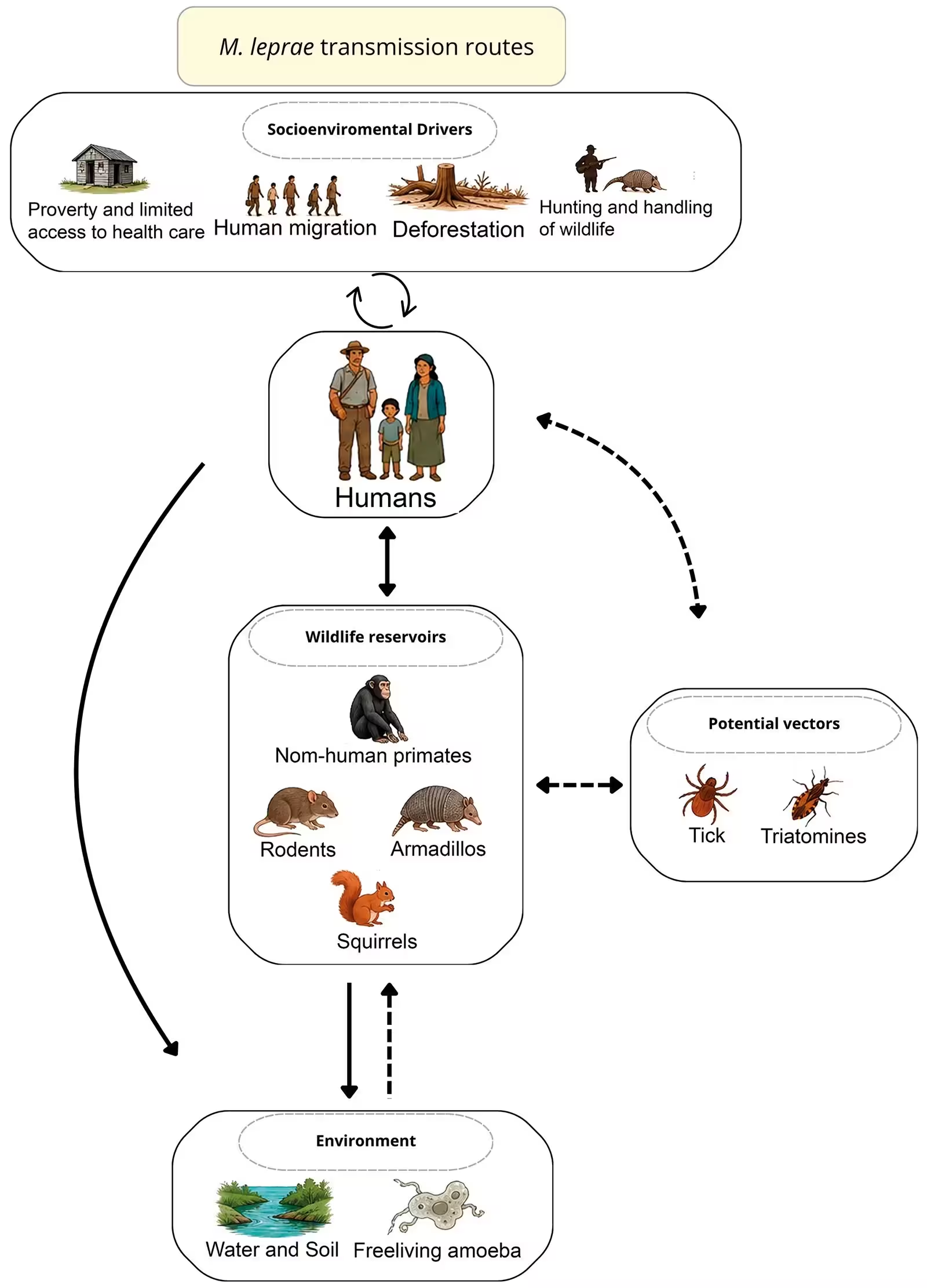
For years, medical science viewed humans as the sole reservoir for the infection, but recent findings point strongly to animal hosts. In countries across the Americas, armadillos such as the nine-banded armadillo, scientifically named Dasypus novemcinctus, frequently carry the bacteria in deforested zones. Studies published in Memorias do Instituto Oswaldo Cruz note that communities hunting or consuming armadillo meat face up to twice the risk of developing leprosy. Beyond armadillos, researchers have detected bacterial DNA in rodents and marsupials in the Brazilian Cerrado and Amazon, as well as in wild chimpanzees in West Africa and red squirrels in the United Kingdom.
Can Soil and Insects Act as Hidden Transmission Routes?
Environmental persistence adds another layer of complexity to disease control. Mycobacterium leprae can survive inside amoebae cysts in moist soil for up to 46 days, maintaining its infectious potential for water and land users. Furthermore, historical hypotheses by leprologist Adolf Lutz suggested that insects could spread the pathogen. While common mosquitoes like Aedes aegypti cannot maintain viable bacteria, recent laboratory experiments demonstrate that certain ticks and triatomine bugs can excrete viable bacilli or produce infective stages.
Why Must Public Health Shift Toward One Health?
Current control programs focus strictly on identifying and treating human patients, which leaves environmental and animal pathways unmonitored. Rapid diagnostic tools, such as portable isothermal amplification devices, could soon allow health workers to screen soil, water, and animal carcasses in remote areas within roughly one hour. The authors emphasize that integrating human, animal, and environmental surveillance through a One Health framework is essential to finally eliminate the disease.
The research was published in Memorias do Instituto Oswaldo Cruz on November 20, 2026.
This article has been fact checked for accuracy, with information verified against reputable sources. Learn more about us and our editorial process.
Last reviewed on .
Article history
- Latest version
Reference(s)
- Araujo, Nicole Rodrigues., et al. “One Health and the ecology of leprosy: the potential role of wildlife, environment, and arthropods in Mycobacterium leprae transmission.” Memórias do Instituto Oswaldo Cruz, vol. 121, no. suppl 1, January 1, 2026 FapUNIFESP (SciELO), doi: 10.1590/0074-02760250304. <https://doi.org/10.1590/0074-02760250304>.
Cite this page:
- Posted by Omar Mirza