Fayetteville State University Researchers Find Common Ape Spinal Trait Challenges Fossil Classification And Locomotion Theories
An anatomical survey of 88 museum skeletons shows that bony ridges on ape lower spines vary too widely to reliably classify ancient primate fossils.
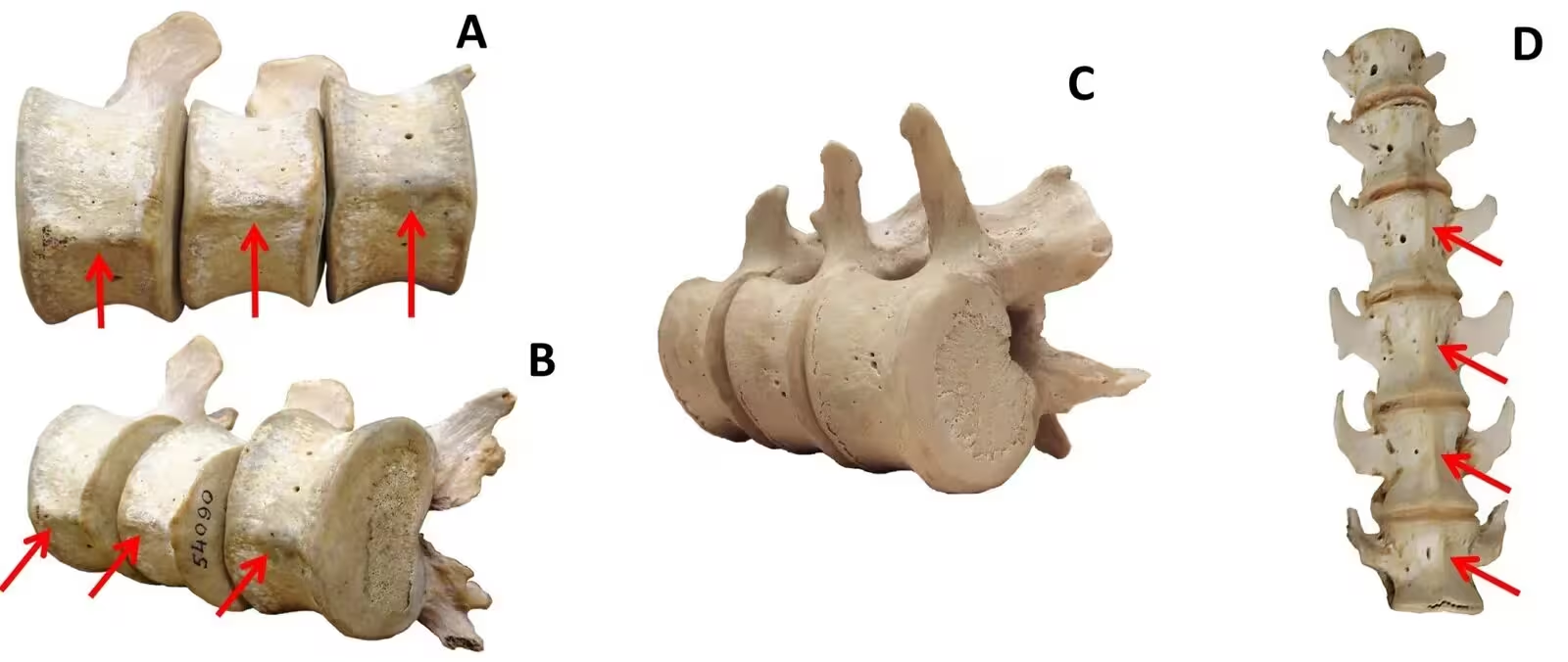
An anatomical analysis of 88 museum skeletons has revealed that bony ridges on the lower spine, long used to classify ancient primate fossils, appear frequently in living apes. Philip Senter from Fayetteville State University examined the lumbar vertebrae of five ape species and found that strong ventral keeling is common across living species, challenging decades of assumptions in paleoanthropology.
For years, researchers studying fossil primates relied on a straightforward rule of thumb. A longitudinal keel, which is a narrow ridge running along the bottom surface of a lower spinal bone, was thought to be a monkey-like trait. In contrast, the absence of this ridge was widely considered an ape-like feature that signaled upright posture and specialized climbing habits. Scientists frequently used this skeletal trait to determine how closely a newly discovered fossil primate resembled modern apes or how it moved through the trees. To test this traditional view, the researcher inspected museum specimens representing hoolock gibbons, Bornean orangutans, chimpanzees, eastern gorillas, and western gorillas, recording the precise physical traits of 327 individual spinal bones.
Why Do Living Apes Have Monkey-Like Bones?
The new investigation, published in PeerJ, discovered that strong spinal keels are far from rare in living apes. Strong ventral keels turned up in 90 percent of the chimpanzees examined and in 67 percent of eastern gorillas. Even among Bornean orangutans and western gorillas, strong keels appeared in 27 percent and 20 percent of specimens, respectively. Hoolock gibbons also frequently displayed the feature, with strong keels appearing in 50 percent of the individuals in that group. When keels were present, they typically appeared near the middle of the lower spinal series rather than at the ends.
Does Body Size Or Sex Explain Spinal Differences?
The study also tested whether these bony ridges relate to the sex of the animal or the physical size of its bones. By sorting the vertebrae into distinct size classes and separating them by sex, the author looked for clear patterns. The analysis showed that no single character state mapped exclusively to any particular size class. Furthermore, roughly half of the vertebrae from male apes and half from female apes featured strong keels, showing no statistical preference for sex. Captivity also failed to explain the variation, as captive specimens displayed roughly the same distribution of spinal features as wild-born animals.
What This Means For Tracing Primate Evolution
These findings suggest that anthropologists should exercise extreme caution when using lower spinal traits to reconstruct the past. Because the ridges vary wildly both within individual apes and across entire species, their absence cannot be called uniquely ape-like, nor can their presence be dismissed as strictly primitive. Including such a highly variable trait in computerized evolutionary trees risks obscuring true relationships rather than clarifying them. Consequently, the author suggests omitting spinal ventral keeling from anatomical data matrices used to determine primate lineages.
Can Spine Shape Reveal How Ancient Apes Walked?
The widespread presence of keels across living apes also undercuts their use as indicators of specific locomotor styles. Because animals that practice quadrumanous climbing, which means moving through branches using all four limbs while maintaining an upright torso, possess such varying spine shapes, the trait cannot reliably predict how an extinct species moved. While preliminary comparisons hint that eastern gorillas might show higher keeling prevalence than western gorillas, small sample sizes mean researchers will need larger datasets to confirm any subtle differences between closely related species.
The research was published in PeerJ on November 22, 2026.
This article has been fact checked for accuracy, with information verified against reputable sources. Learn more about us and our editorial process.
Last reviewed on .
Article history
- Latest version
Reference(s)
- Senter, Philip J.. “Ventral keeling in the lumbar vertebrae of extant apes: intraspecific variation and its implications for studies of fossil primates.” PeerJ, vol. 14, November 22, 2026, pp. e21992 PeerJ, doi: 10.7717/peerj.21992. <https://doi.org/10.7717/peerj.21992>.
Cite this page:
- Posted by Michael Ellison