Researchers Biosynthesize Zinc Oxide Zeolite Nanocomposites With 92 Percent Dye Degradation And Potent Antibacterial Activity
Plant-derived zinc oxide anchored on porous mineral frameworks achieves high photocatalytic breakdown of industrial dyes and inhibits pathogenic bacteria.
Plant extracts from household greenery could soon help clean up toxic industrial wastewater, as researchers successfully create sustainable zinc oxide nanoparticles and anchor them inside porous mineral structures.
Industrial textile and printing operations release massive quantities of synthetic dyes into global waterways every year. Methylene blue, a common cationic thiazine dye found in industrial effluent, poses severe risks to aquatic life and human health through skin irritation, respiratory distress, and nervous system complications. Conventional wastewater treatments such as physical adsorption or chemical coagulation often produce secondary solid sludges, require expensive chemical additives, and fail to completely destroy the harmful compounds. Researchers are therefore turning toward semiconductor photocatalysis, a technique that uses light-activated materials to break down refractory pollutants into harmless byproducts without generating toxic waste.
How Do Plant Extracts Shape Nanoparticle Performance?
Led by Muhammad Sarwar Hossain and colleagues from Khulna University, the research team utilized leaf extracts from Pilea peperomioides (commonly known as the Chinese money plant) and Eragrostis tenella to biosynthesize zinc oxide nanoparticles. Plant secondary metabolites such as polyphenols, flavonoids, and alkaloids act as natural reducing and capping agents during nanoparticle nucleation. This eco-friendly method avoids the toxic chemical precursors and high temperatures typically required by conventional synthetic pathways. The resulting zinc oxide nanoparticles, designated as P-ZnO and E-ZnO, were subsequently immobilized onto a synthesized SGU-29 zeolite framework, forming stable nanocomposites that prevent particle agglomeration and enhance catalytic surface area.
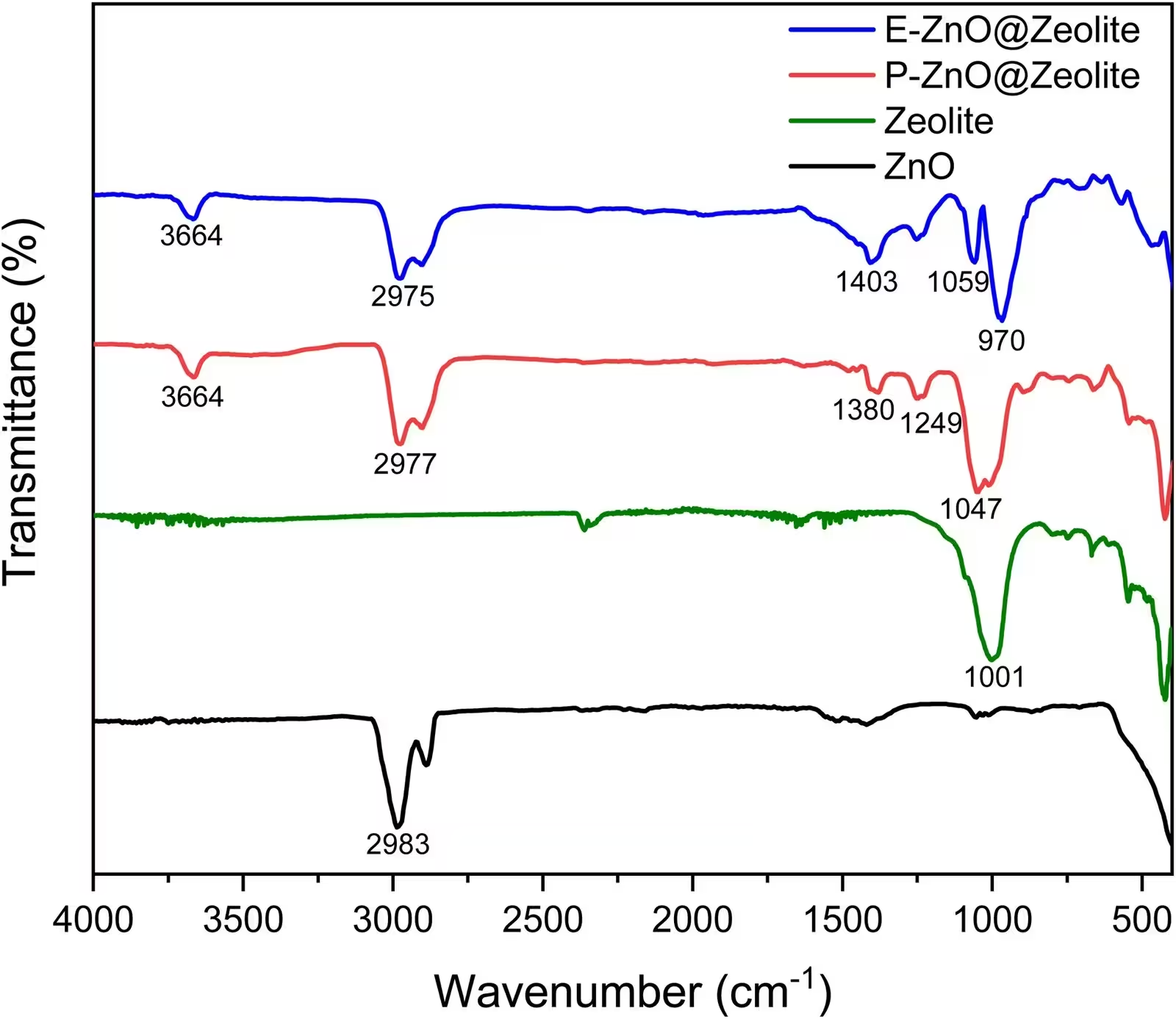
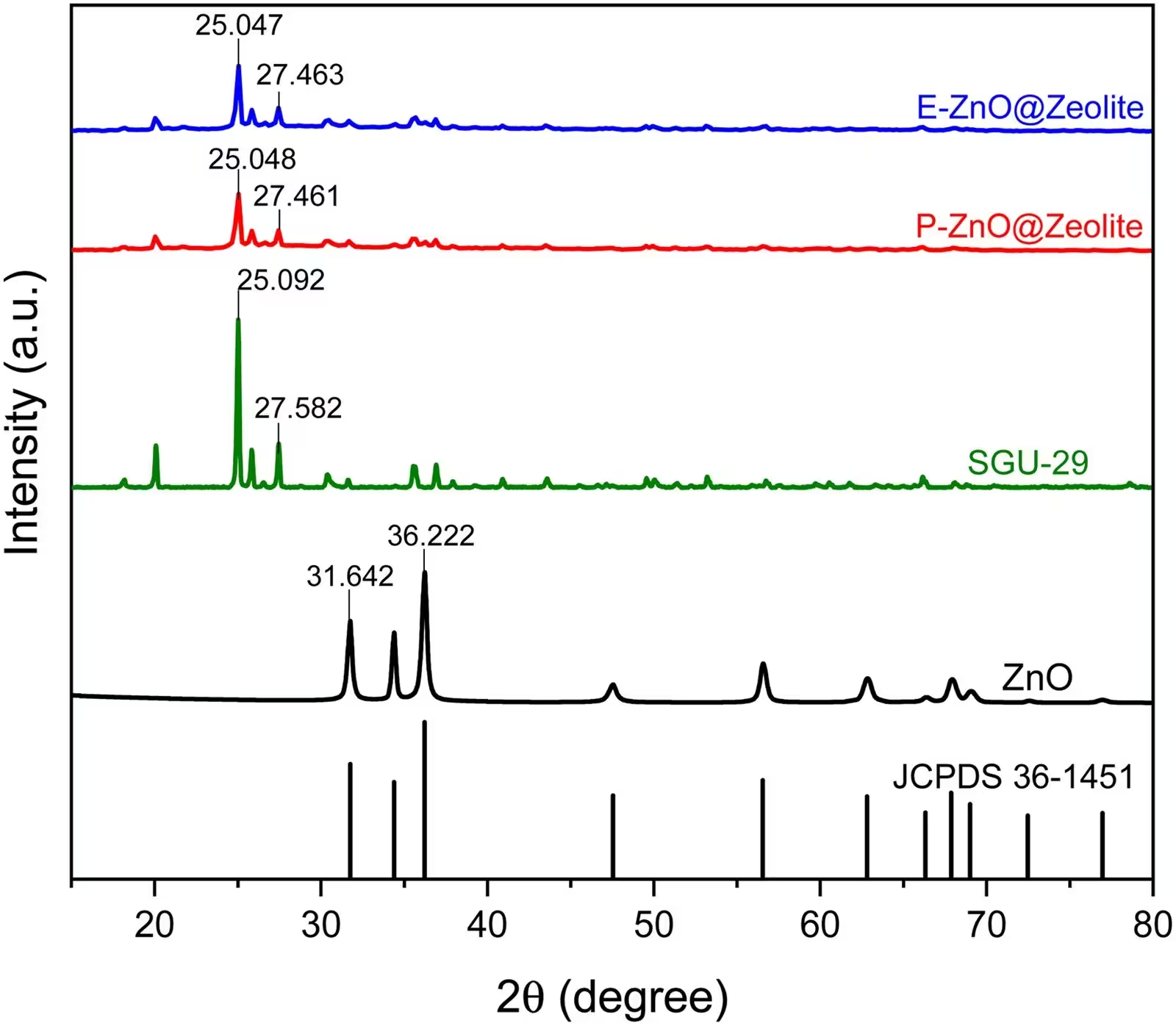
Detailed material characterizations, published in RSC Advances, confirmed the successful integration of the mineral supports. Powder X-ray diffraction patterns verified that the crystalline wurtzite structure of the zinc oxide and the structural integrity of the SGU-29 zeolite remained intact following combination. Scanning electron microscopy revealed that anchoring the nanoparticles onto the porous aluminosilicate framework significantly reduced particle aggregation compared to unsupported zinc oxide, yielding average particle sizes of 39 nanometers for the P-ZnO composite and 44 nanometers for the E-ZnO version. Nitrogen adsorption measurements demonstrated that the zeolite-supported composites retained specific surface areas exceeding 270 square meters per gram, representing an eleven-fold improvement over unsupported zinc oxide nanoparticles.
Which Nanocomposite Cleans Dyes Most Efficiently?
The catalytic performance of the newly developed materials was tested through the photocatalytic degradation of methylene blue under simulated irradiation. While pristine zeolite and unsupported zinc oxide showed limited removal efficiencies, the zeolite-supported nanocomposites achieved dramatic improvements. Under optimized conditions, the Eragrostis tenella derived composite (E-ZnO@zeolite) degraded 92.6 percent of the dye at a catalyst dosage of 3 milligrams per 50 milliliters. The porous zeolite matrix acts as an adsorptive micro-reservoir that pre-concentrates dye molecules near the photoactive zinc oxide centers, accelerating the destruction of the chemical chromophore.
Can These Materials Withstand Repeated Industrial Use?
Reusability remains a critical benchmark for practical water purification technologies, as many traditional catalysts lose efficiency quickly due to fouling and particle loss. The researchers evaluated the stability of the zeolite composites across 4 consecutive degradation cycles without thermal regeneration. The E-ZnO@zeolite material maintained a high degradation efficiency of 78 percent after the fourth cycle, suffering a loss of only 8.2 percentage points. This durability stems from the porous zeolite framework protecting the zinc oxide crystallites from photocorrosion and continuously in-situ degrading surface-adsorbed species to regenerate active sites.
Do These Green Composites Fight Pathogenic Bacteria?
Beyond wastewater remediation, the team tested the multifunctional biological properties of the nanocomposites against reference bacterial strains, including Staphylococcus aureus and Escherichia coli. Using an agar well diffusion assay, the researchers observed clear zones of inhibition that expanded with increasing sample concentrations. At a concentration of 4 milligrams per milliliter, the E-ZnO@zeolite composite produced the largest inhibition zone of 19.33 millimeters against Staphylococcus aureus. Minimum inhibitory concentration and minimum bactericidal concentration assays further demonstrated strong bactericidal activity, with low ratios indicating that the combination of plant-derived phytochemicals, zinc oxide, and the zeolite support creates a potent antimicrobial platform against both Gram-positive and Gram-negative pathogens.
The research was published in RSC advances on November 25, 2026.
This article has been fact checked for accuracy, with information verified against reputable sources. Learn more about us and our editorial process.
Last reviewed on .
Article history
- Latest version
Reference(s)
- Mitu, Jannatul Ferdous., et al. “Comparative phytochemical-assisted synthesis of ZnO@zeolite nanocomposites for multifunctional environmental and antibacterial applications.” RSC Advances, January 1, 2026 Royal Society of Chemistry (RSC), doi: 10.1039/d6ra08065k. <https://doi.org/10.1039/d6ra08065k>.
Cite this page:
- Posted by Rohan Kumar