How Random Environmental Noise Triggers Hidden Extinction Cascades in Complex Food Webs
A new mathematical framework reveals that ecosystems unravel through precise, sequential pathways rather than simultaneous collapse.
Even stable ecosystems with plenty of resources will eventually collapse due to the random fluctuations of everyday births, deaths, and hunting events. Researchers have long struggled to map out how multi-species food webs unravel because populations do not usually vanish all at once, instead following complex chains of partial extinctions. A team of scientists has now developed a mathematical framework that charts these invisible pathways, revealing the exact routes communities take before complete ruin.
To understand how complex webs fall apart, the researchers focused on hierarchical food webs of arbitrary size where a basal species reproduces on its own and every consumer preys on any species ranked below it. Writing in the preprint server arXiv, Varun Nevash from the University of Pennsylvania, alongside Eric Forgoston and M. Ani Hsieh, published in arXiv a large-deviation theory using Wentzel-Kramers-Brillouin analysis to decode how demographic noise drives species to extinction. By examining the master equations governing population probabilities, the authors found that systems with three or more interacting species generate vast extinction networks whose pathways depend on specific structural rules.
How Does Random Demographic Noise Trigger a Cascade of Extinctions?
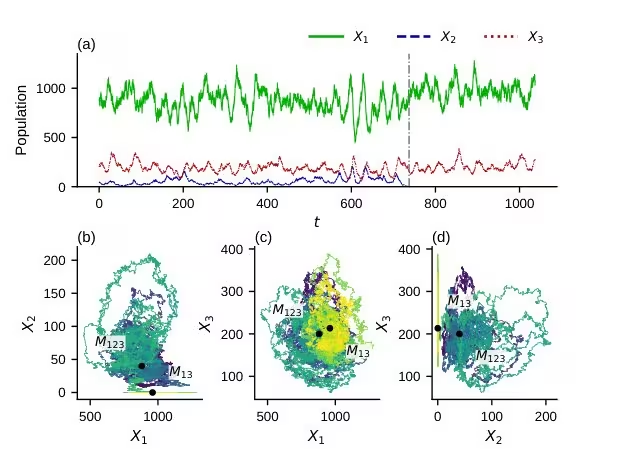
In ecology, small populations face immediate threats from random demographic variations, but large communities can maintain a stable coexistence state for extremely long periods. An unusually massive fluctuation is required to push a stable community across a barrier into extinction. When looking at three-species omnivory modules, where two consumers compete for a single basal species while the apex predator also consumes the intermediate species, the authors discovered that extinction is rarely simultaneous. Instead, it follows a strict sequence governed by the stability boundaries of the community.
The mathematical model demonstrates that every partial community acts as a saddle point in phase space, maintaining stability within its own extinction hyperplane until a rare fluctuation triggers a transition. For a three-species system containing a basal species, an intermediate consumer, and an apex predator, the network contains nine distinct transition paths. The research reveals that the intermediate species, sitting closest to its feasibility boundary, is almost always lost first. Once that consumer vanishes, the system transitions to a simpler two-species state before the final collapse.
What Role Do Trophic Links Play in Preventing Ecosystem Collapse?
The structure of the food web dictates its ultimate survival time, and removing even a single predatory connection radically reshapes the entire extinction network. When the authors evaluated reduced topologies by deleting specific trophic links, the stability dynamics shifted entirely. Eliminating the omnivorous link turns the system into a standard food chain with six transitions, while removing the intermediate species’ food source collapses the community into a basic predator-prey setup.
The study highlights that the basal species alone acts as the most persistent state in the entire network, boasting an action barrier that exceeds every other pathway by a factor of two or more. Consequently, the mean time to total extinction is almost entirely dominated by the residence time of the basal species surviving on its own after all consumers have vanished. Stochastic simulations confirm that real populations follow these predicted trajectories closely, spending extended periods fluctuating near stable states before sudden, noise-driven exits seal their fate.
The study was posted to the arXiv preprint server on November 25, 2026.
This article has been fact checked for accuracy, with information verified against reputable sources. Learn more about us and our editorial process.
Last reviewed on .
Article history
- Latest version
Reference(s)
- Nevash, Varun. “Noise-induced Extinction in Hierarchical Food Webs.” arXiv.org <http://arxiv.org/abs/2611.33569v1>.
Cite this page:
- Posted by Omar Mirza