Active Liquid Crystals Reveal How Living Matter Organizes Chaos
Physicists review how active soft matter utilizes topological defects and internal energy to drive biological morphogenesis and chaotic flows.
Living materials possess a remarkable ability to consume internal energy and perform complex biological tasks out of equilibrium. A comprehensive review published in arXiv by researchers Livio Nicola Carenza, Giuseppe Negro, and Adriano Tiribocchi details how physicists model these soft biological systems using the framework of active liquid crystals. By converting chemical energy stored in molecules into mechanical work, biological matter drives phenomena ranging from bacterial biofilm formation to animal morphogenesis and tissue repair.
How Active Soft Matter Defies Equilibrium Thermodynamics
Unlike classical equilibrium soft matter that evolves solely to minimize thermodynamic potentials, active systems constantly expend energy to sustain collective motion. This active matter encompasses diverse scales, from microscopic cytoskeletal filaments and bacterial colonies to macroscopic schools of fish and human crowds. At the heart of modeling these systems is the transition from individual particle tracking to mesoscopic coarse-grained fields, which capture orientational symmetries like polar, nematic, and hexatic order.
Topological Defects As Organizers of Living Architecture
The local alignment of active units frequently breaks down at specific points known as topological defects or disclinations, where orientation becomes undefined. The authors report that these defects are not merely flaws but active organizing centers in biology. For instance, in epithelial cell sheets, positive half-integer defects correlate strongly with apoptotic cell extrusion, a process where dying cells are pushed out of a tissue layer. Similarly, in early-stage regeneration of the freshwater organism Hydra, topological defects in actin fiber organization mark the exact future sites of the animal mouth and foot.
The Onset of Active Turbulence and Chaos
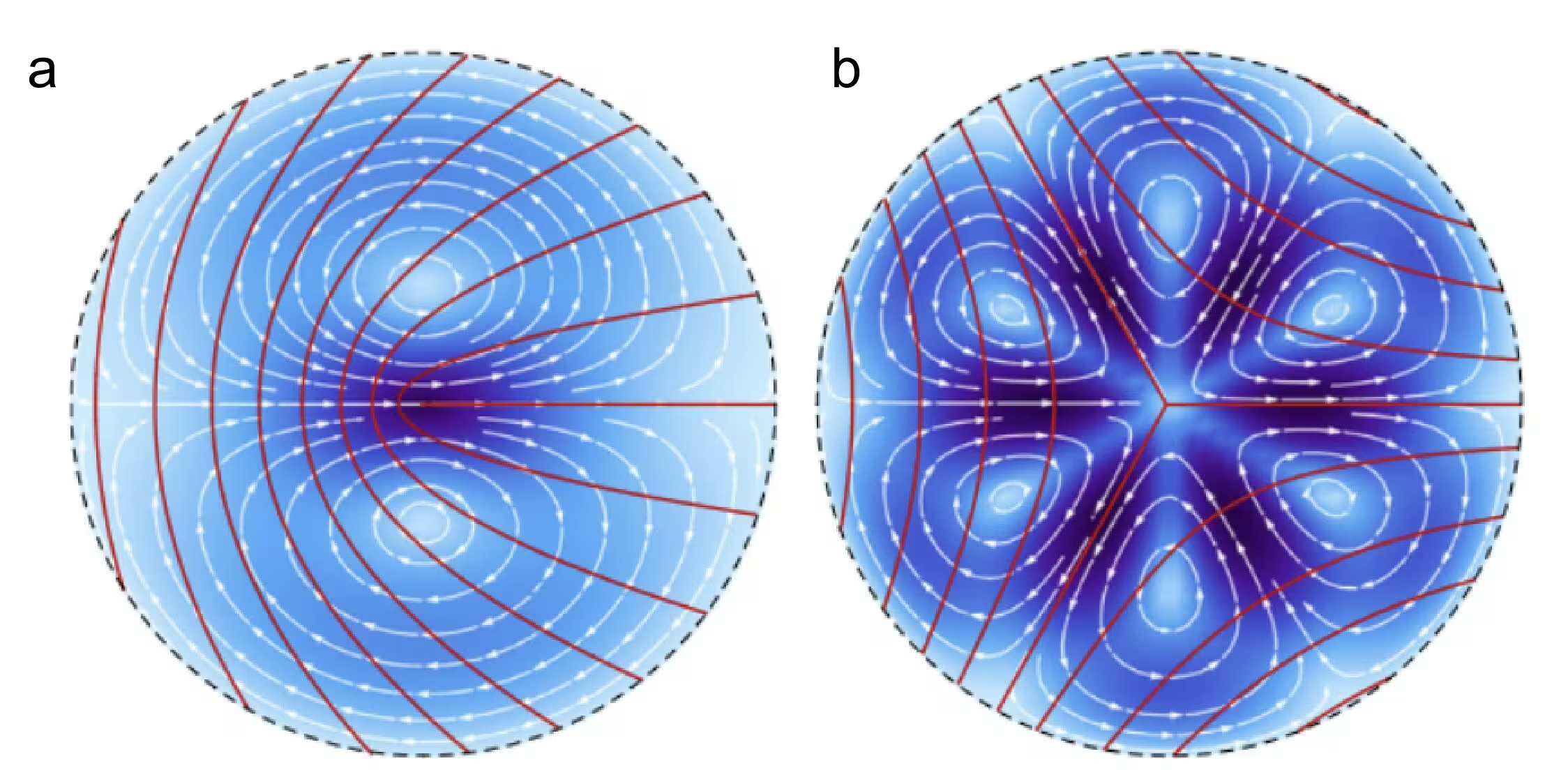
When internal energy injection increases significantly, active liquid crystals can enter a chaotic state known as active turbulence. This regime features swirling patterns, vortices, and continuous proliferation through the unbinding of topological defect pairs. As detailed in the review, active turbulence occurs at very low Reynolds numbers where traditional nonlinear advective effects are negligible, meaning the chaos is driven by a delicate balance between active stress injection and viscous dissipation.
Controlling Chaos Through Geometry and Confinement
To harness active systems for technological applications such as soft robotics and targeted drug delivery, researchers explore methods to tame active turbulence. Confinement in microchannels or circular disks alters defect dynamics significantly, shifting systems from chaotic flows to ordered vortex lattices or dancing disclination states. Furthermore, topological constraints imposed by curved surfaces, such as spherical active shells, guide defect stabilization and drive out-of-plane buckling deformations that generate complex biological shapes.
The study was posted to the arXiv preprint server on November 19, 2026.
This article has been fact checked for accuracy, with information verified against reputable sources. Learn more about us and our editorial process.
Last reviewed on .
Article history
- Latest version
Reference(s)
- Carenza, Livio. “Soft biological and bio-inspired materials.” arXiv.org <http://arxiv.org/abs/2611.25959v1>.
Cite this page:
- Posted by Anjali Singh