Researchers Test Optical Scanning On 30 Corn Seeds To Detect Agrochemical Treatments, And Find Surprising Pigment Effects
Photoacoustic spectroscopy reveals distinct optical fingerprints for coated and uncoated corn varieties, though natural pigments complicate chemical screening.

Researchers analyzed 30 independent corn seeds using photoacoustic spectroscopy to test whether optical scanning can distinguish between untreated kernels and those coated with commercial agrochemical formulations.
Modern agricultural practices frequently coat hybrid corn seeds with formulations containing insecticides, fungicides, polymers, and color dyes to protect seedlings during early development. Monitoring these seed coatings is essential for quality control and traceability, but standard laboratory techniques like chromatography require complex sample preparation and chemical reagents. Optical methods offer a faster alternative, though measuring opaque agricultural materials remains challenging because conventional transmission instruments struggle with strongly scattering surfaces. Photoacoustic spectroscopy overcomes this hurdle by detecting acoustic waves generated when a sample absorbs modulated light and undergoes non-radiative thermal relaxation, making it well-suited for heterogeneous solid matrices. In this study published in Food Biophysics, Sindy Janneth Olvera Vazquez and colleagues at their institution evaluated the photoacoustic response across 6 different corn varieties.
How Do Untreated And Treated Seeds Compare Optically?
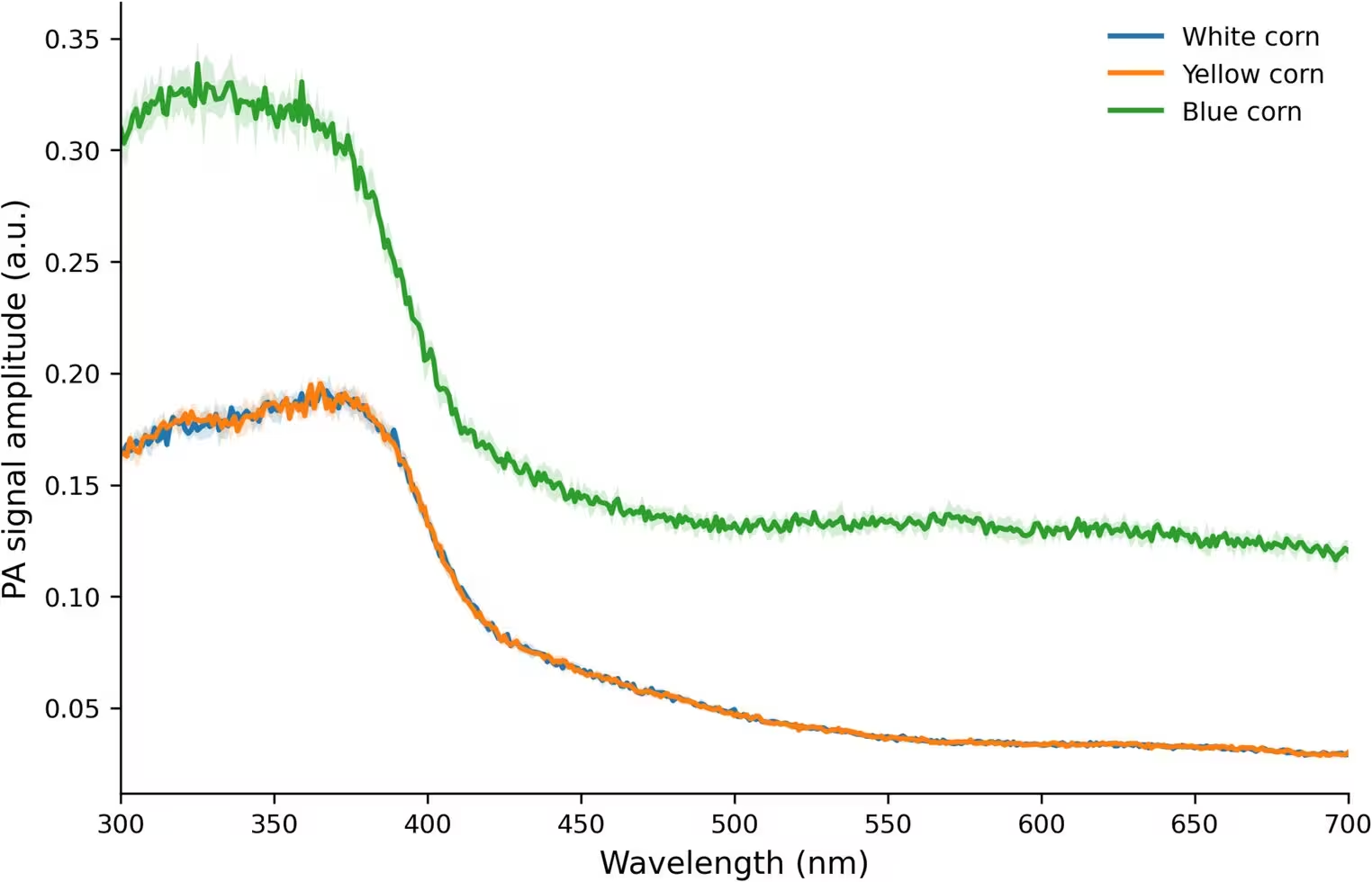
The team examined 3 untreated corn types, consisting of white, yellow, and blue varieties, alongside 3 commercially treated hybrids known as CB-28, PW-404, and Teniente. Five independent seeds were tested for each group, yielding 30 spectral profiles across the 300 to 700 nanometer wavelength range. The optical absorption spectra revealed that white and yellow untreated corn shared nearly identical profiles, while untreated blue corn exhibited a markedly higher photoacoustic signal due to its natural anthocyanin and flavonoid pigmentation.
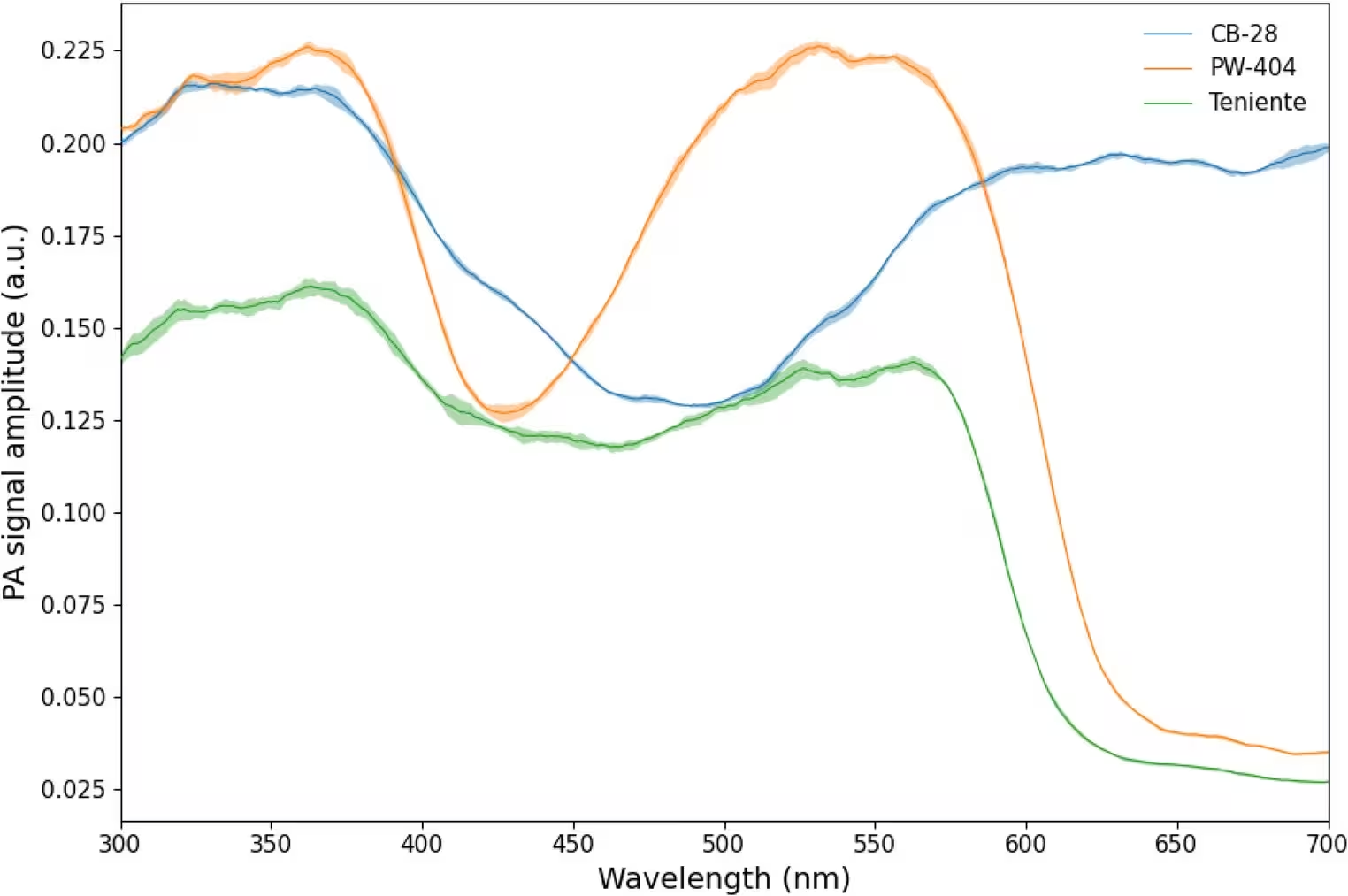
The commercially treated seeds also showed distinct spectral curves, influenced heavily by the color of their respective coatings. While PW-404 and Teniente featured pink coatings and displayed specific absorption peaks near 530 nanometers, CB-28 possessed a blue-purple coating that drove higher signal amplitudes at longer wavelengths past 590 nanometers. Phase-resolved analysis further separated overlapping signals from the waxy pericarp layer and the coating additives, though the researchers emphasize that these broad profiles represent overall optical fingerprints rather than the identification of specific active chemical ingredients.
What Does Chemometric Modeling Reveal About Variance?
To quantify these optical patterns, the authors applied principal component analysis to mean-centered spectral data from all 30 seeds. The first three principal components accounted for 99.3% of the total spectral variance in the dataset. Specifically, PC1 captured 64.2% of the variance, while PC2 accounted for 23.5%.
Score plots demonstrated compact clustering for each corn type, confirming high measurement reproducibility across independent seeds. Untreated blue corn formed a distinct cluster away from the overlapping white and yellow samples, highlighting how natural pigmentation strongly shapes the multivariate optical structure. The team also used the Rosencwaig-Gersho model with an adopted thermal diffusivity value of 2.4 x 10⁻⁴ square centimeters per second for raw corn pericarp to calculate the optical absorption coefficient and optical penetration length for each seed.
Can Machine Learning Accurately Classify Seed Treatments?
An exploratory linear discriminant analysis using the principal component scores was trained to classify the seeds into treated and untreated categories. When subjected to internal cross-validation schemes, the model correctly classified all 30 out of 30 withheld spectra, achieving 100% accuracy in both leave-one-seed-out and leave-one-corn-type-out tests.
However, the authors caution that these high classification accuracies do not validate a universal detector for commercial seed treatments. Because the untreated reference varieties were not genetically matched with the treated hybrids, treatment status is currently confounded with genotype, background pigmentation, and natural matrix differences. Furthermore, the physical protocol required removing the outer pericarp layer from each seed, meaning the current setup is not non-destructive at the whole-seed level.
What Are The Limitations And Future Directions?
The optical parameters estimated in this work remain model-based comparative estimates rather than absolute physical constants, because sample-specific thickness and individual thermal properties were not directly measured. Commercial seed coatings represent complex mixtures containing binders, solvents, polymers, and active pesticide compounds that cannot be individually isolated through photoacoustic spectra alone. Future research must incorporate genetically matched treated and untreated hybrid pairs, larger independent seed lots, and whole-seed measurement protocols to establish whether photoacoustic screening can reliably isolate chemical treatments from natural biological variability.
The research was published in Food Biophysics on November 27, 2026.
This article has been fact checked for accuracy, with information verified against reputable sources. Learn more about us and our editorial process.
Last reviewed on .
Article history
- Latest version
Reference(s)
- Vazquez, Sindy Janneth Olvera., et al. “Photoacoustic Spectroscopy for Optical Discrimination of Commercially Treated and Untreated Corn Seeds.” Food Biophysics, vol. 21, no. 4, November 27, 2026 Springer Science and Business Media LLC, doi: 10.1007/s11483-026-10249-y. <https://doi.org/10.1007/s11483-026-10249-y>.
Cite this page:
- Posted by Anjali Singh