Researchers Find Heated Hand Veins Match Arterial Blood Gas Tests Only At High Altitude
Warming hands in hot water for 25 minutes successfully tracks blood oxygen levels during high-altitude research expeditions.
Researchers warming hands in 45°C water found that heated venous blood matched direct arterial samples at an altitude of 3,800 meters, offering a simpler way to track blood gases.
Measuring oxygen and acid levels in the blood usually requires sticking a needle directly into an artery, which is painful, technically demanding, and difficult to perform in remote field research. To bypass this, scientists use a technique called venous arterialization, where a hand is warmed in a hot water bath to open tiny blood vessels called cutaneous arteriovenous anastomoses that let arterial blood flow past inactive tissues and into superficial hand veins. While this method is well studied at sea level, researchers did not know if it would work reliably during hypobaric hypoxia, a condition of low oxygen pressure caused by high altitude.
How Warming Hand Veins Changes Oxygen Readings
Jessica Kenney and her colleagues at the University of Windsor tested 15 healthy adults at sea level and 11 of those same participants 2 months later at the Barcroft White Mountain Research Station in California. The team placed catheters in both a brachial artery in the arm and a dorsal hand vein, then immersed the hand in a 45°C water bath using an Anova culinary heater for 25 minutes. Blood samples were drawn simultaneously before and after the heating period, then analyzed immediately using an ABL90 FLEX blood gas analyzer at a standard temperature of 37°C. As published in Experimental Physiology, the researchers evaluated the agreement between arterial and heated venous measurements using Bland-Altman statistical analyses and equivalence testing.
Why High Altitude Changes Blood Gas Agreement
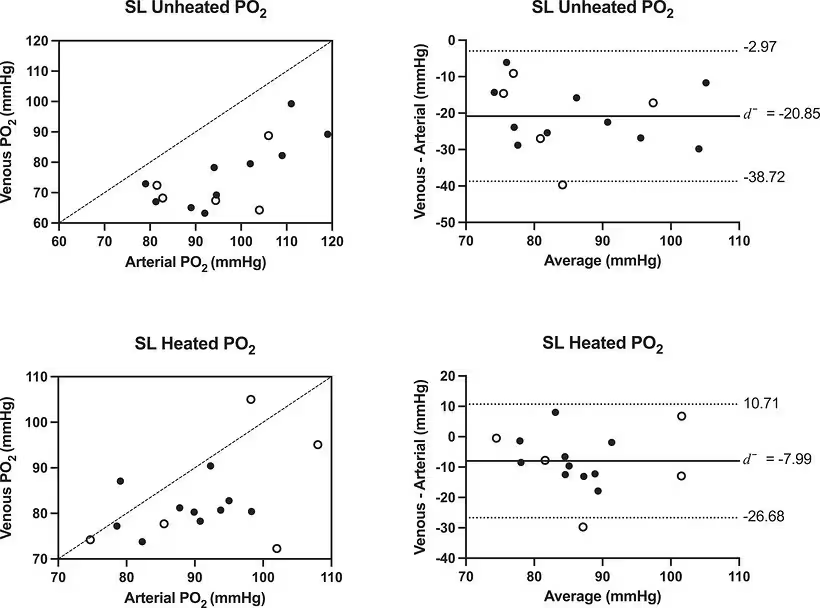
At sea level, warming the hand narrowed the gap between arterial and venous oxygen pressure, dropping the mean bias from -20.85 mmHg down to -7.99 mmHg. However, this difference still remained outside the researchers’ pre-established equivalence margin of 5 mmHg. At high altitude, where baseline arterial oxygen levels dropped from a sea level average of 96 mmHg down to 58 mmHg, hand heating reduced the mean bias to just -0.98 mmHg. Statistical tests confirmed that the heated venous oxygen pressure was equivalent to direct arterial pressure only at high altitude.
What Happens to Other Blood Markers
Beyond oxygen tension, the team analyzed carbon dioxide, pH, bicarbonate, oxygen saturation, glucose, and lactate levels. Agreement for carbon dioxide, pH, and metabolic markers was generally good across all conditions regardless of whether the hand was heated. For oxygen saturation, hand heating successfully improved agreement at both sea level and high altitude, narrowing the limits of agreement and reducing the measurement bias.
Why This Technique Works Better on Mountains
The researchers note that the improved oxygen agreement at high altitude is likely tied to the shape of the oxyhaemoglobin dissociation curve. At high elevations, lower oxygen pressures place blood on a steeper part of the curve, meaning that small changes in oxygen saturation correspond to much smaller absolute differences in oxygen pressure. This physiological shift means that heated hand veins closely mirror arterial blood gas values during high-altitude climbs even if the physical arterialization process itself remains similar to sea level conditions.
The research was published in Experimental physiology on November 27, 2026.
This article has been fact checked for accuracy, with information verified against reputable sources. Learn more about us and our editorial process.
Last reviewed on .
Article history
- Latest version
Reference(s)
- Kenney, Jessica N.., et al. “WM‐S25: Validation of heated‐hand venous arterialization at sea level and high altitude.” Experimental Physiology, November 27, 2026 Wiley, doi: 10.1113/EP093946. <https://doi.org/10.1113/EP093946>.
Cite this page:
- Posted by Hassan Raza