New AI Model Emulates Complex Molecular Dynamics And Protein Folding At Breakthrough Speeds
BioEmu2 combines structure prediction and equilibrium sampling to simulate biomolecular motions orders of magnitude faster than conventional molecular dynamics.
Proteins, DNA, and RNA undergo continuous internal motions and binding interactions to drive biological function, yet mapping these physical dynamics has traditionally required exhaustive computer simulations. A team of researchers led by Frank Noé at Microsoft has introduced a generative artificial intelligence model called BioEmu2, which models atomically resolved biomolecular structures and dynamic trajectories orders of magnitude faster than conventional molecular dynamics simulations.
The new model unifies static structure prediction, room-temperature equilibrium sampling, and time-resolved propagation into a single framework. As detailed in a study published on the arXiv preprint server, the system can handle complex multi-component molecular assemblies containing proteins, nucleic acids, ligands, ions, and modified residues at heavy-atom resolution.
How Does BioEmu2 Accelerate Molecular Dynamics?
Traditional molecular dynamics simulations solve physics equations step by step at femtosecond intervals, making long conformational changes and binding events computationally expensive to observe. BioEmu2 bypasses these intermediate computational steps by directly sampling target distributions and using an implicit transfer operator framework to propagate molecular structures forward over arbitrary time intervals. The architecture separates biological reasoning in a sequence trunk from coordinate generation in a diffusion-based structure module.
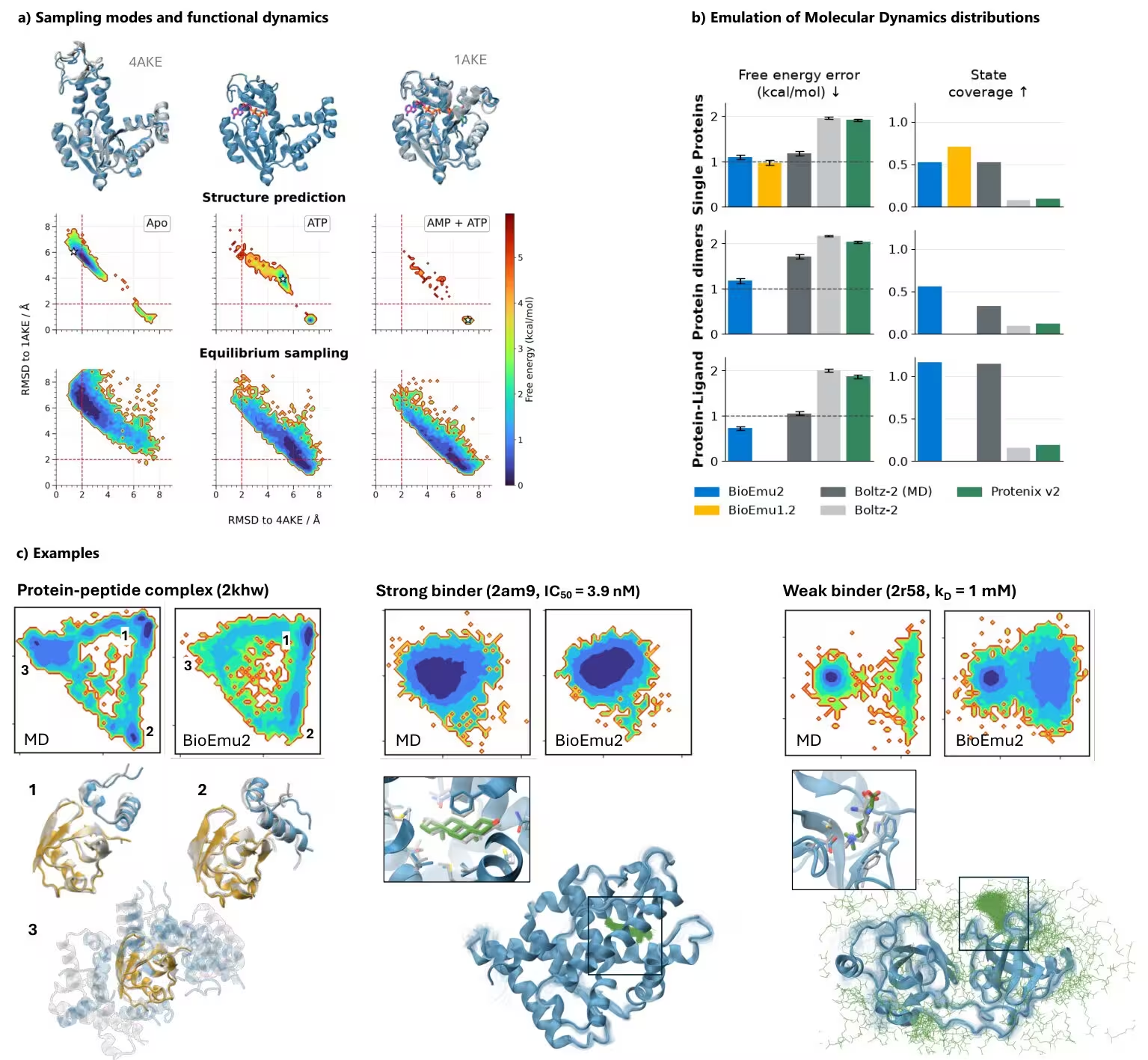
To evaluate the model, the authors tested its ability to emulate molecular dynamics across single proteins, protein dimers, and protein-ligand systems. The results indicate that BioEmu2 captures approximately fifty percent of the conformational states found in standard simulations for proteins and protein complexes, and over one hundred percent for protein-ligand systems, while maintaining free energy errors between 0.7 and 1.2 kilocalories per mole across tested benchmarks.
Can the AI Predict Complex Protein Folding and Binding Pathways?
The research team tested the time-propagation mode on challenging biological events, such as ligand-coupled domain closure in adenylate kinase and the coupled folding and binding of the intrinsically disordered protein PUMA to MCL-1. When simulating adenylate kinase with added substrates, about forty percent of independent trajectories closed into the active state within 50 microseconds. For the PUMA and MCL-1 system, 78 percent of 500 emulated trajectories successfully bound, with many passing through a non-native helical intermediate before snapping into the correct register.
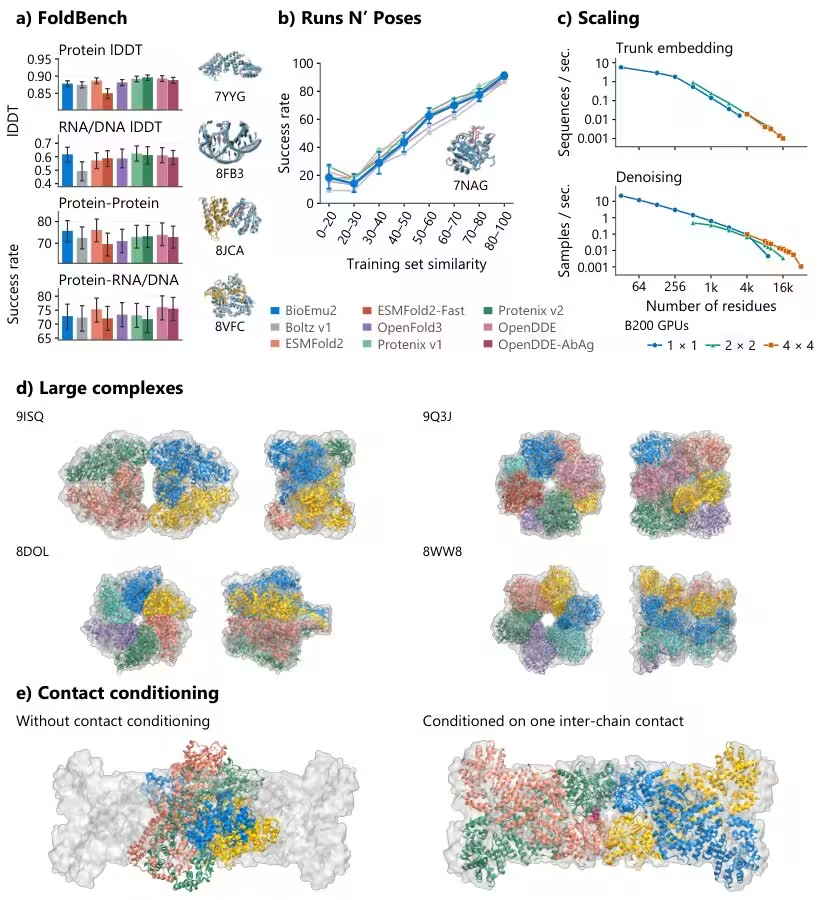
To manage extremely large macromolecular assemblies, the model incorporates a context parallelism mode that distributes pair representations across multiple graphics processing units. This capability enabled the team to successfully perform inferences on massive multimeric complexes containing over 5,000 residues, such as protein assemblies spanning thousands of atoms.
What Are the Current Limitations of the Model?
Despite its impressive computational speedups, the authors note several limitations in the current release. Nearly all the dynamics training data came from simulations lasting up to one microsecond, meaning predictions for slower processes such as long-timescale binding, dissociation, or large unfolding events require independent experimental validation. Furthermore, while physics-informed steering and enhanced sampling techniques successfully reduced unphysical polymer clashes and improved rare state coverage, the underlying generative framework remains an approximation of physical reality rather than an exact thermodynamic proof.
The study was posted to the arXiv preprint server on November 20, 2026.
This article has been fact checked for accuracy, with information verified against reputable sources. Learn more about us and our editorial process.
Last reviewed on .
Article history
- Latest version
Reference(s)
- Gastegger, Michael. “BioEmu2: Scalable Emulation of Biomolecular Dynamics.” arXiv.org <http://arxiv.org/abs/2611.27924v1>.
Cite this page:
- Posted by Priya Sharma