Euclid Telescope Stumbles Upon A Hidden Comet While Hunting For Distant Galaxies
A University of Helsinki student has identified a previously unknown comet in Euclid telescope images, marking a milestone for future space exploration.
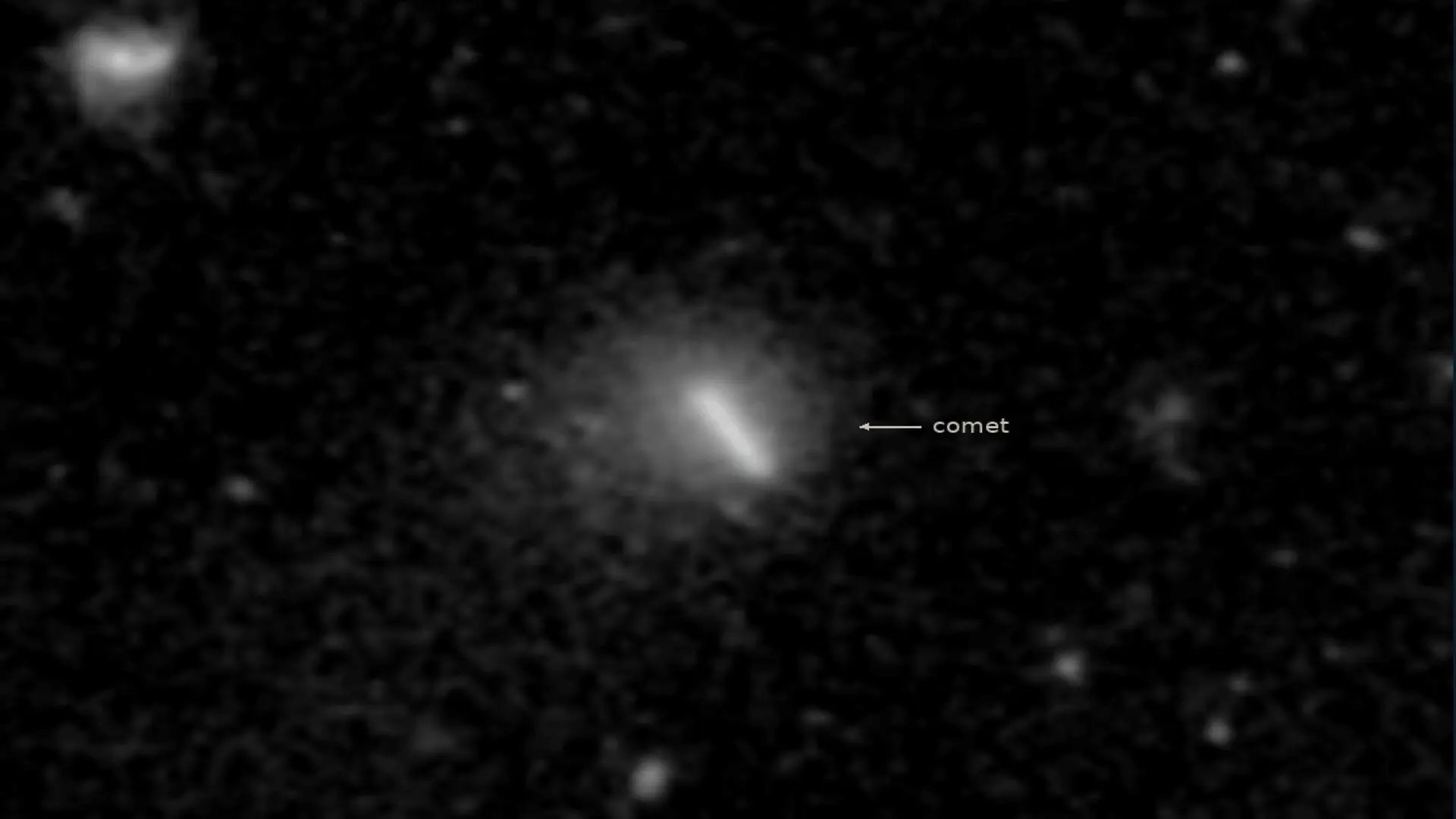
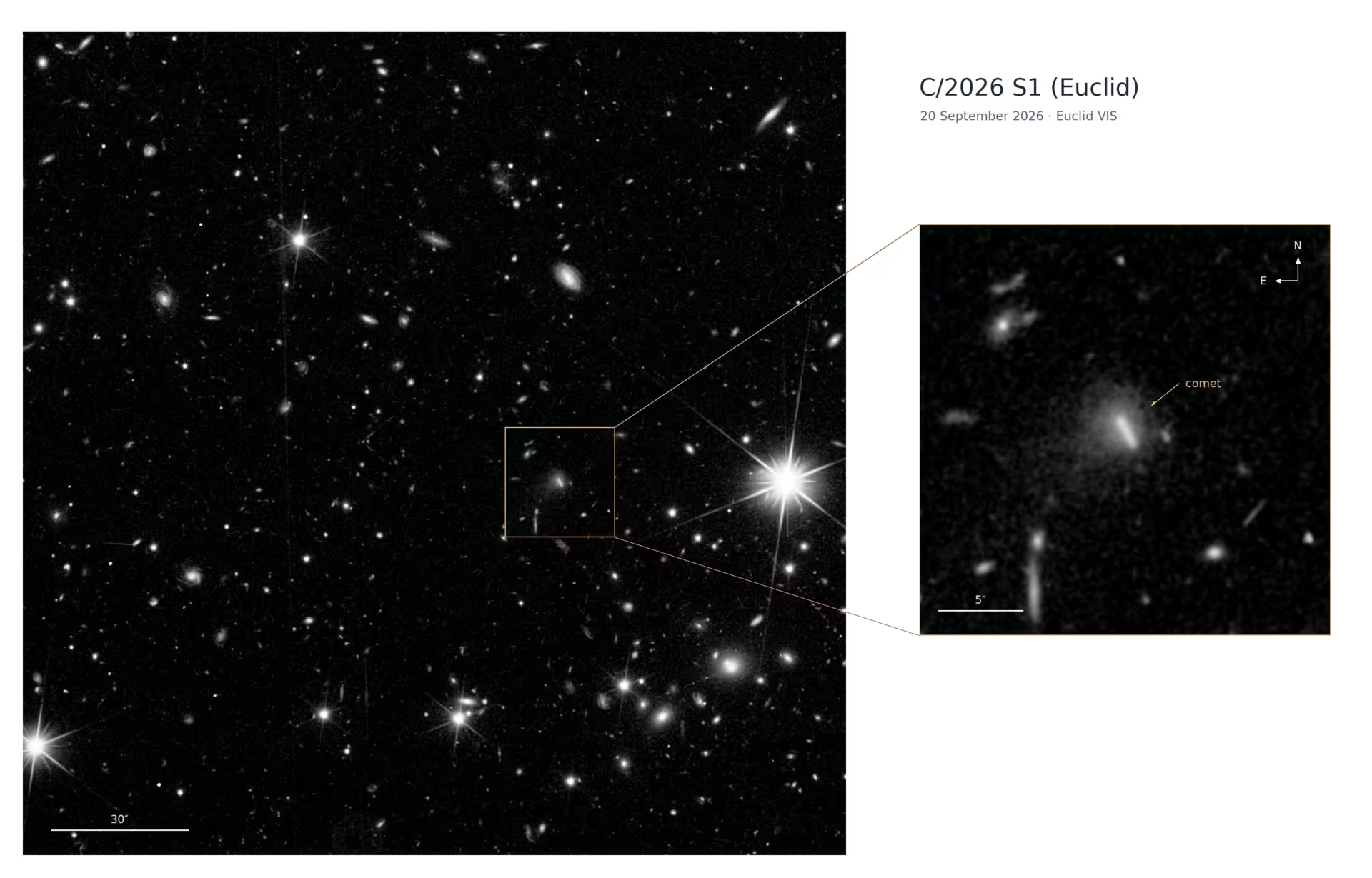
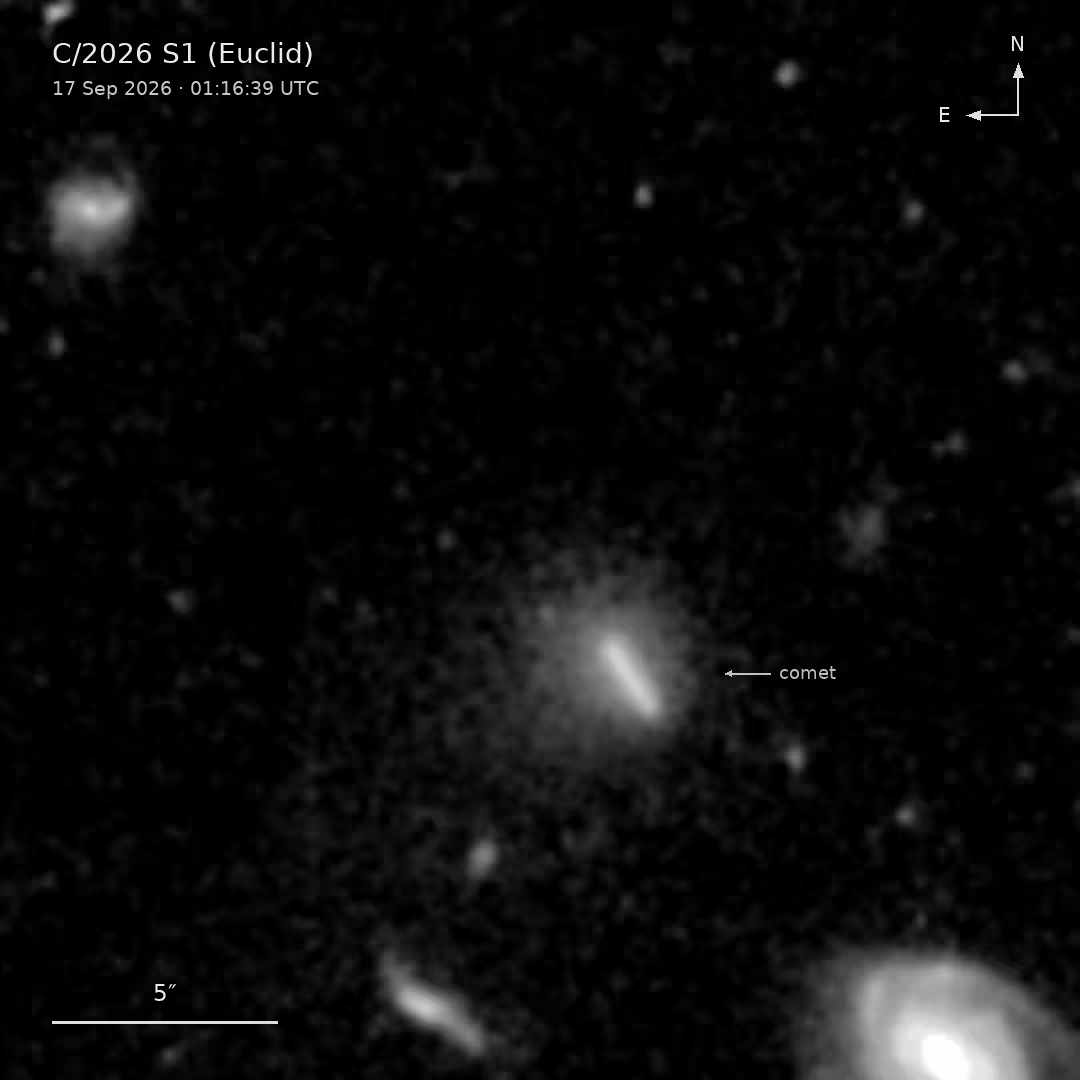
Europe’s Euclid space telescope has unexpectedly captured its first-ever sighting of a previously unknown comet. While scanning the distant reaches of the cosmos for signs of dark matter and dark energy, the observatory recorded a faint, streaking anomaly between September 16 and 24, 2026, eventually identified as C/2026 S1 (Euclid).
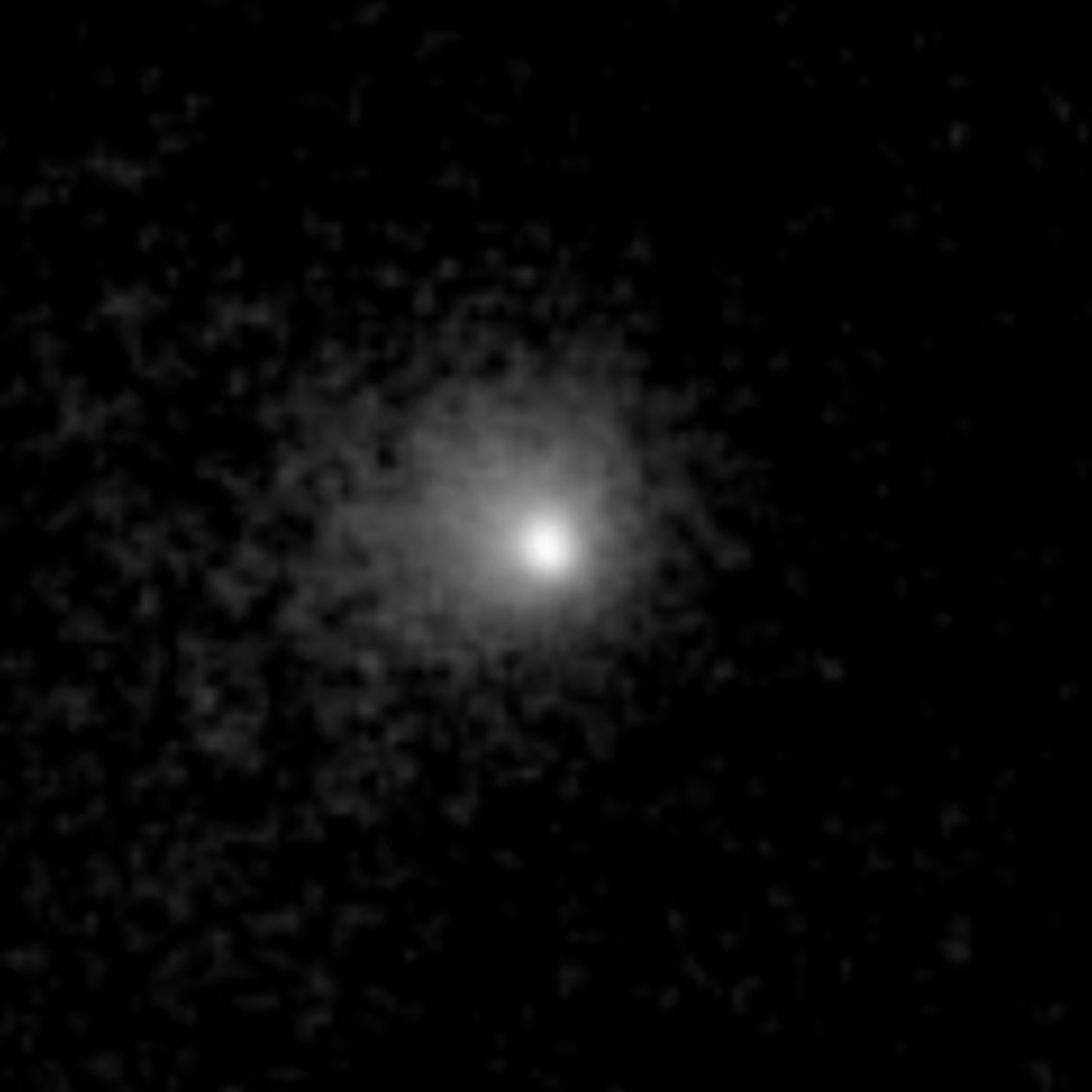
The discovery was made possible by specialized software developed by Mikko Pöntinen, a doctoral student at the University of Helsinki, who works with the Euclid Consortium’s Solar System Objects Science Working Group. By analyzing the telescope’s deep-space imagery, the software flagged a moving object that appeared as an elongated trail across 16 individual exposures. A subsequent investigation confirmed that the object was shrouded in a characteristic coma—a fuzzy cloud of gas and dust that serves as a hallmark of active comets.
Detecting an Interloper in Deep Space
The comet was officially recognized by the International Astronomical Union’s Minor Planet Center on October 8, following a submission from the research team. Unlike the galaxy-scale phenomena Euclid is designed to map, this object was relatively close by cosmic standards, situated roughly 1.3 billion kilometers from Earth. It appears to be traveling on a trajectory that arcs high above the plane of the solar system, which explains why it appeared in the telescope’s field of view.
Euclid’s observation strategy, a “step-and-stare” method that targets specific patches of the sky, is not optimized for tracking nearby, fast-moving objects. However, the mission’s dedicated deep-survey regions allowed the team to capture the comet across five separate image sets. This persistence enabled researchers to verify the object’s movement and confirm that it was not merely a data artifact or a static background object.
Refining Future Search Capabilities
While C/2026 S1 (Euclid) is not a candidate for the European Space Agency’s Comet Interceptor mission—a project designed to study pristine comets as they enter the inner solar system—the discovery serves as a vital proof-of-concept. Astronomers hope that the software used to identify this comet can eventually be used to spot future, more accessible targets for space probes.
Identifying such objects remains a priority not only for asteroid and comet science but for the accuracy of Euclid’s primary mission. Foreground objects like small icy bodies can interfere with the telescope’s highly sensitive cosmological measurements. By developing robust algorithms to recognize and filter out these “local” intrusions, scientists can improve the clarity of the deep-space data while simultaneously cataloging the remnants of the early solar system.
Further Reading and Resources
- Understanding Comets: NASA’s guide to the icy, primitive building blocks of the solar system.
- Euclid’s Survey Strategy: An overview of how the telescope balances its wide-field and deep-field observations.
- The Comet Interceptor Mission: Details on the upcoming ESA mission designed to study visiting objects from deep space.
This article has been fact checked for accuracy, with information verified against reputable sources. Learn more about us and our editorial process.
Last reviewed on .
Article history
- Latest version
Reference(s)
- “University of Helsinki.” <https://www.helsinki.fi/en>.
- “IAU Minor Planet Center.” <https://minorplanetcenter.net/>.
- “Comet Interceptor.” <https://www.esa.int/Science_Exploration/Space_Science/Comet_Interceptor>.
- Cermak, Alicia. “Comets.”, October 26, 2017 NASA <https://science.nasa.gov/solar-system/comets/>.
- <https://www.esa.int/ESA_Multimedia/Images/2023/02/Euclid_s_wide_and_deep_surveys>.
Cite this page:
- Posted by Aisha Ahmed