James Webb Space Telescope Reveals Major Flaw in Models of Distant Ancient Galaxies
New research shows that standard astrophysical assumptions overestimate infrared emissions in dusty galaxies by up to a factor of three.
Distant galaxies at cosmic noon, sitting about two to three billion years after the Big Bang, hold secrets about how stars formed rapidly during the universe’s most prolific era. A team of astronomers has discovered that standard computer models used to simulate these ancient star-forming systems systematically overestimate their infrared glow by up to a factor of three. Led by Benjamin P. Collins at the University of Chile and the University of Bologna, the researchers analyzed data from the James Webb Space Telescope to test a foundational rule of astrophysics known as dust energy balance. Their work reveals that while current modeling tools work well for relatively clear galaxies, they stumble when trying to predict the hidden thermal output of dusty, complex systems.
Astronomers rely heavily on spectral energy distributions, which are graphs showing how much light a galaxy emits across every wavelength, to understand chemical compositions and star formation rates. Because direct infrared observations of distant galaxies have historically been sparse, most modeling software uses an assumption called dust energy balance. This principle dictates that all starlight absorbed by dust grains in the ultraviolet and optical parts of the spectrum must equal the energy re-emitted by that same dust in the infrared regime. Testing this assumption at high redshift requires peering deep into the infrared spectrum using space-based observatories.
How Did Researchers Test Dust Energy Balance Using Space Telescopes?
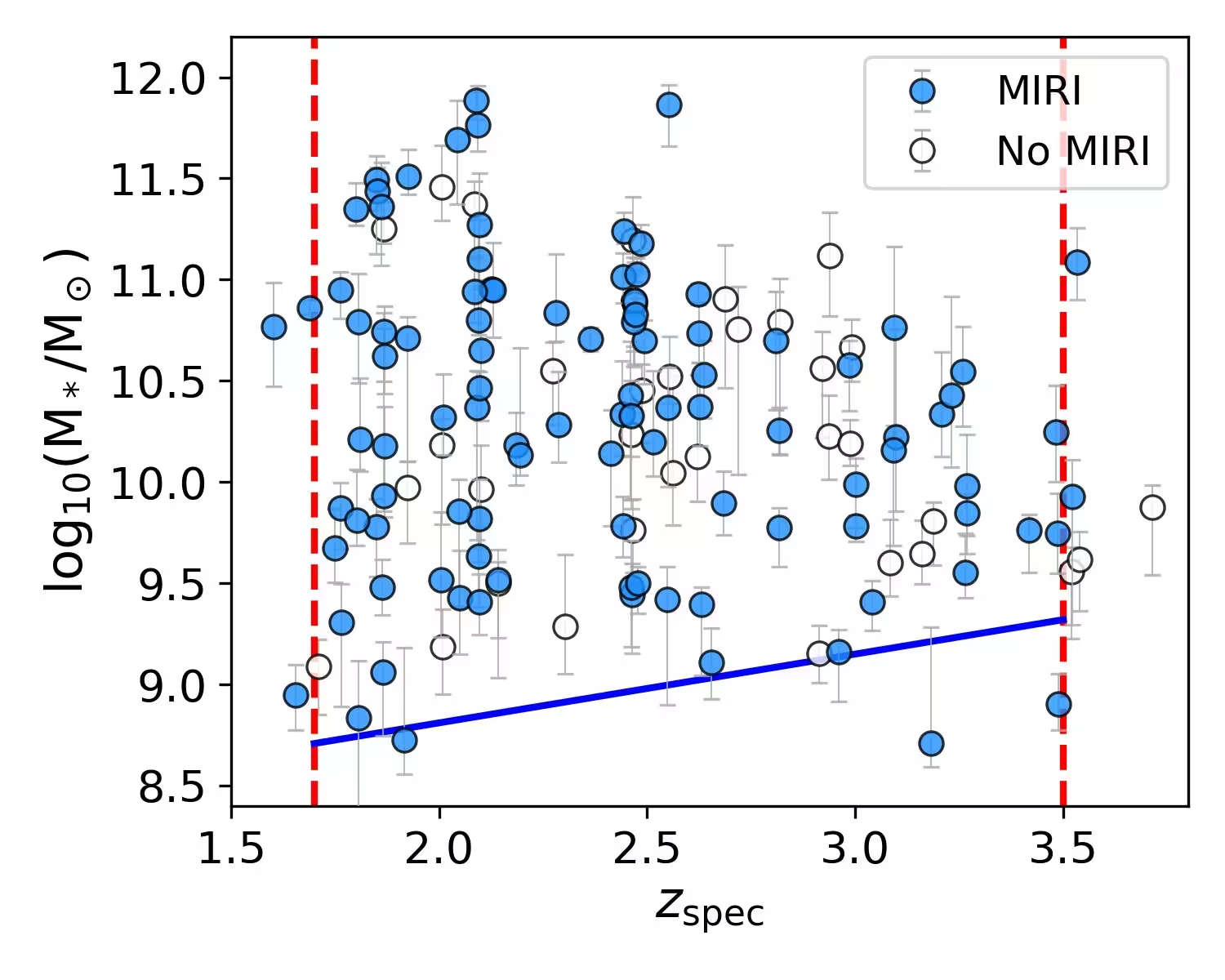
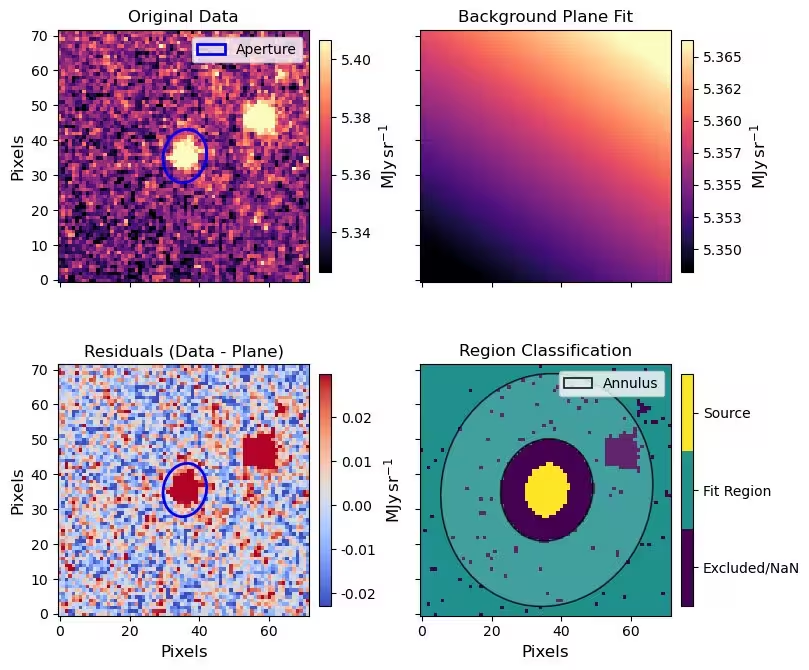
To put the energy balance assumption to the test, the authors examined 111 galaxies from the Blue Jay survey, focusing on a subset of 89 actively star-forming galaxies located at redshifts between 1.7 and 3.5. They gathered archival mid-infrared images captured by the Mid-Infrared Instrument aboard the James Webb Space Telescope across four specific bands, ranging from 7.7 micrometers to 21 micrometers. The team built a custom photometric pipeline to measure the faint light from these distant sources while carefully subtracting complex background noise and instrumental artifacts.
The researchers then ran computer models using a Bayesian inference code called Prospector, which reconstructs stellar populations and dust attenuation based solely on shorter-wavelength data from the Hubble Space Telescope and the James Webb Space Telescope’s Near-Infrared Camera. By comparing these ultraviolet-to-near-infrared predictions directly against the actual mid-infrared measurements, the team could evaluate whether the models accurately guessed the infrared output. As detailed in a study published on the arXiv preprint server, the predicted mid-infrared fluxes grew increasingly inaccurate at longer wavelengths.
Why Do Standard Models Overpredict Infrared Emissions in Dusty Galaxies?
The analysis showed that while model predictions matched observations closely at 7.7 micrometers, they overshot the actual measured fluxes by a factor of about three at 21 micrometers. This discrepancy worsened significantly in galaxies with high dust attenuation, meaning systems packed with thick dust clouds showed the largest errors. The authors considered several physical explanations for this mismatch, including the possibility that complex galaxy geometries or edge-on viewing angles lead models to miscalculate how much starlight the dust actually absorbs along a single line of sight.
Another possibility is that heavily obscured galaxies experience strong self-shielding, where dense birth clouds trap energetic ultraviolet photons before they can heat the broader interstellar medium. This lowers the average dust temperature and shifts the thermal emission peak further into the far-infrared, beyond what mid-infrared instruments can detect. However, when the team incorporated direct mid-infrared data into their fits, the total inferred infrared luminosity dropped by up to 0.6 dex in dusty systems, supporting the conclusion that optical-only models simply overestimate the total starlight absorbed by dust.
What Happens When Spectroscopy and Direct Infrared Data Are Added?
To see if the overpredictions could be fixed, the researchers incorporated medium-resolution optical spectroscopy from the James Webb Space Telescope’s Near-Infrared Spectrograph into the computer models. This additional data broke fundamental degeneracies between stellar age, chemical metallicity, and dust attenuation. Even though the spectrograph is blind to infrared dust emission, better constraints on the absorbed starlight reduced the mid-infrared flux overpredictions by about half.
When the team fitted the models using direct mid-infrared photometry alongside optical data, the resulting spectra matched observations within ten percent. However, tests using simulated galaxy data revealed that broadband mid-infrared images alone cannot uniquely constrain complex dust grain properties like polycyclic aromatic hydrocarbon fractions at high redshift. The authors emphasize that future observations combining mid-infrared photometry with sub-millimeter facilities like the Atacama Large Millimeter Array will be essential to accurately map star formation and dust heating across the early universe.
The study was posted to the arXiv preprint server on November 25, 2026.
This article has been fact checked for accuracy, with information verified against reputable sources. Learn more about us and our editorial process.
Last reviewed on .
Article history
- Latest version
Reference(s)
- Collins, Benjamin. “Tipping the scales in Blue Jay: Dust energy balance overpredicts IR luminosity in galaxies at $z\sim2$.” arXiv.org <http://arxiv.org/abs/2611.34802v1>.
Cite this page:
- Posted by Aisha Ahmed