New Drill-Free Treatment Stops Childhood Cavities Without Injections or Sedation
A new clinical trial shows that silver diamine fluoride can stop tooth decay in children without the need for painful drilling or anesthesia.

A non-invasive treatment for childhood cavities could soon gain broader regulatory backing in the United States, potentially sparing young patients from the stress of traditional drilling and restorative dental surgery. New research published in JAMA Pediatrics provides the robust clinical evidence necessary to potentially secure official federal approval for silver diamine fluoride (SDF) as a primary method for arresting tooth decay.
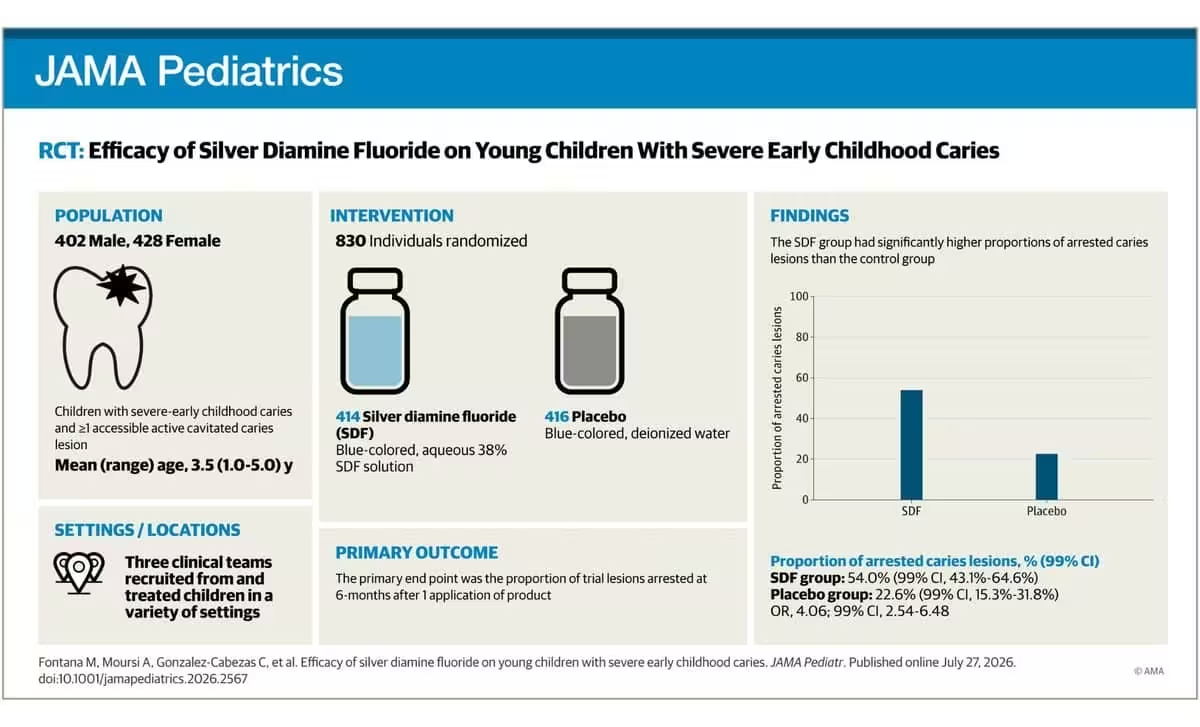
A Large-Scale Evaluation of Drill-Free Dentistry
Led by the University of Michigan, the Phase III clinical trial tracked 830 children between the ages of 12 and 71 months who were suffering from significant tooth decay. The participants were drawn from a variety of settings across Iowa, New York, and Michigan, including pediatric practices and early childhood education centers.
The intervention utilized a 38% silver diamine fluoride solution, which clinicians applied directly to affected teeth using a small, sponge-tipped tool. The process is remarkably efficient, taking roughly 10 seconds per tooth and requiring no anesthesia, sedation, or mechanical drilling. While standard fillings necessitate the removal of diseased tooth structure, SDF works chemically: the silver component suppresses the bacteria responsible for decay, while the fluoride reinforces the tooth’s remaining mineral structure.
Throughout the eight-month study, researchers compared the performance of SDF against a placebo. The results were clear: 54.0% of the cavities treated with SDF showed no progression after six months, compared to only 22.5% in the placebo group. At the three-month check-in, the arrest rate for the SDF group reached 57.5%.
“This is a very effective and safe treatment—even in children as young as 1,” noted Margherita Fontana, a professor at the University of Michigan School of Dentistry who served as the lead investigator. The study also confirmed that the treatment was well-tolerated, with no significant differences in pain levels or adverse events between the treatment and control groups.
Navigating the Path to Regulatory Approval
Although SDF has been utilized globally for years, its use in the United States has been somewhat limited by its current regulatory status. While the FDA cleared the substance in 2014 specifically for managing tooth sensitivity, its use for halting active cavities currently falls under an off-label designation. By conducting this pivotal trial, researchers hope to provide the necessary data for a formal FDA indication for cavity arrest.
The implications are significant for public health. More than 40% of children in the U.S. experience tooth decay, which, if left untreated, can lead to chronic infections, nutritional challenges, and missed schooling. For patients who find traditional dental procedures traumatic—including children, those with special needs, or individuals with severe dental anxiety—SDF represents a more accessible, less invasive path to oral health.
However, the treatment does come with a noted aesthetic trade-off: it causes permanent staining on the decayed portions of the tooth, which can be a concern for visible, front-facing teeth. Furthermore, experts emphasize that SDF is not a cure-all. It requires ongoing clinical monitoring, and it should be viewed as part of a comprehensive, long-term dental care plan rather than a total replacement for all restorative work. The research was supported by over $12 million in funding from the National Institute of Dental and Craniofacial Research.
This article has been fact checked for accuracy, with information verified against reputable sources. Learn more about us and our editorial process.
Last reviewed on .
Article history
- Latest version
Cite this page:
- Posted by Zara Tariq