Curiosity Rover Spots Baffling New Pattern on Mars Surface That Defies Easy Explanation
A mysterious set of tire-like tracks spotted in new NASA Curiosity rover imagery of the Martian surface has sparked fresh debate over their origin.
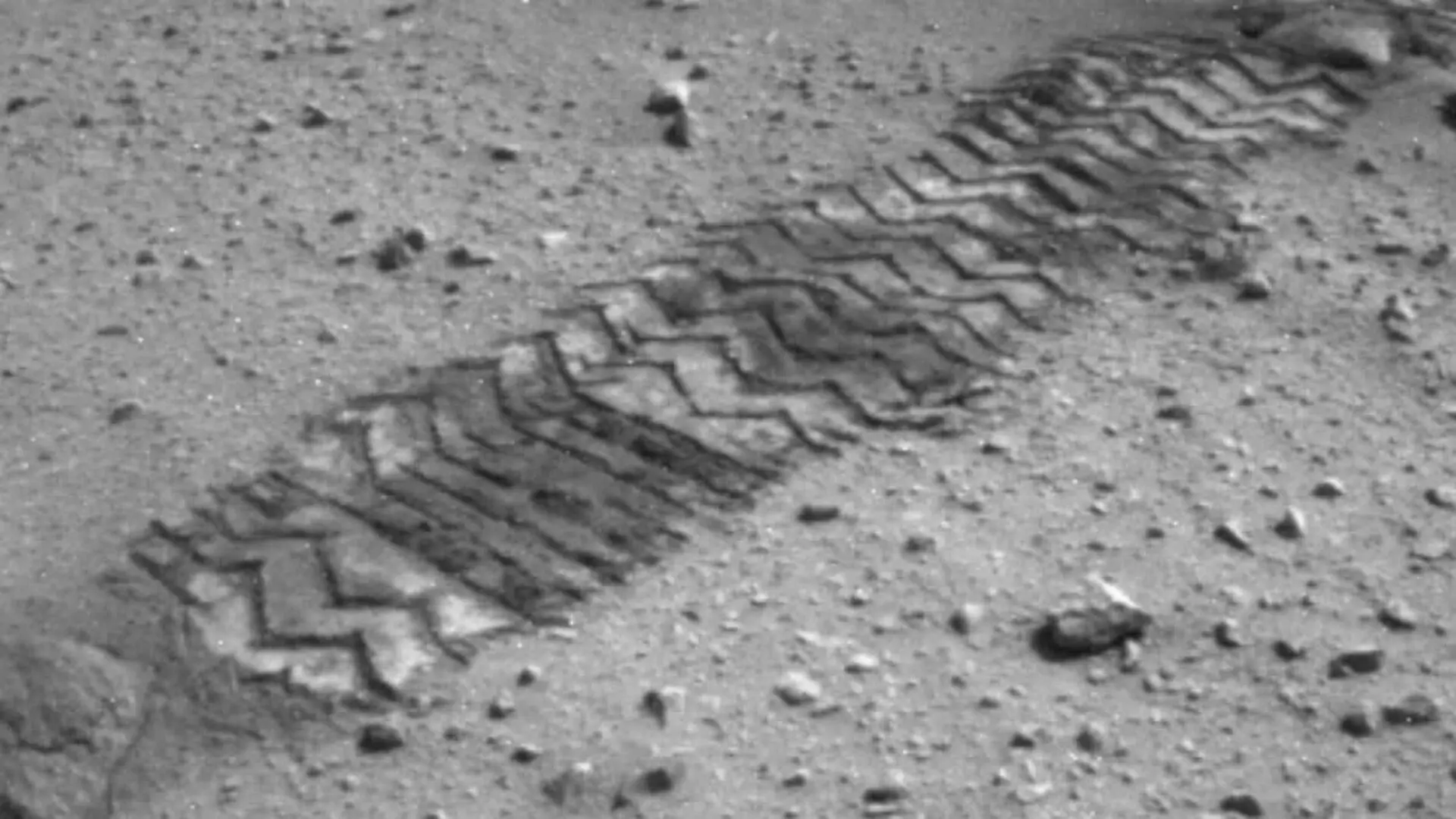
A recent series of images transmitted by NASA’s Curiosity rover has ignited intense speculation across social media platforms. The photos, captured on May 19, 2025, during the rover’s long-running mission in Gale Crater, reveal a distinct, linear pattern etched into the Martian dust. Unlike the twin, blocky treads typically carved into the soil by the rover’s wheels, this feature appears as a singular, narrow track marked by repetitive, evenly spaced indentations.
Analyzing the Martian Trail
The curiosity surrounding these images began when space enthusiast Kari Sivertzen shared the raw navigation camera data on X. Sivertzen, who frequently monitors public NASA archives for geological anomalies, initially pointed out peculiar depressions nearby that some observers speculated could be tied to historical water activity or impact events. However, public interest quickly shifted to the unusual, continuous trail visible in the frame.
Observers were quick to note that the geometry of the track differs significantly from the standard wheel marks left by the Curiosity rover, which has been exploring the Martian surface since 2012. Because a second photograph, taken approximately two minutes after the first, confirmed the presence of the same formation from a different perspective, many commenters have dismissed the possibility that the image is merely a digital artifact or a trick of light.
Sol 4544: Left Navigation Camera
— kari sivertzen (@KariSivertzen) September 1, 2026
This image was taken by NAV_LEFT_B onboard NASA’s Mars rover Curiosity on Sol 4544 (2025-05-19T02:40:42.000Z)
Credits: NASA/JPL-Caltech https://t.co/OcwPJ68ItT
Curiosity (MSL) Analyst’s Notebook https://t.co/K5itoBqBvkpic.twitter.com/MPdifi2iPA
The Psychology of Pareidolia
While these images have fueled theories regarding potential extraterrestrial activity, experts often point to pareidolia—a psychological phenomenon where the human brain identifies recognizable patterns, such as faces or artificial structures, in random or ambiguous data—as a primary driver of such interpretations. Throughout the history of planetary exploration, this tendency has led to numerous high-profile misidentifications.
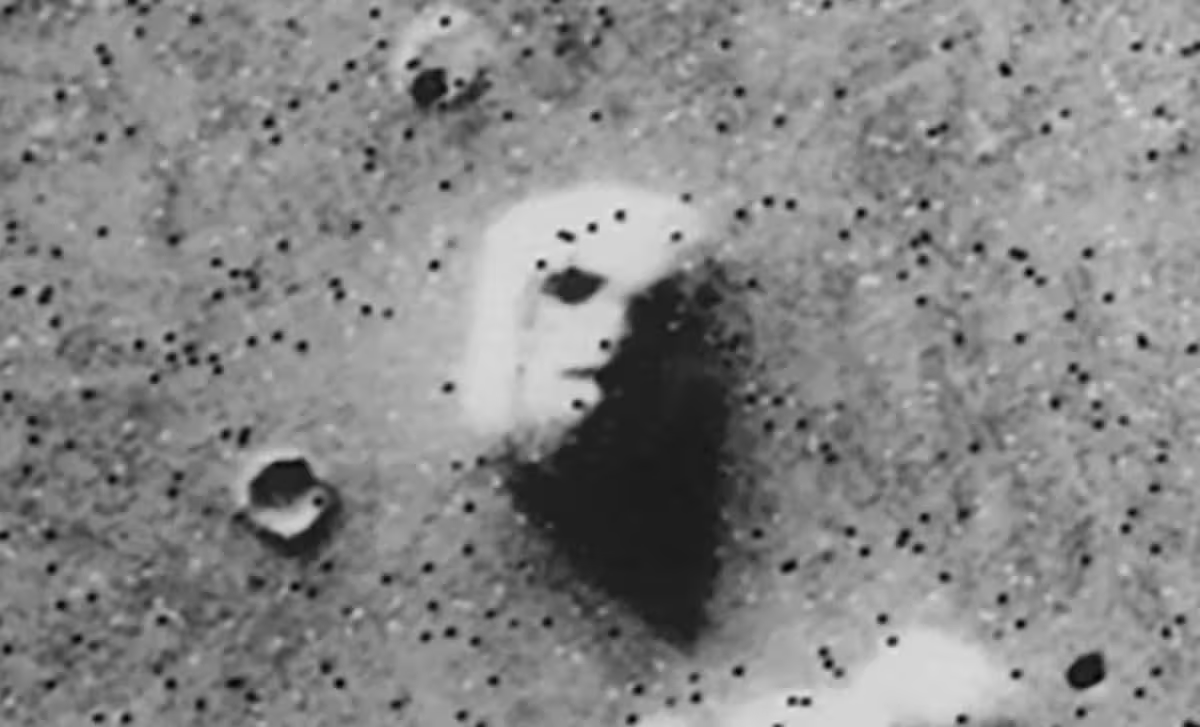
Perhaps the most famous instance occurred in 1976, when the Viking 1 orbiter captured an image of a Martian hill that appeared strikingly like a human face. Subsequent high-resolution imagery eventually clarified that the formation was simply an eroded mesa, with its familiar appearance entirely dependent on the specific angle of the sun and shadows. Similar confusion arose in 2023, when an object spotted near the horizon in a Curiosity panorama was momentarily theorized to be an artificial, jellyfish-like machine, despite failing to appear in earlier photographs of the same location.
Scientific Investigation Continues
NASA continues its search for evidence of ancient life through more robust channels, such as the Perseverance rover’s ongoing analysis of mineral samples, which recently provided some of the most compelling chemical evidence of past microbial life to date. There has been no official statement from the space agency or the White House suggesting that the recently discussed tracks are anything other than geological features or environmental phenomena typical of the Martian landscape.
While the internet continues to speculate, the current consensus remains that the tracks, however unusual they may appear at first glance, lack any verifiable link to artificial engineering or intelligent extraterrestrial presence. For now, Curiosity remains focused on its primary objective: deciphering the complex environmental history of Gale Crater.
This article has been fact checked for accuracy, with information verified against reputable sources. Learn more about us and our editorial process.
Last reviewed on .
Article history
- Latest version
Reference(s)
- “https://mars.nasa.gov/raw_images/1468189/?site=msl.” <https://t.co/OcwPJ68ItT>.
- “https://an.rsl.wustl.edu/msl/AN/mvSimple.aspx?tic=BPR&it=&ii=NLB_800890507RADLF1160576NCAM00292M1.” <https://t.co/K5itoBqBvk>.
- “https://twitter.com/KariSivertzen/status/2094919647518658599/photo/1.” <https://t.co/MPdifi2iPA>.
Cite this page:
- Posted by David Anderson