Artificial Intelligence Matches Stroke Survivors to Specialized Rehabilitation Programs
A new computational framework uses simulated patient profiles to help hospitals optimize recovery pathways and tailor post-stroke care.

A new machine learning framework designed to triage stroke survivors into the most effective subacute rehabilitation programs has been tested on a simulated cohort of 700 patients, offering a glimpse into how artificial intelligence might soon assist doctors in matching patients with specialized care. When recovering from a stroke, getting patients into the right type of program—whether it is high-intensity hospital therapy or lower-intensity home care—makes a profound difference in their long-term recovery and independence. However, deciding which setting suits a patient best often relies on subjective clinical judgment and varies widely between different hospitals and countries.
The research, published in PLOS One, addresses the longstanding challenge of subacute rehabilitation triage by constructing a detailed synthetic dataset. Because real-world patient records are often restricted by privacy regulations or fragmented across different healthcare systems, the study authors built a heterogeneous virtual population of 700 stroke patients. Each profile was characterized by 49 distinct demographic, clinical, and functional variables drawn from statistical distributions reported in medical literature. These variables covered everything from stroke severity and cognitive scores to pre-existing conditions and potential in-hospital complications.
How Experts Evaluated Seven Distinct Recovery Pathways
To establish a reliable baseline, an expert panel of four senior physicians from the neurorehabilitation unit at University Hospital del Mar in Barcelona reviewed the patient profiles. The clinicians assigned each of the 700 virtual patients to one of seven distinct rehabilitation pathways. These options ranged from no need for hospitalization and low-intensity nursing homes or home-based care to outpatient clinics, intermediate hospital-based programs, high-intensity inpatient units, and specialized complex care facilities for patients with severe cognitive alterations or ongoing medical needs like dialysis.
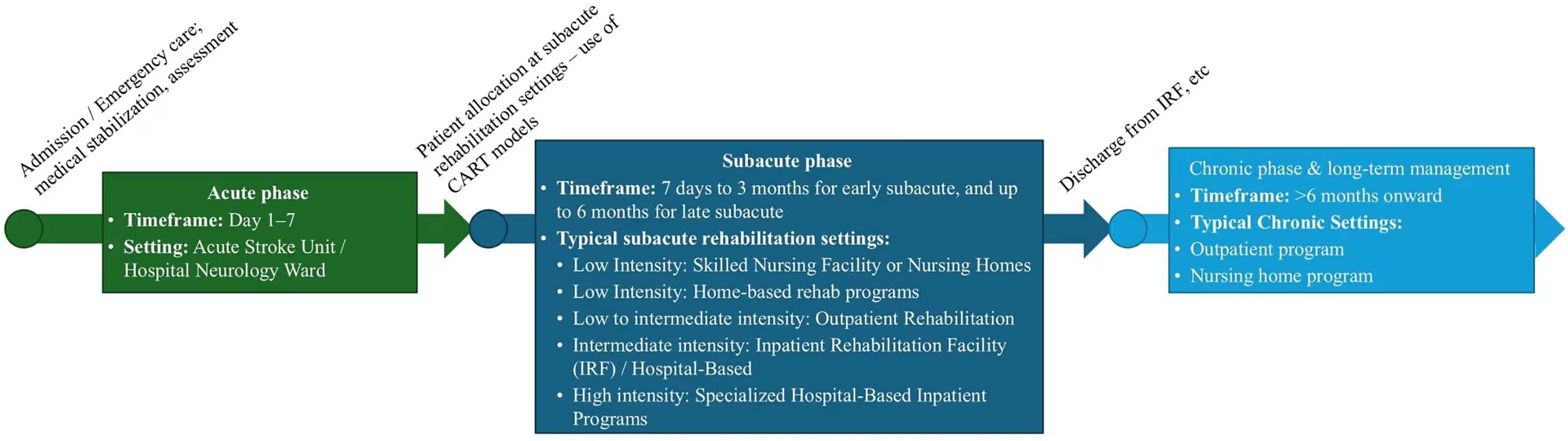
The expert panel generally followed a conservative allocation strategy, favoring the highest intensity program compatible with each patient profile to maximize their chances of functional recovery. This expert-annotated dataset served as the ground truth for training and evaluating several predictive models, including classification and regression trees, random forests, and extreme gradient boosting algorithms known as XGBoost.
The Most Critical Factors Driving Rehabilitation Decisions
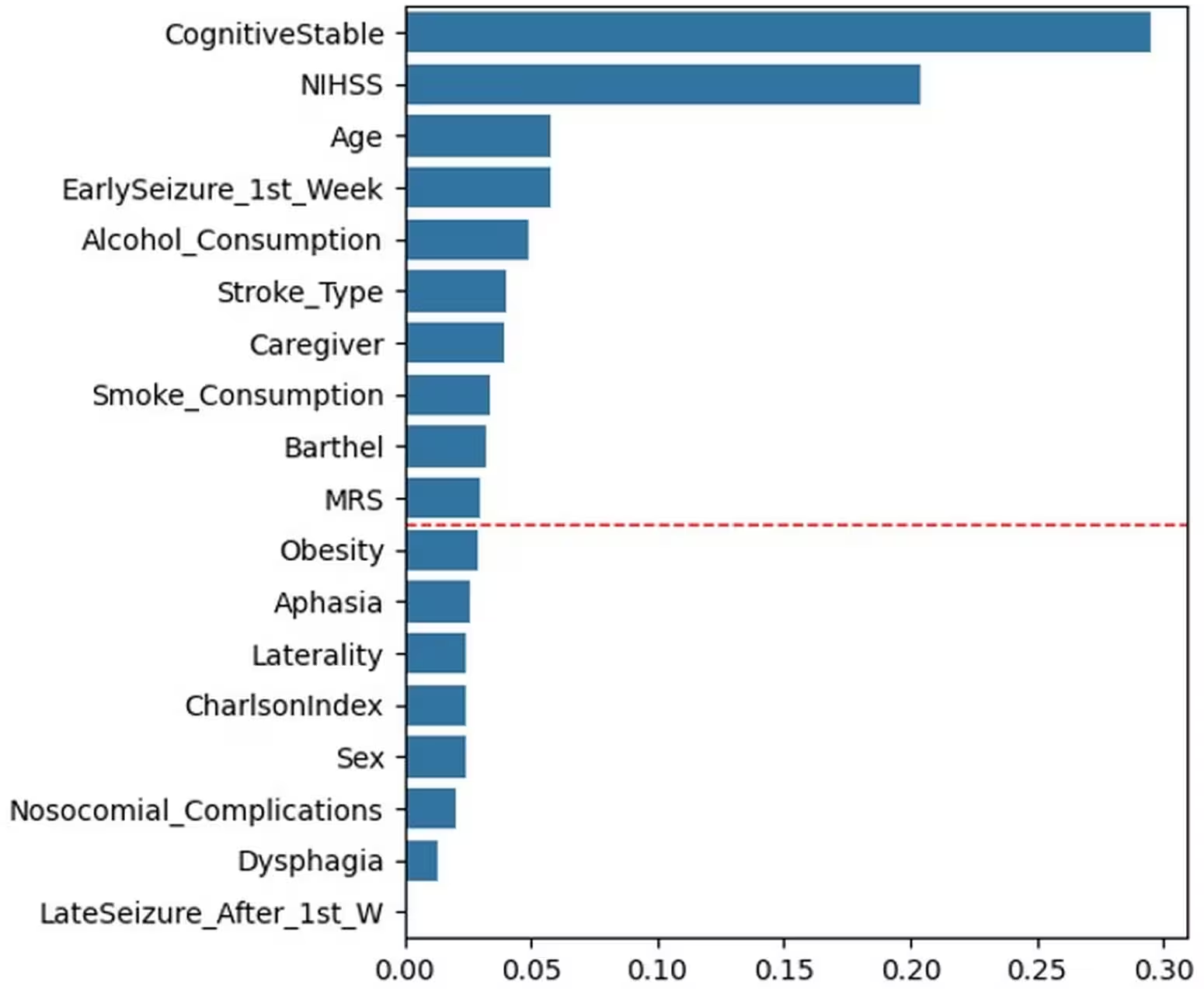
Using feature importance analysis, the researchers identified the most influential parameters guiding rehabilitation placement. Neurological severity, measured by the National Institutes of Health Stroke Scale, and cognitive status emerged as the primary drivers for program allocation. Patient age, the presence of a caregiver, the Modified Rankin Scale measuring daily disability, and the Barthel Index measuring functional independence also played decisive roles in determining where a patient should be sent.
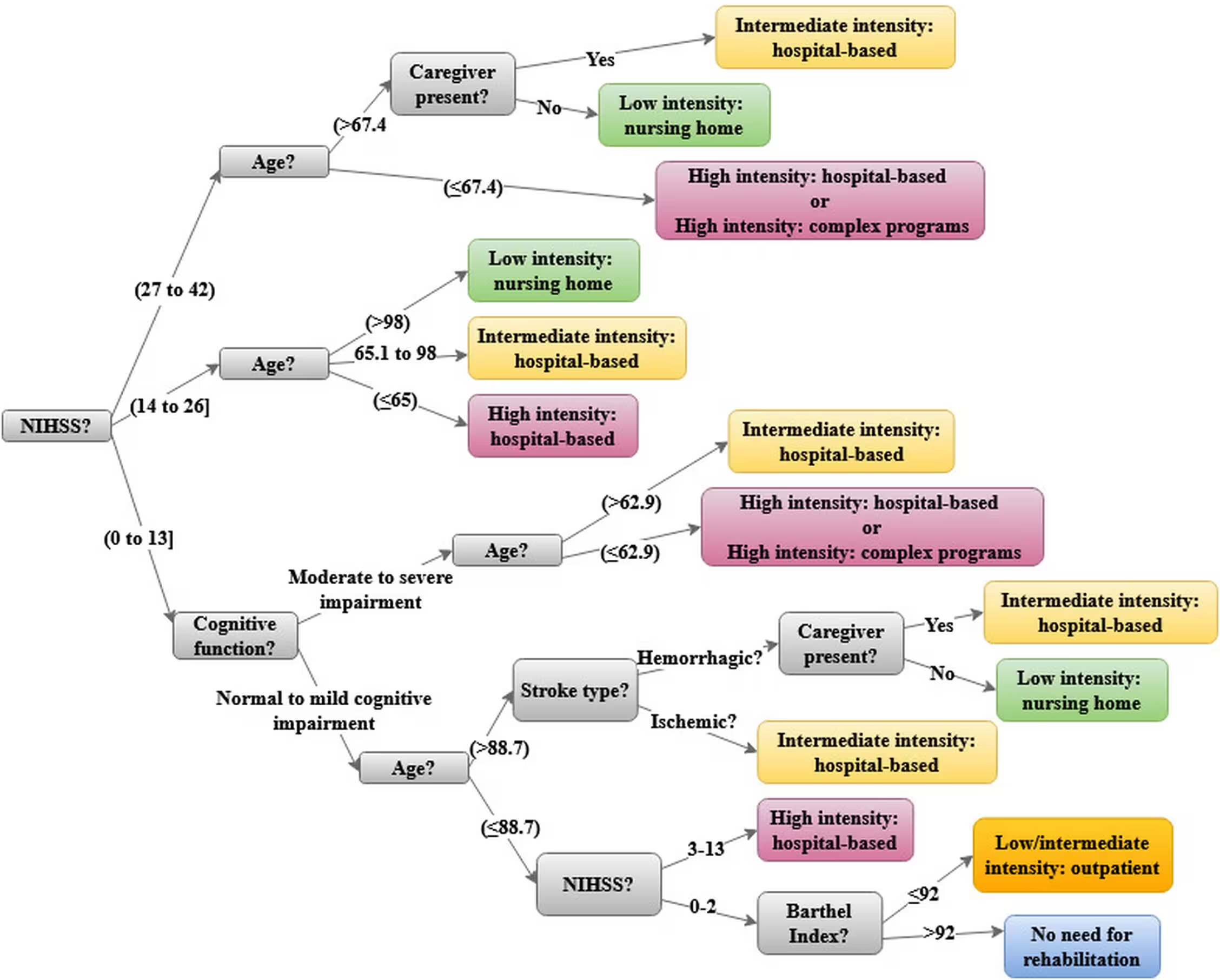
Interestingly, the analysis also highlighted stroke type as a significant prognostic factor, noting that patients who suffered hemorrhagic strokes were more frequently allocated to nursing homes when no caregiver was available. This reflects the clinical expectation that bleeding strokes often present with greater severity and poorer long-term neurological outcomes than ischemic strokes caused by blocked blood vessels.
Comparing Artificial Intelligence with Traditional Institutional Guidelines
The data-driven decision trees and machine learning models were rigorously tested using stratified cross-validation and compared against an in-house decision tree currently used at the Catalan hospital. The XGBoost model and the optimized classification and regression trees achieved overall accuracies exceeding 83 percent, outperforming the institutional benchmark in overall accuracy. Furthermore, the study utilized Generative Topographic Mapping to project the multidimensional patient data into a visual two-dimensional latent space.
This visualization technique allowed the team to compare how the medical experts, the automated models, and the traditional institutional guidelines distributed patients across the various rehabilitation settings. The visual comparison revealed that the traditional institutional decision tree adopted a more conservative approach, frequently routing patients to intermediate care facilities rather than the high-intensity hospital programs favored by both the expert panel and the XGBoost model.
Limitations and Necessary Steps Before Clinical Implementation
The authors emphasize several important limitations that must be addressed before these tools can be used in actual hospitals. Because the study relied entirely on a synthetic dataset generated from statistical distributions rather than real patient records, it cannot fully capture the complex correlations, missing data, and unpredictable clinical hurdles encountered in everyday hospital wards. Furthermore, the expert annotations reflect the specific clinical practices and resource availability of a single institution, meaning the resulting decision rules cannot be directly generalized to other healthcare systems.
While the models demonstrated moderate predictive performance, class imbalances among the rarest rehabilitation categories posed a challenge, as some programs contained only a handful of cases. The researchers stress that these predictive tools require rigorous validation on independent, real-world clinical cohorts before they can be considered for routine bedside use. Ultimately, the framework provides a transparent foundation that hospitals can recalibrate to match their local resources and regional guidelines, supporting more individualized and data-driven post-stroke care.
The research was published in PLOS One on November 19, 2026.
This article has been fact checked for accuracy, with information verified against reputable sources. Learn more about us and our editorial process.
Last reviewed on .
Article history
- Latest version
Reference(s)
- Komaris, Dimitrios Sokratis., et al. “Data-driven clinical decision trees and generative topographic mapping to guide stroke rehabilitation program allocation.” PLOS One, vol. 21, no. 11, November 19, 2026, pp. e0363251 Public Library of Science (PLoS), doi: 10.1371/journal.pone.0363251. <https://doi.org/10.1371/journal.pone.0363251>.
Cite this page:
- Posted by David Anderson