25-Year Quest Yields Approved Diagnostic Test for Hidden Parasite
A historical review details how researchers overcame technical hurdles to create a standardized molecular test for Chagas disease.
An estimated 6 to 8 million people worldwide carry the parasite responsible for Chagas disease, yet up to 90 percent of those infected remain undiagnosed, facing a hidden health burden that spans Latin America and reaches into global urban centers. A new narrative review traces the 25-year trajectory of the Fiocruz Translational Programme in Chagas Disease, highlighting the development and recent regulatory approval of a standardized molecular diagnostic test designed to overcome decades of detection hurdles.
Published in Memorias do Instituto Oswaldo Cruz, the historical overview details how researchers advanced from foundational sequencing in the 1980s to establishing reliable quantitative polymerase chain reaction assays. The work marks a significant milestone for a neglected tropical infection where traditional parasitological methods often fall short.
How Early Sequencing Laid the Groundwork for Modern Parasite Detection
During the 1980s and 1990s, scientists at the Oswaldo Cruz Institute focused on understanding the genetic variability of Trypanosoma cruzi, the protozoan parasite transmitted primarily by triatomine bugs. A major breakthrough came with the discovery that the parasite’s mitochondrial genome, known as kinetoplast DNA or kDNA, contains thousands of minicircles with highly conserved regions. These invariant sequences provided ideal targets for early polymerase chain reaction amplification.
However, translating these laboratory discoveries into routine clinical tools faced substantial hurdles. Early methods required complex sample handling, and the natural biology of chronic Chagas disease complicated testing. In chronically infected individuals, circulating parasite levels are typically low and intermittent, making single blood tests prone to missing active infections. Researchers eventually shifted attention from kDNA to nuclear satellite DNA, which offers greater copy-number consistency across diverse parasite lineages and improves quantitative accuracy.
Overcoming Translational Obstacles to Deliver a Commercial Kit
The establishment of the Fiocruz Translational Programme in Chagas Disease in 2000 fostered multidisciplinary collaboration to tackle these diagnostic gaps. Over the following decade, international consortia organized by the World Health Organization and the Pan American Health Organization worked to standardize and validate quantitative polymerase chain reaction protocols across 14 countries. These efforts paved the way for the creation of prototype diagnostic kits manufactured by the Institute of Molecular Biology of Paraná.
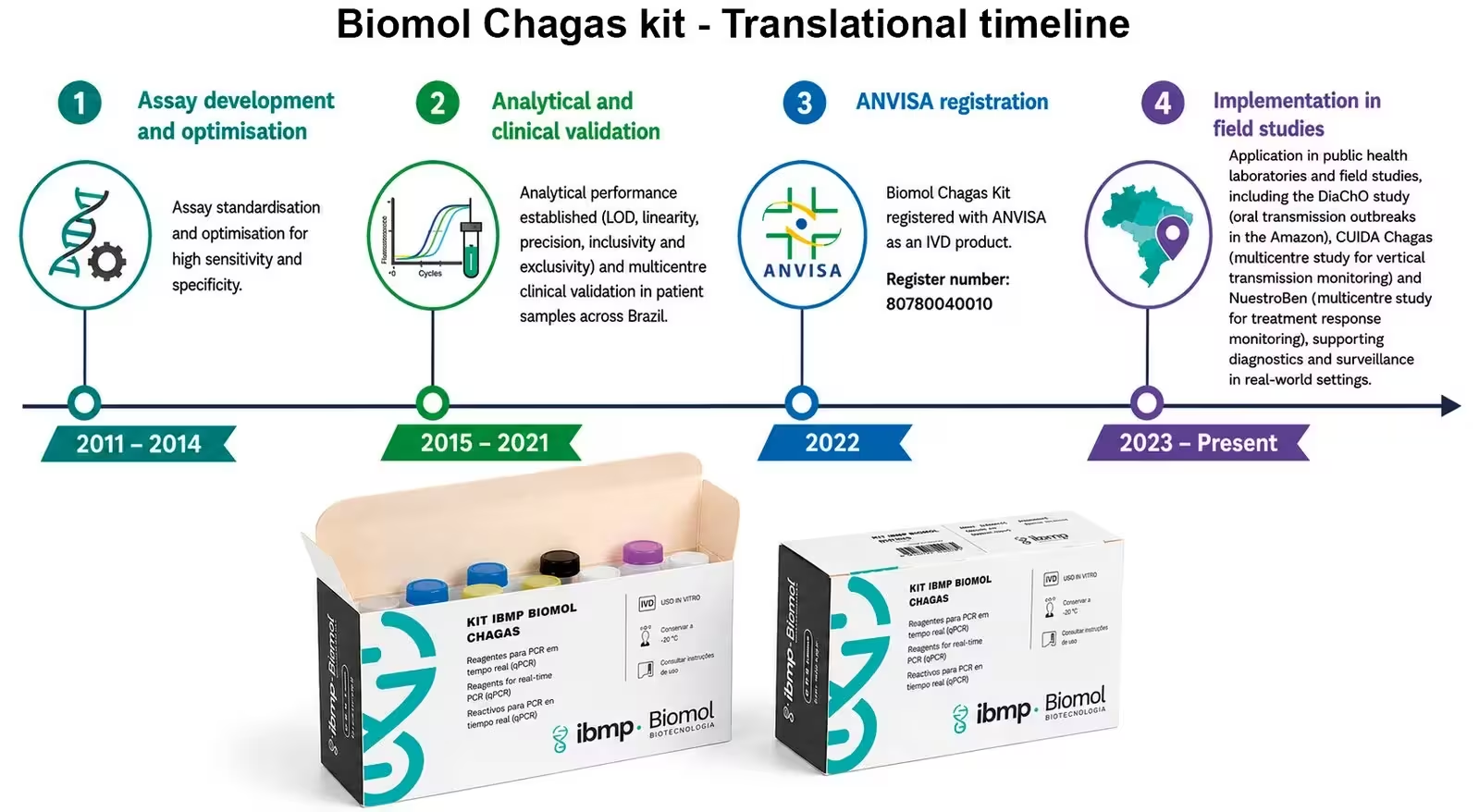
Despite facing temporary setbacks during public health emergencies like the Zika and Yellow Fever epidemics, institutional momentum revived in 2018 following high-level commitments from public health leadership. Collaborative validation studies demonstrated that the resulting real-time polymerase chain reaction assay, named the Biomol Chagas kit, achieves high analytical sensitivity and can detect multiple discrete typing units of the parasite. In July 2022, the kit secured official registration from the Brazilian Health Regulatory Agency.
What This Diagnostic Milestone Means for Patients Across Latin America
The newly registered kit is currently being deployed in major clinical studies across Latin America, including initiatives focused on diagnosing congenital transmission, monitoring antiparasitic treatment efficacy, and evaluating oral transmission outbreaks linked to food consumption in northern Brazil. Because standard serological tests remain persistently positive for years after treatment, molecular assays provide a crucial tool for early detection of therapeutic failure.
Public health experts emphasize that expanding access to standardized kits will help bridge the gap between specialized reference laboratories and routine healthcare settings. By integrating these molecular diagnostics into existing public health laboratory networks, health authorities aim to improve patient management and address one of the most overlooked global health challenges of our time.
The research was published in Memorias do Instituto Oswaldo Cruz on November 16, 2026.
This article has been fact checked for accuracy, with information verified against reputable sources. Learn more about us and our editorial process.
Last reviewed on .
Article history
- Latest version
Reference(s)
- Britto, Constança., et al. “Technological advances in the molecular diagnosis of Chagas disease from the perspective of the Fio-Chagas Translational Programme.” Memórias do Instituto Oswaldo Cruz, vol. 121, no. suppl 2, January 1, 2026 FapUNIFESP (SciELO), doi: 10.1590/0074-02760260186. <https://doi.org/10.1590/0074-02760260186>.
Cite this page:
- Posted by Faisal Qureshi