Buried Volcanic Discovery Reveals Secrets of the Moon’s Lost Ancient Magnetic Field
A volcanic structure on the Moon’s far side reveals evidence of an ancient magnetic dynamo, suggesting our neighbor had a magnetic field 4.2 billion years ago.
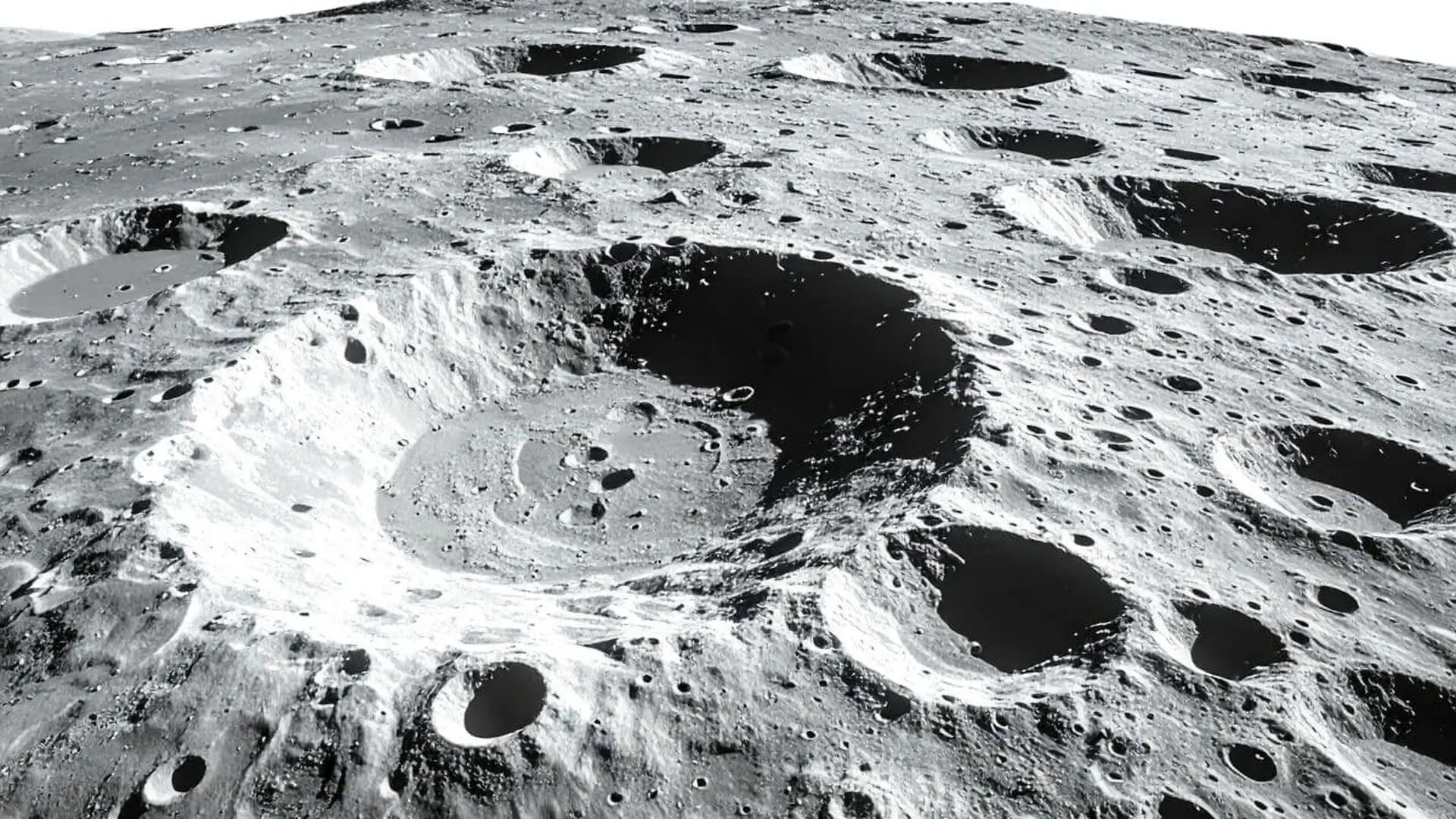
Unlike Earth, which maintains a robust magnetic shield powered by the churning of its molten outer core, the Moon today is essentially magnetic-neutral. For decades, the question of whether our celestial neighbor ever possessed its own internal dynamo has triggered intense debate, with Apollo-era samples yielding frustratingly inconsistent results. However, a new investigation using orbital data has provided fresh evidence that the Moon likely hosted a sustained magnetic field billions of years ago.
A team from ETH Zurich has utilized a novel approach, integrating gravitational and magnetic measurements from NASA’s GRAIL mission alongside data from the Kaguya and Lunar Prospector spacecraft. By creating a unified three-dimensional model, researchers were able to pinpoint a massive, hidden geological feature beneath the Dewar region on the Moon’s far side.
A Buried Volcanic Titan
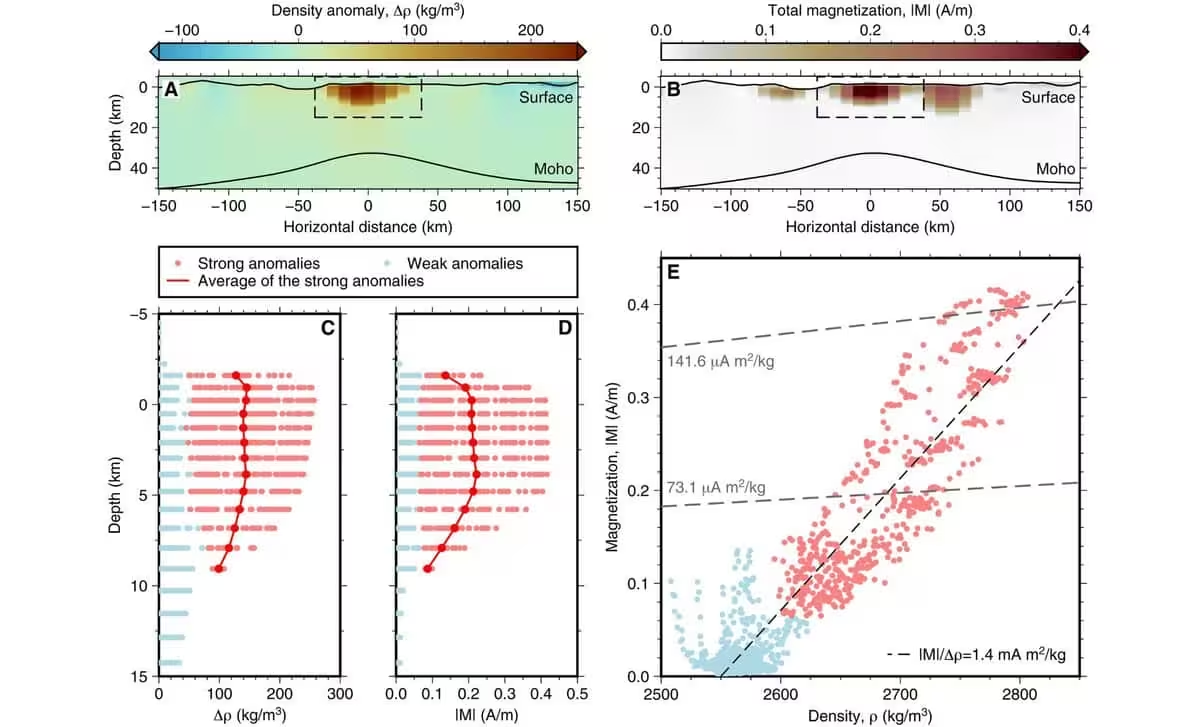
The study, published in Science Advances, identifies a dense, highly magnetized rock formation measuring 60 kilometers across and extending 9 kilometers into the lunar crust. The composition and geometry of this subterranean mass point toward a massive reservoir of solidified magma—the remnants of an ancient, cooling volcanic complex.
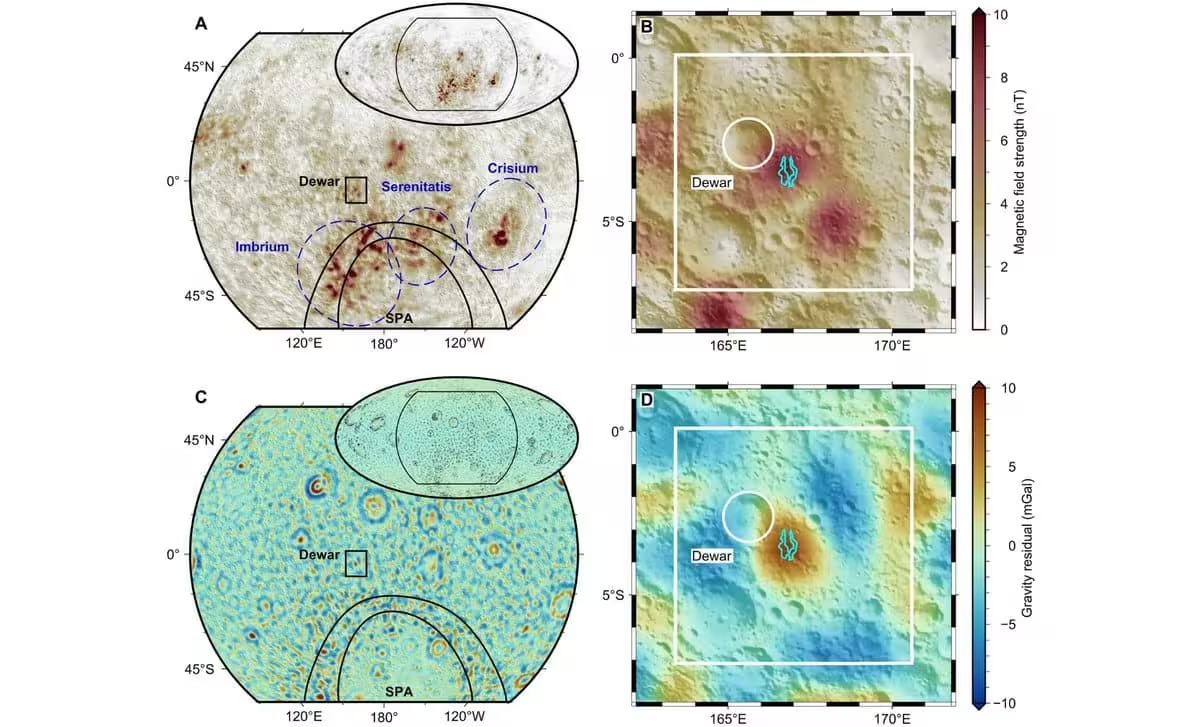
By analyzing the geological context of the surrounding South Pole–Aitken and Freundlich-Sharonov basins, the team dated the formation to approximately 4.22 billion years ago. “The Dewar region is a genuine stroke of luck: one of the strongest magnetic field anomalies on the far side of the Moon and a distinct gravity anomaly coincide spatially there,” noted geophysicist Anna Mittelholz.
Evidence for a Long-Lived Dynamo
The magnetization trapped within this ancient rock serves as a geological tape recorder, capturing the strength of the lunar environment as the magma slowly solidified. Calculations suggest that the Moon was bathed in a magnetic field of at least 11 microteslas at the time—roughly one-fifth the strength of Earth’s current field. Because such a significant, sustained field cannot be explained by short-lived asteroid impacts, the evidence strongly favors a persistent, internally driven core dynamo.
This discovery also sheds light on “lunar swirls,” the enigmatic, bright surface markings found across the Moon. These features appear to be created where horizontal magnetic fields deflect solar wind, shielding the surface from weathering and keeping it brighter than the surrounding lunar dust. While the study confirms the existence of this ancient magnetic activity, the mechanisms behind how such a small planetary body could power such a robust dynamo remain a mystery for future missions like China’s Chang’e program and NASA’s Artemis to solve.
This article has been fact checked for accuracy, with information verified against reputable sources. Learn more about us and our editorial process.
Last reviewed on .
Article history
- Latest version
Reference(s)
- Yang, Xi., et al. “Magmatic origin of the Dewar magnetic anomaly: Implications for an early lunar dynamo.” Science Advances, vol. 12, no. 39, September 25, 2026 American Association for the Advancement of Science (AAAS), doi: 10.1126/sciadv.aec0341. <https://www.science.org/doi/10.1126/sciadv.aec0341?referrer=https%3A%2F%2Fedition.cnn.com%2F>.
- “Dr. Anna Mittelholz | ETH Zurich.” <https://eaps.ethz.ch/en/people/profile.anna-mittelholz.html>.
Cite this page:
- Posted by David Anderson