New Tool Cuts Genomic Table Redundancy With Semantic Reranking
Genetics

New Tool Cuts Genomic Table Redundancy With Semantic Reranking

By combining empirical enrichment and semantic clustering, a new bioinformatics workflow organizes thousands of candidate genes into compact, traceable summaries.
By Elizabeth Taylor
Published:
Email this Article
New Tool Cuts Genomic Table Redundancy With Semantic Reranking
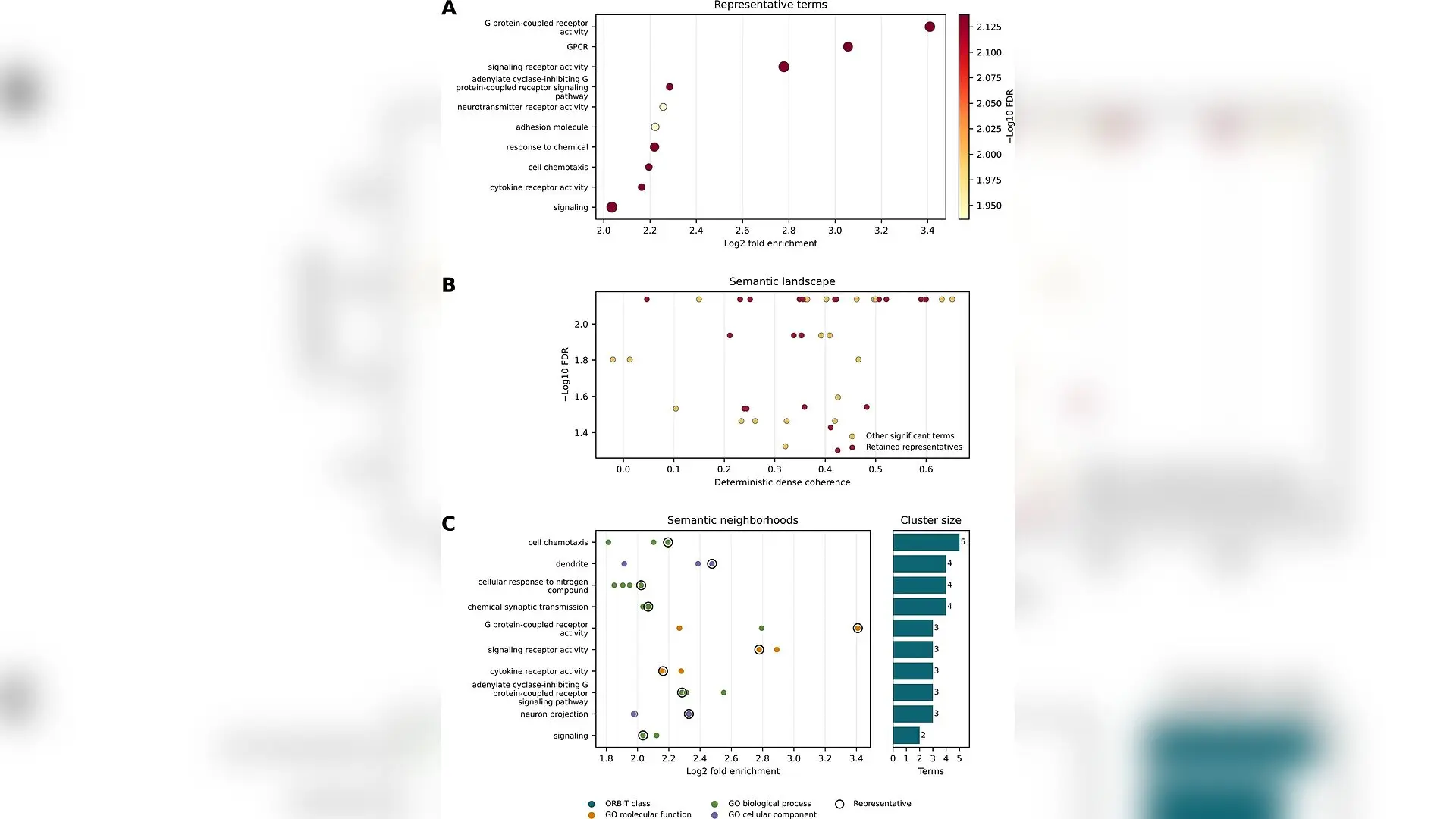
GPCR mixed-hard case study and semantic-neighborhood reduction. All panels were generated from the same deterministic 1000-permutation GPCR output used in Fig. 3 and Supplementary Fig. S6. (A) Representative enriched terms recovered from the GPCR mixed-hard query, plotted by log2 fold enrichment. (B) Semantic landscape of the 47 FDR-significant enriched terms, showing the 20 retained cluster representatives in relation to deterministic dense coherence and statistical significance. (C) Semantic-neighborhood reduction at threshold 0.58; colored points are significant member terms, outlined points are retained ORBIT representatives, and right-side bars show the number of terms assigned to each displayed neighborhood. Evan G W Robyns et al. / NAR genomics and bioinformatics

A new bioinformatics workflow cuts through redundant genomic result tables by organizing hundreds of candidate genes into compact, readable biological summaries. Large-scale biology and proteomics experiments routinely generate extensive candidate gene lists, forcing researchers to manually parse dozens of overlapping ontology terms to find underlying biological signals. To address this computational bottleneck, scientists developed a method that combines empirical enrichment with semantic scoring and redundancy-aware clustering.

The new computational framework, named the Ontology-Ranked Biological Interpretation Tool or ORBIT, was published in NAR Genomics and Bioinformatics by researchers Evan G.W. Robyns and Benjamin L. Kidder from the Wayne State University School of Medicine and the Karmanos Cancer Institute. Released as an open-source Python package in late 2026, the software is designed to transform lengthy lists of genes into prioritized, traceable functional classes without losing connection to underlying evidence.

How the ORBIT Workflow Processes Gene Sets

Standard enrichment tools often output long, overlapping tables that require tedious manual cleanup before researchers can extract meaningful insights. ORBIT tackles this challenge by executing a multi-step pipeline starting with identifier mapping against an offline human background of mapped proteins. It integrates diverse biological annotations, including Gene Ontology categories, UniProt entries, the Human Protein Atlas, and localization contexts.
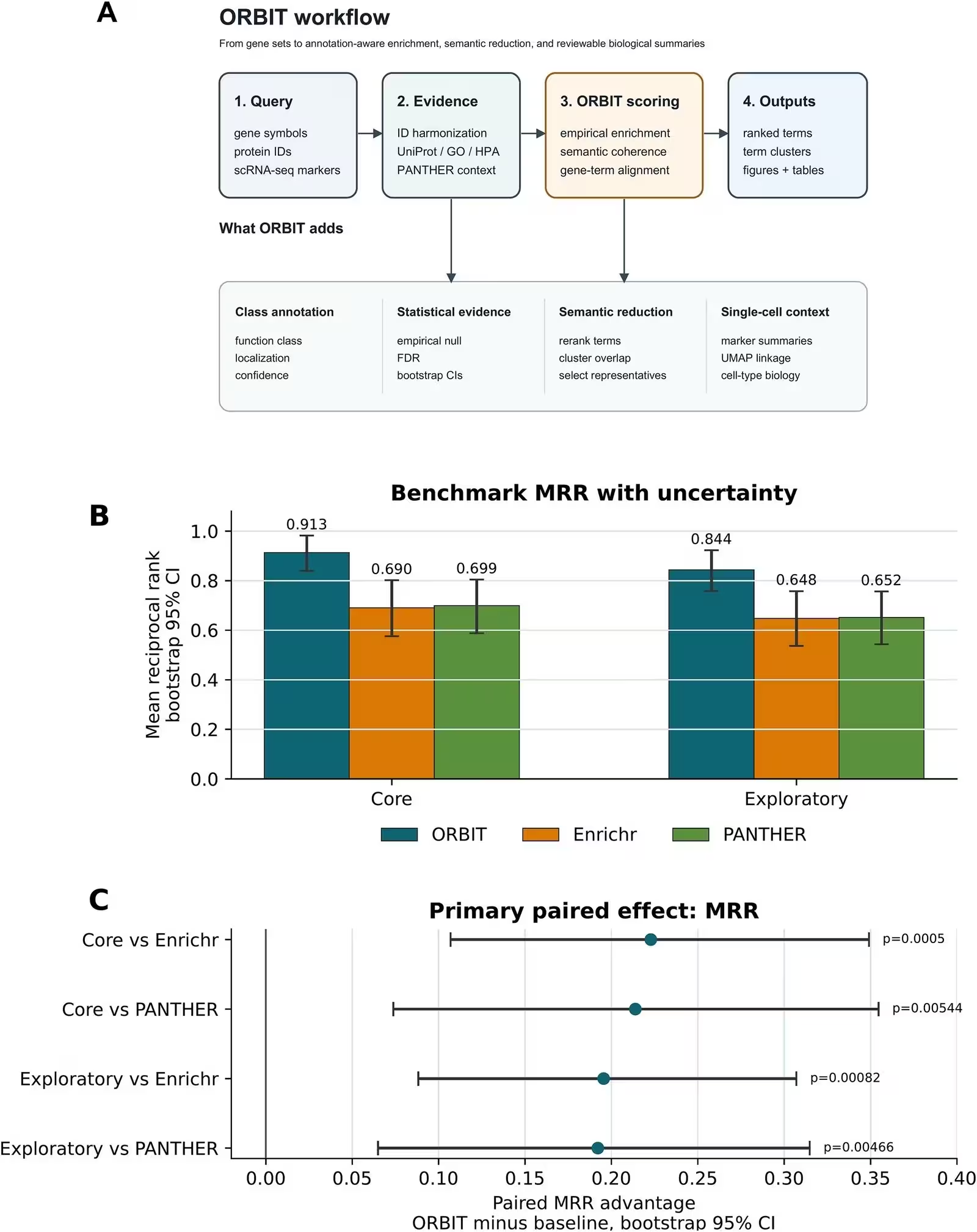
Figure 1: ORBIT workflow and primary benchmark performance. (A) Overview of the ORBIT workflow, from query gene sets or single-cell marker lists through evidence integration, empirical enrichment, semantic scoring, representative-term selection, and report generation. The interpretability layer summarizes ORBIT outputs used in this study: class annotation, statistical support, semantic reduction, and single-cell context. (B) Mean reciprocal rank (MRR) for ORBIT semantic, Enrichr GO molecular-function, and PANTHER GO molecular-function baselines across the core and exploratory benchmark scopes. Error bars show bootstrap 95% confidence intervals across benchmark gene sets. (C) Paired MRR advantage of ORBIT semantic over the two external molecular-function baselines. Points show mean paired deltas, horizontal bars show bootstrap 95% confidence intervals, and displayed P-values are from paired sign-flip permutation tests using the final paired-results table.
ORBIT workflow and primary benchmark performance. (A) Overview of the ORBIT workflow, from query gene sets or single-cell marker lists through evidence integration, empirical enrichment, semantic scoring, representative-term selection, and report generation. The interpretability layer summarizes ORBIT outputs used in this study: class annotation, statistical support, semantic reduction, and single-cell context. (B) Mean reciprocal rank (MRR) for ORBIT semantic, Enrichr GO molecular-function, and PANTHER GO molecular-function baselines across the core and exploratory benchmark scopes. Error bars show bootstrap 95% confidence intervals across benchmark gene sets. (C) Paired MRR advantage of ORBIT semantic over the two external molecular-function baselines. Points show mean paired deltas, horizontal bars show bootstrap 95% confidence intervals, and displayed P-values are from paired sign-flip permutation tests using the final paired-results table. Credit: Evan G W Robyns et al. / NAR genomics and bioinformatics

Following empirical enrichment and false-discovery-rate correction, the workflow applies semantic reranking using token-level coherence, dense hashed-vector coherence, gene-term alignment, and query-level functional consensus. These annotation-derived features act as multiplicative weights that reorder enriched terms so that biologically coherent class-level explanations appear at the top. Finally, a greedy representative-first clustering procedure groups redundant enriched terms into semantic neighborhoods using a default pairwise similarity threshold of 0.58.

Performance Benchmarks and Semantic Consensus

When evaluated on a curated 45-set internal functional-class benchmark comprising clean reference sets, size-ladder variants, and mixed-difficulty sets, the deterministic ORBIT implementation achieved a mean reciprocal rank of 0.913 and a top-1 recovery rate of 0.889. By comparison, traditional molecular-function baselines from Enrichr and PANTHER achieved mean reciprocal ranks of 0.690 and 0.699, respectively. Paired permutation tests confirmed that these improvements were statistically significant.

Component ablations revealed that query-level functional consensus served as the strongest individual semantic contributor to the tool’s ranking performance. When researchers removed semantic reranking entirely, ranking performance dropped substantially. However, control tests showed that vocabulary blinding and matching restricted to basic Gene Ontology molecular function annotations narrowed the performance gap, indicating that the tool’s rich internal functional labels and annotation breadth account for a substantial part of its advantage over simpler baselines.
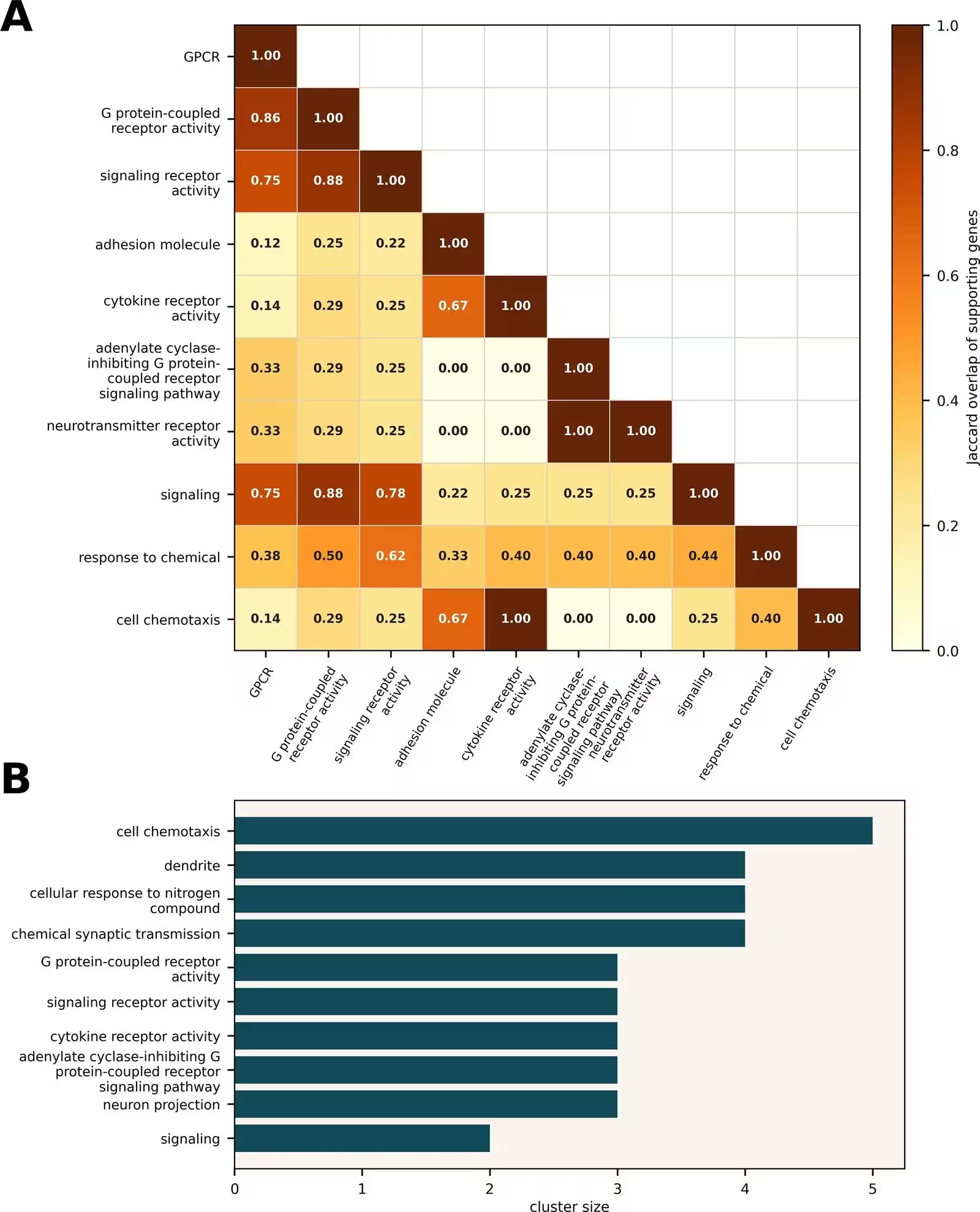
Figure 3: GPCR representative-term support and semantic-cluster structure. Both panels use the deterministic 1000-permutation GPCR output and clustering threshold of 0.58 used in Fig. 2 and Supplementary Fig. S6. (A) Jaccard overlap among supporting query-gene subsets for the 10 highest-ranked retained representatives. The heatmap reports supporting-gene overlap rather than semantic similarity. (B) The 10 largest of the 20 semantic neighborhoods formed from the 47 FDR-significant terms; neighborhood sizes therefore sum to no more than the complete 47-term analysis universe.
GPCR representative-term support and semantic-cluster structure. Both panels use the deterministic 1000-permutation GPCR output and clustering threshold of 0.58 used in Fig. 2 and Supplementary Fig. S6. (A) Jaccard overlap among supporting query-gene subsets for the 10 highest-ranked retained representatives. The heatmap reports supporting-gene overlap rather than semantic similarity. (B) The 10 largest of the 20 semantic neighborhoods formed from the 47 FDR-significant terms; neighborhood sizes therefore sum to no more than the complete 47-term analysis universe. Credit: Evan G W Robyns et al. / NAR genomics and bioinformatics

Resolving Complex Biological Landscapes in Practice

To demonstrate its utility beyond abstract benchmarks, the authors applied ORBIT to several real-world transcriptomic datasets. In a mixed-hard G protein-coupled receptor case study containing 12 input genes, the software reduced 47 false-discovery-rate-significant terms down to 20 semantic representatives, representing a 57.4 percent reduction in redundancy. This organization successfully highlighted major receptor signaling and neurotransmitter receptor activities without burying the primary signal in repetitive entries.

When tested on single-cell peripheral blood mononuclear cell marker genes from SeuratData, ORBIT mapped distinct biological signatures across nine immune populations, such as enriched secreted factors in natural killer cells and heightened enzyme representations in CD14-positive monocytes. Additional evaluations using interferon-stimulated peripheral blood mononuclear cells and breast cancer tumor subtypes from The Cancer Genome Atlas successfully recovered antiviral programs and distinguished basal-like proliferative cell cycles from luminal transporter activities.
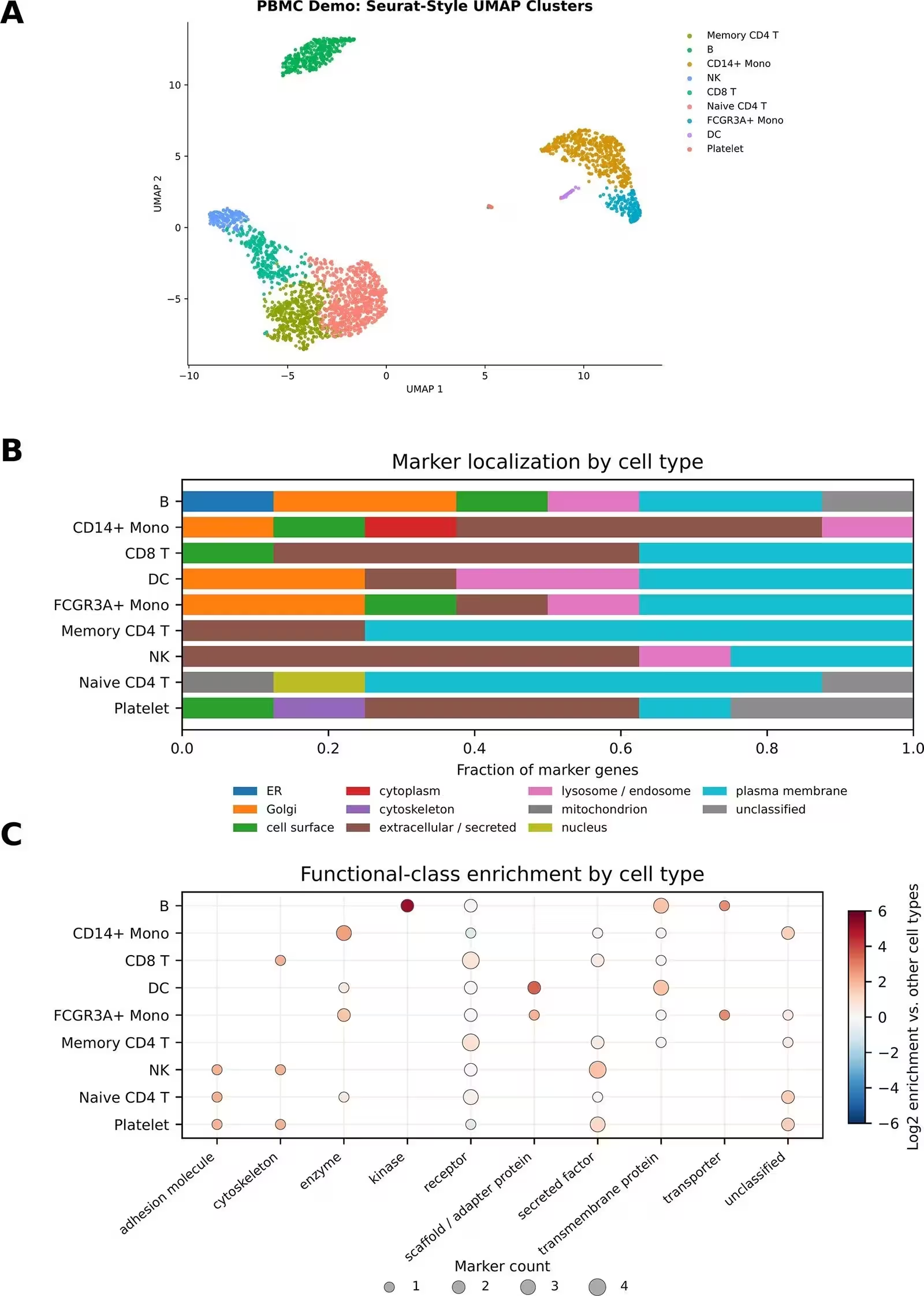
Figure 4: SeuratData PBMC3K single-cell marker interpretation with ORBIT. (A) UMAP of annotated PBMC3K cell populations used to define marker-gene inputs. (B) Fraction of the eight marker genes per cell type assigned to each localization class. (C) Functional-class enrichment relative to markers from all other cell types. Dot size indicates marker count, and color indicates log₂ enrichment calculated using a 0.5 pseudocount. Only classes with at least one marker in a cell type are plotted for that cell type. Markers without a class assignment are included as unclassified in the corresponding summaries..
SeuratData PBMC3K single-cell marker interpretation with ORBIT. (A) UMAP of annotated PBMC3K cell populations used to define marker-gene inputs. (B) Fraction of the eight marker genes per cell type assigned to each localization class. (C) Functional-class enrichment relative to markers from all other cell types. Dot size indicates marker count, and color indicates log₂ enrichment calculated using a 0.5 pseudocount. Only classes with at least one marker in a cell type are plotted for that cell type. Markers without a class assignment are included as unclassified in the corresponding summaries.. Credit: Evan G W Robyns et al. / NAR genomics and bioinformatics

Current Limitations and Future Improvements

Despite strong performance on curated functional classes, the authors noted important boundaries to the tool’s capabilities. When evaluated on 20 externally defined gene sets from the Molecular Signatures Database Hallmark collection, vocabulary-blinded semantic reranking did not outperform classical over-representation analysis, demonstrating that the ranking advantage is specific to targeted functional-class recovery rather than universal across all pathway analyses.

Furthermore, the developers noted that enzyme-class benchmark sets occasionally prioritized specific catalytic subtypes over broader generic labels, which can reduce expected-label recovery when targets are defined at coarser classification tiers. Future updates will incorporate explicit controls for functional granularity, allowing users to choose between broad biological summaries and fine-grained mechanistic details.

The research was published in NAR genomics and bioinformatics on November 18, 2026.

Fact Checked

This article has been fact checked for accuracy, with information verified against reputable sources. Learn more about us and our editorial process.

Last reviewed on .

Article history

  • Latest version

Reference(s)

  1. Robyns, Evan G W., et al. “ORBIT: annotation-aware empirical enrichment and semantic reranking for interpretable functional-class recovery.” NAR Genomics and Bioinformatics, vol. 8, no. 4, November 18, 2026 Oxford University Press (OUP), doi: 10.1093/nargab/lqag139. <https://doi.org/10.1093/nargab/lqag139>.

Cite this page:

Taylor, Elizabeth. “New Tool Cuts Genomic Table Redundancy With Semantic Reranking.” BioScience. BioScience ISSN 2521-5760, 21 November 2026. <https://www.bioscience.com.pk/en/subject/genetics/orbit-annotation-aware-empirical-enrichment-and-semantic-reranking-for-interpretable-functional-class-recovery>. Taylor, E. (2026, November 21). “New Tool Cuts Genomic Table Redundancy With Semantic Reranking.” BioScience. ISSN 2521-5760. Retrieved November 21, 2026 from https://www.bioscience.com.pk/en/subject/genetics/orbit-annotation-aware-empirical-enrichment-and-semantic-reranking-for-interpretable-functional-class-recovery Taylor, Elizabeth. “New Tool Cuts Genomic Table Redundancy With Semantic Reranking.” BioScience. ISSN 2521-5760. https://www.bioscience.com.pk/en/subject/genetics/orbit-annotation-aware-empirical-enrichment-and-semantic-reranking-for-interpretable-functional-class-recovery (accessed November 21, 2026).
End of the article