Massive Audit Reveals 85 Percent of Public Microbiome Data Is Unusable for AI
A new evaluation of nearly 3,000 studies shows that missing biological metadata is stalling artificial intelligence breakthroughs in microbiome science.
A massive audit of 2,896 human microbiome studies reveals that roughly 85 percent of publicly available sequencing samples are completely unusable for modern artificial intelligence training because they lack basic biological details like disease status, age, and sex. Researchers analyzed literature published between 2012 and 2025 and found that while scientists are uploading raw DNA data to public archives more frequently, the essential contextual information required to interpret those genetic sequences remains trapped behind a self-reported honor system.
The human microbiome consists of trillions of microorganisms living in and on our bodies, and analyzing these communities can help scientists understand diseases ranging from inflammatory bowel disorders to obesity. However, building artificial intelligence models that can reliably predict health outcomes from genetic data requires enormous, standardized datasets where every single sample is clearly annotated. To evaluate how well the scientific community meets this goal, a large consortium of researchers conducted a systematic review following standard PRISMA guidelines, as published in iMeta.
How the Research Team Audited Global Microbiome Data
The study authors initially screened 23,781 scientific articles before identifying 2896 human microbiome publications involving DNA sequencing from more than 50 countries and six continents. They established a four-tier classification system called Biological Host-Associated AI-Ready Metadata, or BHAM, to rank each study based on how easily another researcher could reuse its data without having to contact the original authors.
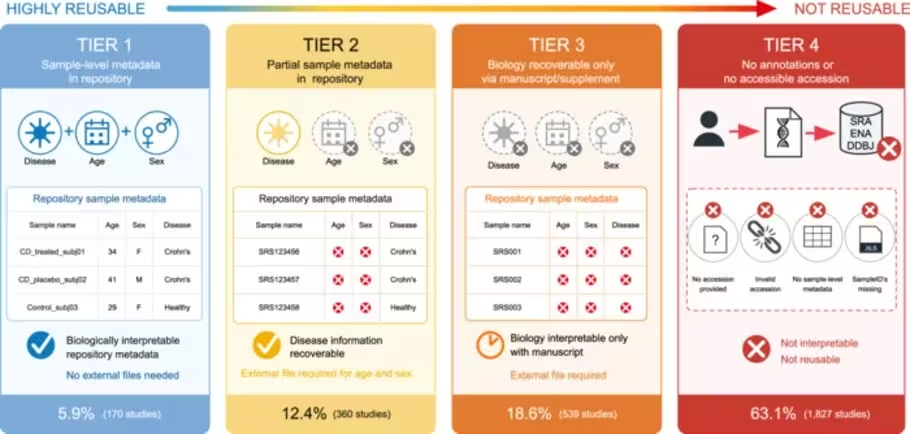
Tier 1 represented the highest standard of reusability, where per-sample host disease status, age, and sex were fully recorded in the public repository. Tier 2 studies included per-sample disease status in a metadata field or within informative sample names, while Tier 3 provided raw sequence access with unique sample identifiers but zero host metadata. Tier 4 captured studies with no accessible accession codes or completely missing sample-level identifiers.
Why Most Public Microbiome Samples Fail Reusability Standards
The results of the audit showed that only 5.9 percent of the analyzed studies, accounting for just 170 papers, reached Tier 1 status. Another 360 studies reached Tier 2, and 539 achieved Tier 3. A staggering 63.1 percent of the papers fell into Tier 4 because they lacked accessible sequencing data or sample identifiers altogether.
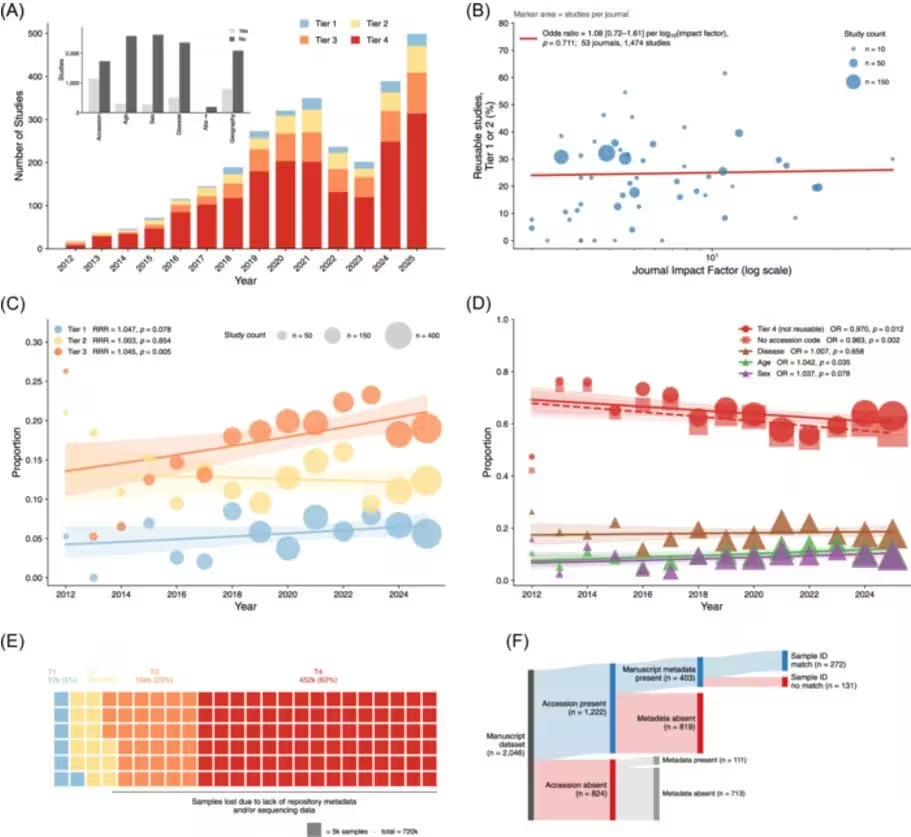
When calculating sample sizes across all repositories, the authors determined that out of approximately 720,097 total microbiome samples, about 615,739 samples, or 85.5 percent, are effectively lost to large-scale computational research due to missing metadata. Even among studies that provided public accession numbers, manuscript-specific metadata files were rare and frequently suffered from mismatched sample identifiers.
What These Findings Mean for Artificial Intelligence and Future Research
The analysis also tracked trends over time from 2012 to 2025 and found that while obtaining public accession codes improved slightly, per-sample biological annotation did not meaningfully increase. The authors suggest that current incentive structures, journal guidelines, and funding agency mandates are insufficient to drive the behavioral changes required for robust data sharing.
To fix this reusability crisis, the research team recommends updating repository submission workflows to make key demographic and clinical fields mandatory, leveraging automated artificial intelligence tools during peer review to check metadata completeness, and establishing citable identifiers for database deposits. Without these structural reforms, billions of dollars in publicly funded research will continue to generate data that artificial intelligence cannot leverage.
The research was published in iMeta on November 18, 2026.
This article has been fact checked for accuracy, with information verified against reputable sources. Learn more about us and our editorial process.
Last reviewed on .
Article history
- Latest version
Reference(s)
- Degregori, Samuel., et al. “A decade‐scale audit of microbiome AI‐readiness.” iMeta, November 18, 2026 Wiley, doi: 10.1002/imt2.70192. <https://doi.org/10.1002/imt2.70192>.
Cite this page:
- Posted by Elizabeth Taylor