Researchers Combine Artificial Intelligence And Nanosensors To Boost Drug Delivery Tracking Accuracy By 60 Percent While Highlighting Validation Hurdles
New review details how machine learning and nanoscale detectors improve real-time pharmaceutical monitoring despite lingering black-box and drift challenges.
Researchers at Discover Nano have harnessed advanced artificial intelligence and nanosensor arrays to track drug delivery behavior with a 60 percent boost in analytical sensitivity. This laboratory-scale study demonstrates how merging machine learning with high-resolution sensors can overcome the limits of traditional chemical testing.
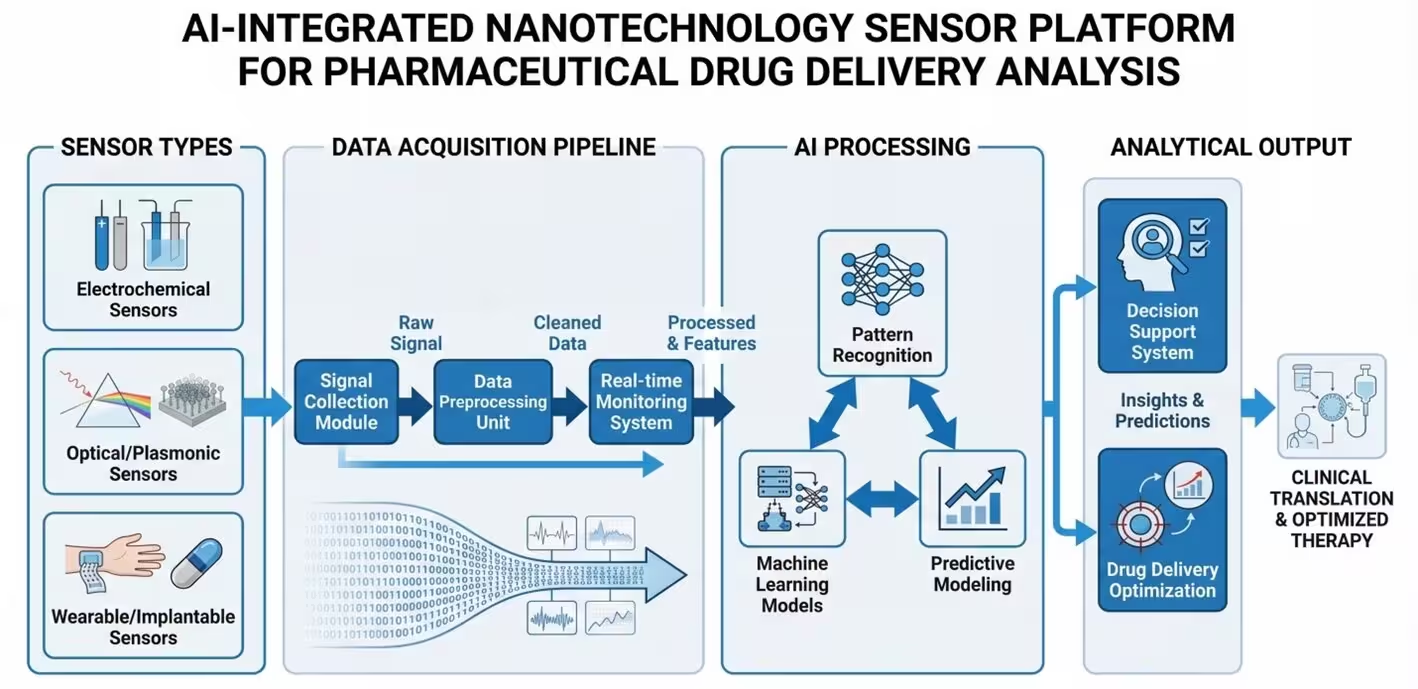
Modern pharmaceutical research relies heavily on analytical chemistry to track how medications move through complex biological environments. Advanced drug carriers such as polymeric nanoparticles and liposomes create intricate datasets that standard linear models struggle to interpret. Annasaheb S. Gaikwad published the study in Discover Nano, detailing how computational models can decode overlapping signals from these sophisticated delivery platforms.
How Machine Learning Overcomes Complex Chemical Data Limits
For years, scientists used classical chemometrics like principal component analysis to evaluate drug formulations. Now, deep learning networks can directly process nonlinear relationships without making strict prior assumptions. These computational models excel at signal deconvolution, separating overlapping peaks in chromatographic data and improving pattern recognition across spectroscopic platforms.
The transition introduces unique challenges regarding model interpretability and regulatory validation. Traditional analytical chemistry offers high transparency, whereas advanced neural networks often function as black boxes. Researchers must balance predictive power with chemical clarity to ensure methods meet strict pharmaceutical standards.
What Nanosensors Bring to Real-Time Delivery Tracking
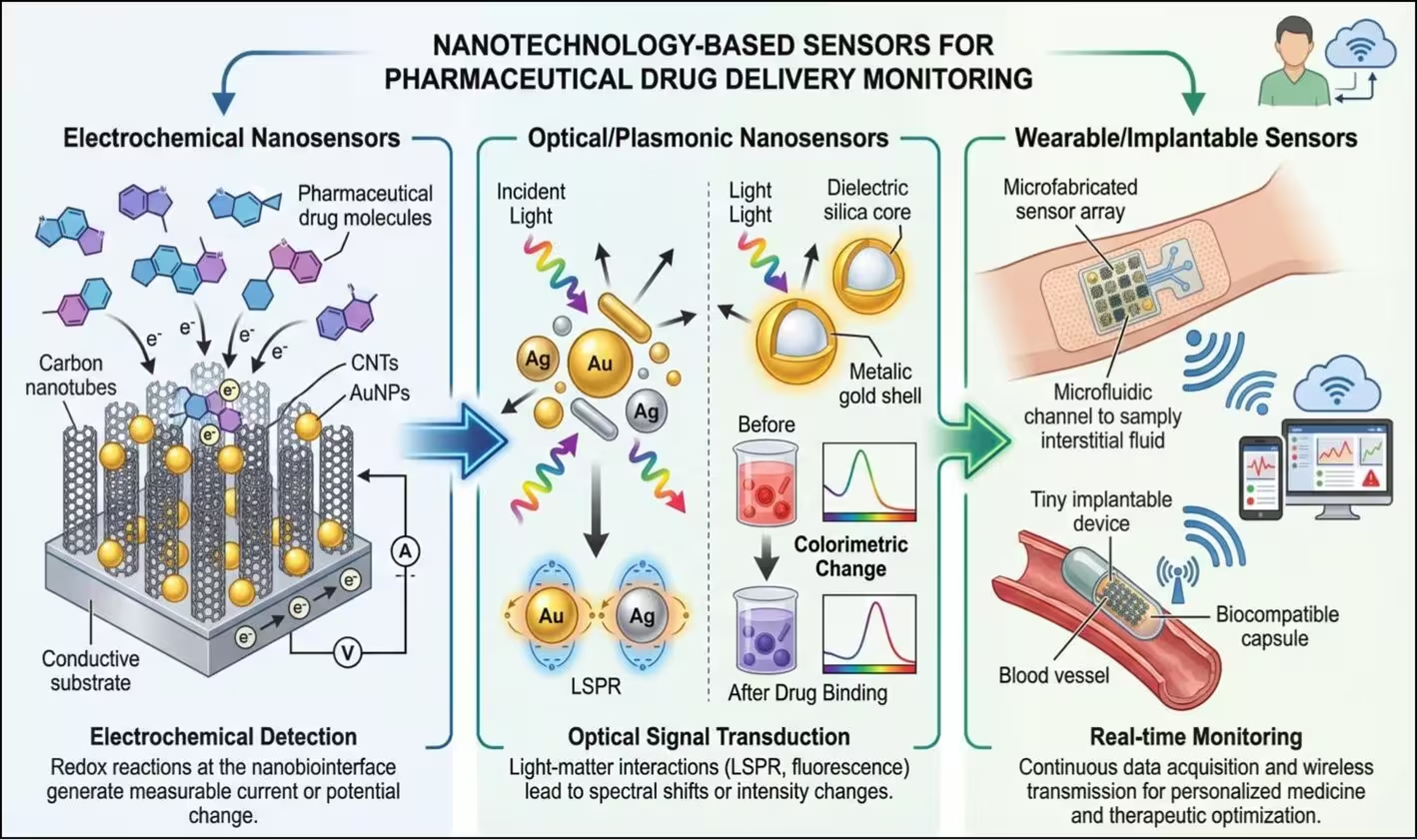
Nanotechnology-enabled sensors exploit nanoscale physical phenomena to measure chemical concentrations with remarkable speed. Electrochemical nanosensors and optical plasmonic devices provide high surface-to-volume ratios that lower detection limits to nanomolar scales. These miniature tools allow scientists to track release kinetics and environmental changes in situ.
Sensor stability remains a persistent hurdle during long-term operational monitoring. Factors like surface fouling and signal drift can degrade performance over time. Integrating AI algorithms helps denoise these fluctuating signals, maintaining data accuracy across extended experimental runs.
Why Regulatory Standards and Validation Must Evolve
Regulatory frameworks enforced by agencies such as the FDA and EMA emphasize reproducibility and auditability. Dynamic AI models that update through continuous learning challenge these conventional validation workflows. Establishing standardized testing protocols is essential for bridging the gap between benchtop innovation and clinical translation.
Future progress depends on developing explainable artificial intelligence models that provide clear links between sensor readouts and physicochemical mechanisms. Researchers are also exploring digital twin simulations to model patient-specific drug behavior under varied physiological conditions.
The research was published in Discover Nano on November 27, 2026.
This article has been fact checked for accuracy, with information verified against reputable sources. Learn more about us and our editorial process.
Last reviewed on .
Article history
- Latest version
Reference(s)
- Gaikwad, Annasaheb S. “AI driven analytical chemistry and nanotechnology sensors for pharmaceutical drug delivery current methodologies limitations and future integration challenges.” Discover Nano, vol. 21, no. 1, November 27, 2026 Springer Science and Business Media LLC, doi: 10.1186/s11671-026-04969-w. <https://doi.org/10.1186/s11671-026-04969-w>.
Cite this page:
- Posted by Anjali Singh