New Algorithm Solves Robot Navigation Dead-Ends Using Adaptive Waypoints
An optimization-based framework helps mobile robots and wheelchairs bypass obstacle traps where traditional guidance systems fail.
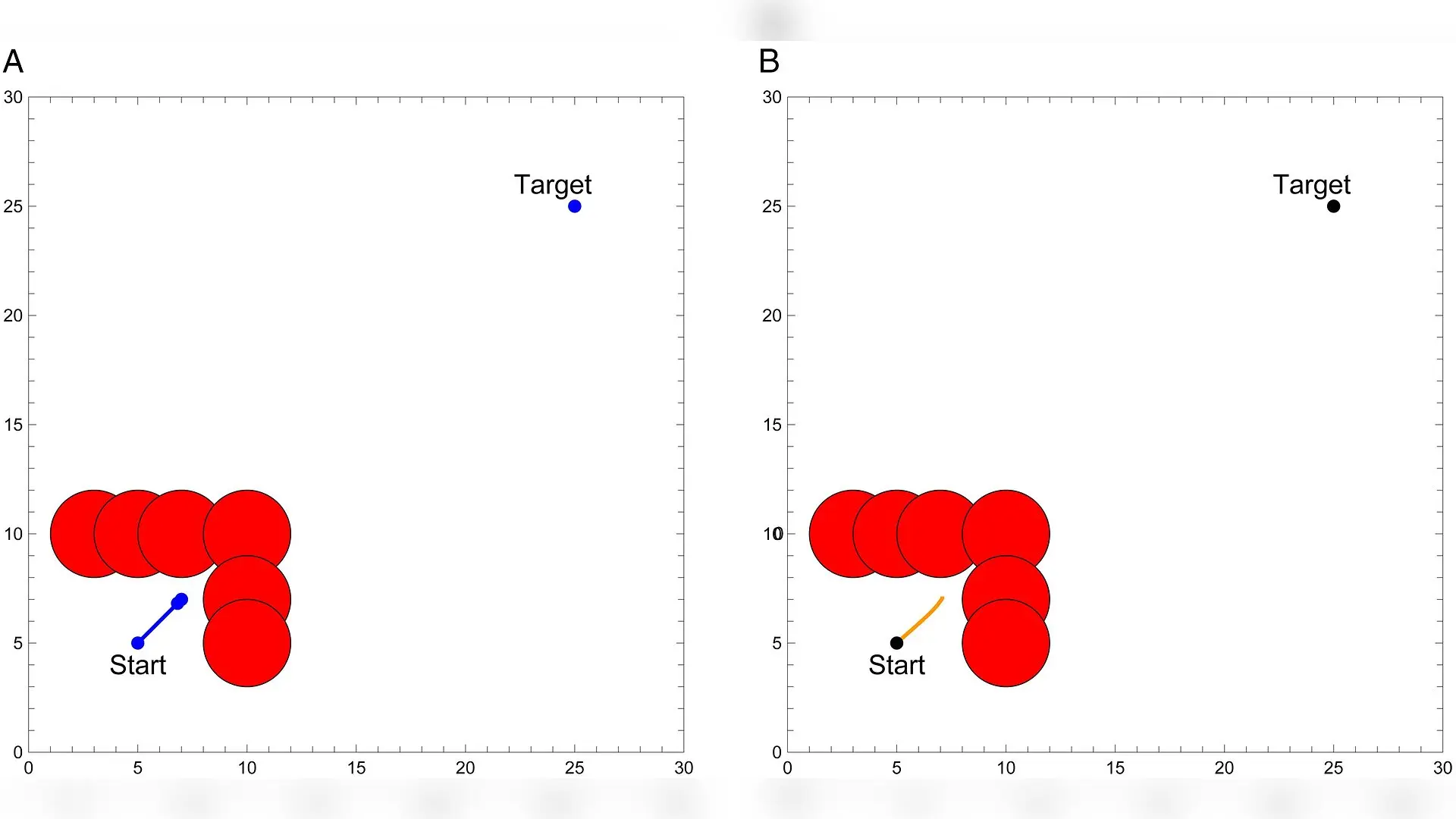
Autonomous mobile robots struggle to navigate cluttered indoor spaces because standard guidance algorithms frequently become trapped behind obstacles, but a newly engineered waypoint navigation technique offers a solution for preventing these motion dead-ends. When a delivery robot or automated wheelchair moves toward a destination, it often relies on the Artificial Potential Field method, a mathematical approach that pulls the machine toward its target while pushing it away from barriers. However, this method frequently suffers from the local minima problem, a mathematical trap where opposing forces cancel each other out and leave the robot stranded in open space. Researchers have now developed an adaptive optimization framework that automatically injects safe intermediate targets to steer mobile platforms around tricky blockages.
The research team, consisting of Avinesh Prasad, Vishal Chand, Sushita Sharma, Priynka Sharma, and Sandeep Ameet Kumar from The University of the South Pacific, detailed their findings in a study published in PLOS One. Traditional potential field systems fail when an obstacle sits directly between the start point and the destination, creating an equilibrium zone where forward motion drops to zero. Instead of altering the core potential equations or using heavy global planners, the new approach uses a continuous segment-wise collision check. When a direct line to the goal is blocked, the algorithm evaluates a finite set of candidate points across the workspace, filtering out unsafe locations and picking a temporary subgoal.
How Adaptive Waypoints Break Through Navigation Traps
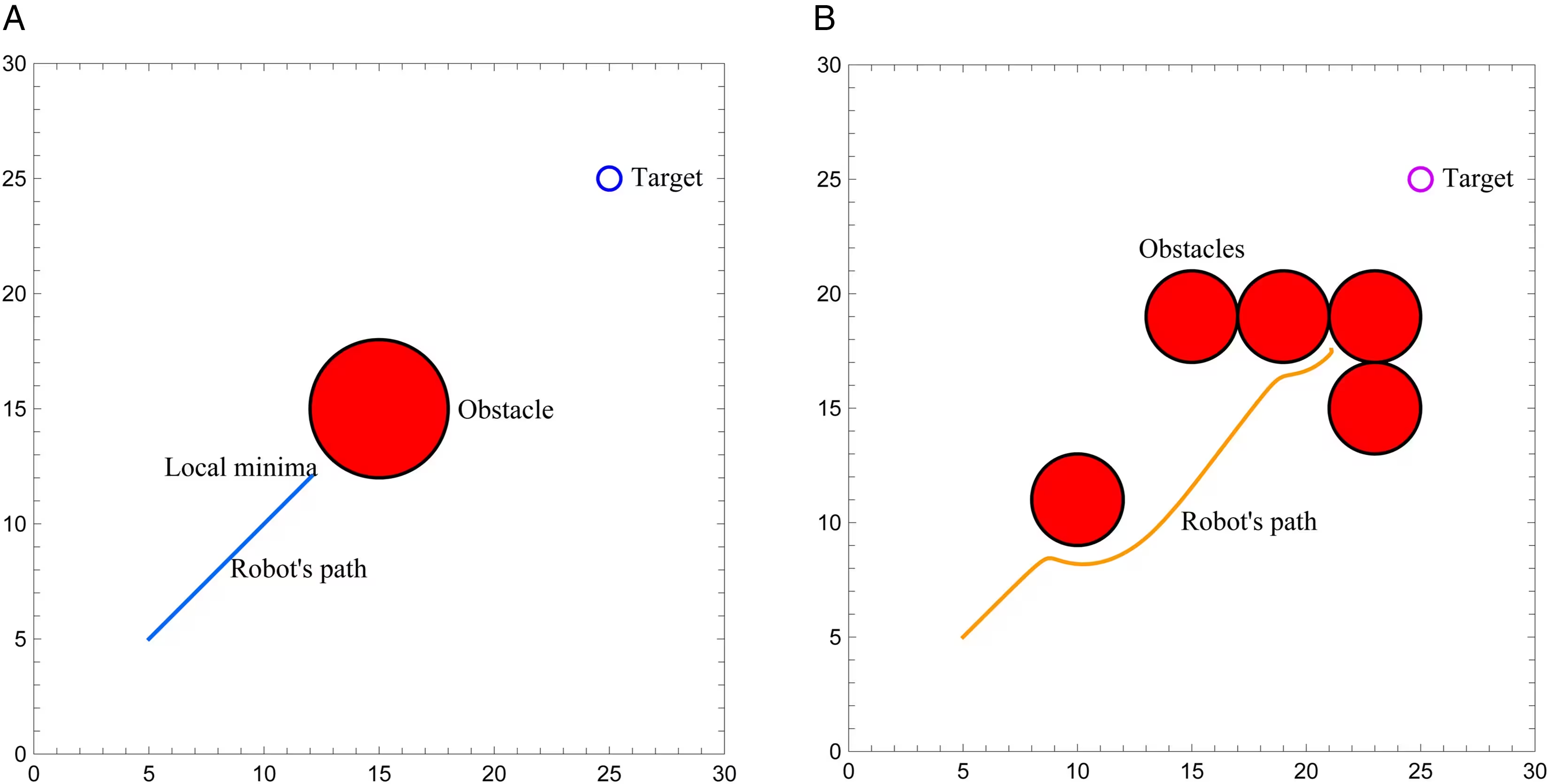
To keep computation fast and avoid heavy mathematical overhead, the framework uses a geometric heuristic based on the centroid of blocking obstacles. This reference point guides the selection of a temporary subgoal that forces the robot to step around the hazard without losing sight of the final target. The team tested the system on both simple point-mass models and complex nonholonomic wheelchair simulations featuring rear drive wheels and front castor wheels.
In simulated environments containing up to 50 randomly distributed obstacles, the adaptive waypoint generator successfully guided robots through tight corridors and concave dead-end traps where standard potential field navigation failed entirely. In comparative benchmarks against stochastic planners like ant colony optimization and firefly algorithms, the new approach achieved success rates of 100 percent in 10-obstacle tests and 99 percent in 20-obstacle tests, while consistently cutting travel times down significantly across successful runs.
Understanding the Trade-Offs and Future Steps
Despite its high success rate in low-to-moderately cluttered environments, the method exhibits clear limitations as obstacle density peaks. In extreme scenarios containing 50 obstacles, the success rate dropped to 21 percent because the finite candidate set occasionally lacked valid points satisfying strict forward-progress rules. Furthermore, because the robot slows down to converge on each intermediate waypoint before turning toward the next, cumulative travel time can occasionally exceed that of pure potential field driving when obstacles are sparse.
The authors emphasize that the current framework assumes static and fully known obstacle maps, meaning future research must adapt the system for moving objects and sensor uncertainty. Expanding the algorithm to handle three-dimensional aerial drones and robotic arms while optimizing trajectory smoothness and energy consumption represents the next phase of development for safe autonomous robotics.
The research was published in PLOS One on October 21, 2026.
This article has been fact checked for accuracy, with information verified against reputable sources. Learn more about us and our editorial process.
Last reviewed on .
Article history
- Latest version
Reference(s)
- Prasad, Avinesh., et al. “An optimization-based waypoint generation method for overcoming local minima in artificial potential field navigation.” PLOS One, vol. 21, no. 10, October 21, 2026, pp. e0360512 Public Library of Science (PLoS), doi: 10.1371/journal.pone.0360512. <https://doi.org/10.1371/journal.pone.0360512>.
- Posted by Robert Brown