Common Bee Viruses Alter Flight Performance Through Stress Pathways
Biology

Common Bee Viruses Alter Flight Performance Through Stress Pathways

Invisible viral infections reshape honey bee stamina and energy production by hijacking the insect fight-or-flight chemical signaling network.
By Hassan Raza
Published:
Email this Article
Common Bee Viruses Alter Flight Performance Through Stress Pathways
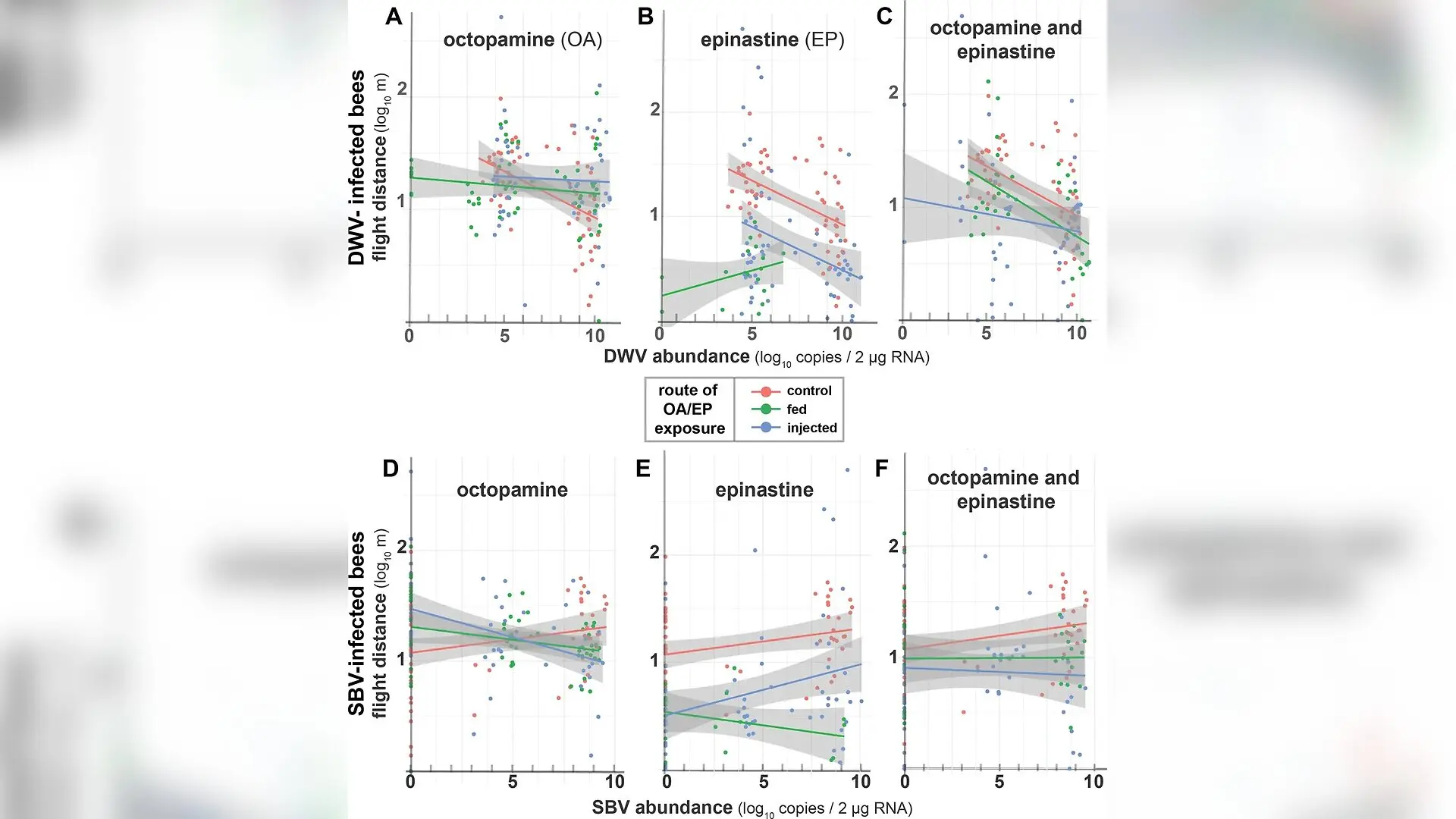
The flight performance of honey bees infected with DWV and/or SBV is differentially impacted by OA and EP treatment. To evaluate the involvement of the OA pathway on virus infection and/or flight performance, virus- or mock-infected honey bees were exposed to OA, EP, or both OA and EP via co-injection (blue) or feeding (green). Honey bees were experimentally infected with or had preexisting infections of DWV (A–C) or SBV (D–F) in three experiments. Flight distance (log10 m) was evaluated using linear mixed effect models to quantify impacts of DWV and/or SBV infection in the context of OA and/or EP treatment. Each data point represents an individual bee (n=336); colors indicate treatment (i.e. bees fed only sucrose in pink, bees fed OA and/or EP in green, and bees injected with OA and/or EP in blue) and gray areas represent 95% confidence intervals. Linear mixed models with estimates in Source data 1, data S4. (A) In bees fed only sucrose, DWV infections negatively impacted flight dista Naomi G Kaku et al. / eLife

Honey bees infected with common viruses show drastically altered flight performance and energy regulation driven by chemical signaling pathways, according to a study published in eLife.

Researchers Naomi G. Kaku and Michelle L. Flenniken at Montana State University investigated how invisible viral infections change insect behavior. High annual honey bee colony losses, which averaged 40 percent in the United States between 2008 and 2025, are closely linked to pathogens such as viruses. Many adult bees harbor high levels of viruses without displaying obvious external signs like wing deformities or larval death, making it vital to understand how these silent infections impact daily survival.

How Two Common Honey Bee Viruses Diverge in Flight Effects

To measure the subtle impacts of asymptomatic infections, the scientists tracked individual honey bee flight endurance, distance, and speed using specialized flight mills that act like insect treadmills. They focused on two prevalent pathogens with positive single-stranded RNA genomes: deformed wing virus, which replicates in Varroa destructor mites, and sacbrood virus, which is mechanically transmitted.

Deformed wing virus infected bees performed exactly as expected by flying significantly shorter distances and at slower speeds compared to uninfected controls. Mock-infected bees with low virus levels flew an estimated 45 meters, whereas bees harboring high deformed wing virus loads flew only about 9 meters. In contrast, honey bees infected with sacbrood virus displayed a surprising enhancement, flying farther distances and at faster speeds than healthy bees.
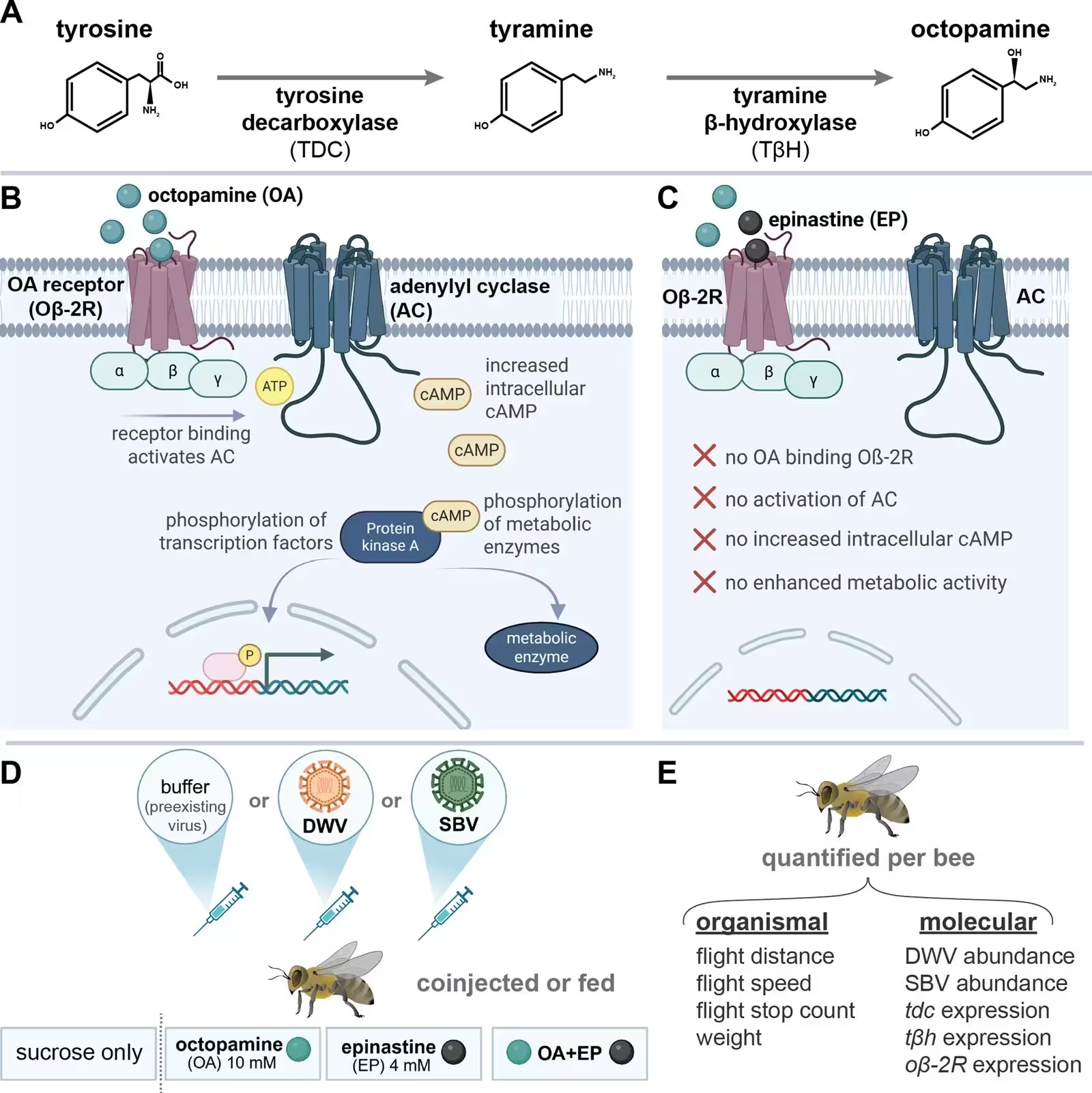
Figure 1: Octopamine (OA) signaling pathway (i.e. synthesis, activation, inhibition and experimental design). (A) OA is synthesized by conversion of tyrosine to tyramine by tyrosine decarboxylase (TDC) and tyramine conversion to OA by tyramine β-hydroxylase (TβH). (B) OA β–2 receptor (Oβ–2R) is one of the most abundant and specific OA-detecting receptors. Upon activation of Oβ–2R, a G-coupled protein receptor, adenylyl cyclase (AC) is activated and increases intracellular cyclic adenylyl monophosphate (cAMP) levels. High cAMP levels induce protein kinase A activity, which phosphorylates metabolic enzymes and transcription factors that enhance metabolic activity. (C) An OA receptor antagonist, epinastine (EP), inhibits OA binding and prevents activation of the Oβ–2R pathway. (D) To evaluate relationships between virus infection and the OA response, honey bees were inoculated with either deformed wing virus (DWV) or sacbrood virus (SBV) via injection or mock infected. Bees were exposed to either O
Octopamine (OA) signaling pathway (i.e. synthesis, activation, inhibition and experimental design). (A) OA is synthesized by conversion of tyrosine to tyramine by tyrosine decarboxylase (TDC) and tyramine conversion to OA by tyramine β-hydroxylase (TβH). (B) OA β–2 receptor (Oβ–2R) is one of the most abundant and specific OA-detecting receptors. Upon activation of Oβ–2R, a G-coupled protein receptor, adenylyl cyclase (AC) is activated and increases intracellular cyclic adenylyl monophosphate (cAMP) levels. High cAMP levels induce protein kinase A activity, which phosphorylates metabolic enzymes and transcription factors that enhance metabolic activity. (C) An OA receptor antagonist, epinastine (EP), inhibits OA binding and prevents activation of the Oβ–2R pathway. (D) To evaluate relationships between virus infection and the OA response, honey bees were inoculated with either deformed wing virus (DWV) or sacbrood virus (SBV) via injection or mock infected. Bees were exposed to either O Credit: Naomi G Kaku et al. / eLife

The Role of the Octopamine Stress Response Pathway

The research team explored whether these contrasting physical outcomes were tied to octopamine, a small neurohormone molecule in invertebrates that acts similarly to the mammalian fight-or-flight hormone norepinephrine. Octopamine orchestrates energy mobilization, temperature regulation, and movement by binding to specific cellular receptors such as the octopamine beta-2 receptor.

To test the mechanism, the authors exposed virus-infected honey bees to octopamine, epinastine, which is an octopamine receptor antagonist that blocks signaling, or a combination of both through injections and diet. Administering octopamine successfully rescued flight deficits in deformed wing virus infected bees, increasing their flight duration to levels comparable to healthy controls. However, treating sacbrood virus infected bees with octopamine unexpectedly diminished their flight performance.
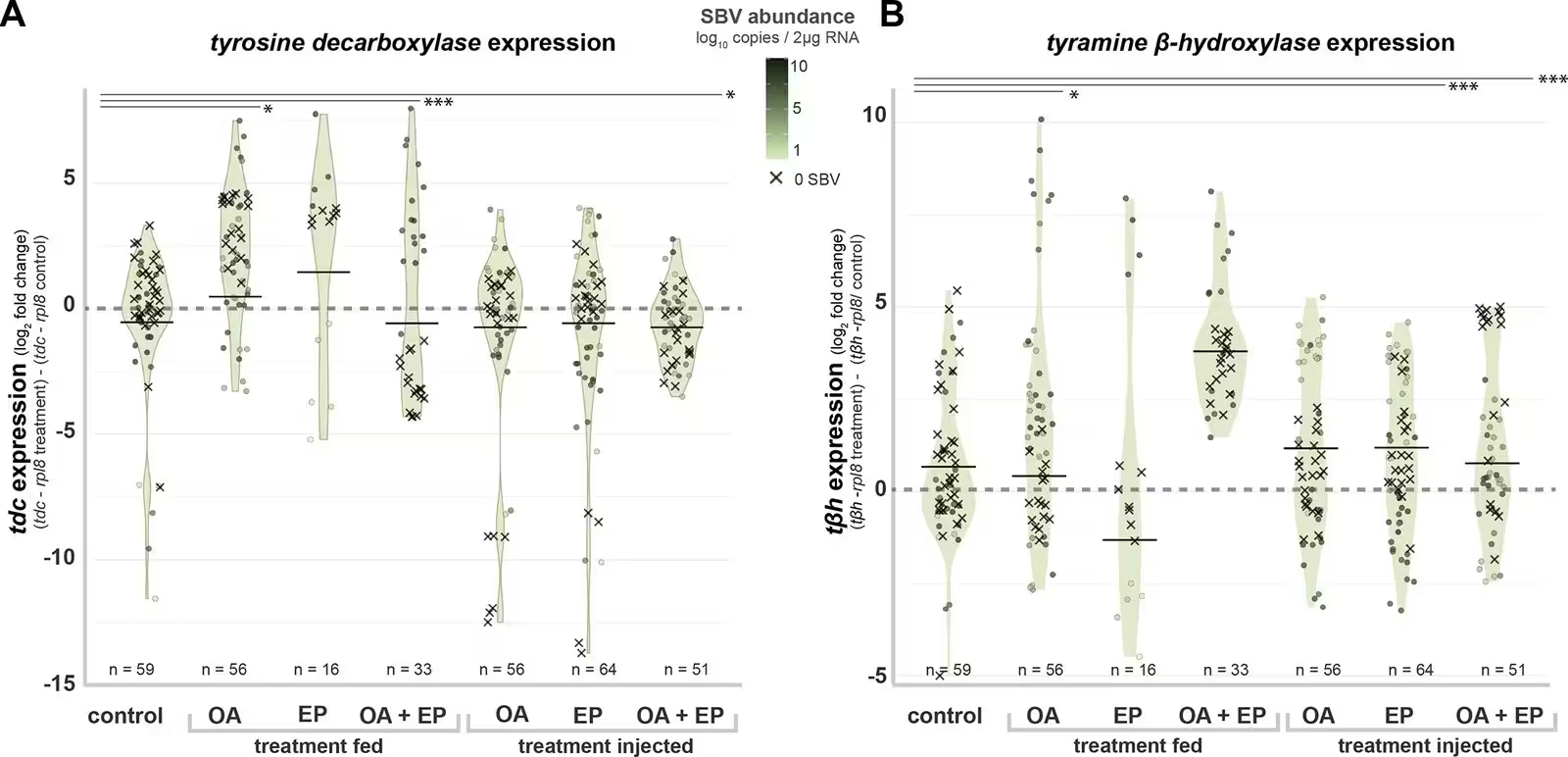
Figure 3: Expression of tyrosine decarboxylase (tdc) and tyramine β-hydroxylase (tβh) across treatments and SBV infection. The relationships between honey bee tdc and tβh expression in the context of virus infection and treatments were evaluated using a linear mixed effect model that included SBV abundance and OA/EP treatments as fixed effects with an interaction. Individual honey bee data plotted by treatment group with either (A) tdc expression or (B) tβh expression. Gene expression was calculated as log2 fold change using the ΔΔCt method relative to housekeeping rpl8 and compared to mock-infected bees. SBV abundance was calculated as log10 copies/2 µg RNA. The background violin plots represent the 95% confidence interval, and the horizontal line in each violin represents the median. SBV abundance is represented by a green color scale and SBV-negative samples with an ‘X’. When SBV abundance did not impact tdc or tβh expression the dark green points are evenly distributed above and below the co
Expression of tyrosine decarboxylase (tdc) and tyramine β-hydroxylase (tβh) across treatments and SBV infection. The relationships between honey bee tdc and tβh expression in the context of virus infection and treatments were evaluated using a linear mixed effect model that included SBV abundance and OA/EP treatments as fixed effects with an interaction. Individual honey bee data plotted by treatment group with either (A) tdc expression or (B) tβh expression. Gene expression was calculated as log2 fold change using the ΔΔCt method relative to housekeeping rpl8 and compared to mock-infected bees. SBV abundance was calculated as log10 copies/2 µg RNA. The background violin plots represent the 95% confidence interval, and the horizontal line in each violin represents the median. SBV abundance is represented by a green color scale and SBV-negative samples with an ‘X’. When SBV abundance did not impact tdc or tβh expression the dark green points are evenly distributed above and below the co Credit: Naomi G Kaku et al. / eLife

Gene Expression Reveals Complex Metabolic Trade-Offs

Transcriptome analyses and quantitative polymerase chain reaction assays revealed that the two viruses perturb metabolic pathways and chemical synthesis differently. Sacbrood virus infections naturally induced higher expression of the octopamine receptor and key synthesis enzymes including tyrosine decarboxylase, which converts tyrosine to tyramine, and tyramine beta-hydroxylase, which converts tyramine into octopamine.

When sacbrood virus infected bees received extra octopamine supplementation, the expression of these synthesis genes dropped, pointing to a potential feedback loop that regulates internal neurohormone concentrations. Meanwhile, treating deformed wing virus infected bees with octopamine activated glucose metabolism genes and mitochondrial energy production pathways, helping explain their physical recovery on the flight mill.

Broader Implications for Colony Health and Miticide Use

These findings demonstrate that invisible virus infections reshape insect stamina through neurohormonal pathways, which may alter foraging efficiency and disease transmission inside the hive. The authors note that agricultural chemicals like amitraz, which are miticides used to control Varroa mites and act as octopamine receptor agonists, might interact with these stress pathways. Because managed colonies frequently experience coinfections, cumulative exposure to miticides and viral stress could create unintended physiological harms that warrant further study.

The research was published in eLife on November 9, 2026.

Fact Checked

This article has been fact checked for accuracy, with information verified against reputable sources. Learn more about us and our editorial process.

Last reviewed on .

Article history

  • Latest version

Reference(s)

  1. Kaku, Naomi G., et al. “Virus-specific impacts on honey bee flight performance are mediated by the octopamine pathway.” eLife, vol. 15, November 9, 2026 eLife Sciences Publications, Ltd, doi: 10.7554/eLife.111072. <https://doi.org/10.7554/eLife.111072>.

Cite this page:

Raza, Hassan. “Common Bee Viruses Alter Flight Performance Through Stress Pathways.” BioScience. BioScience ISSN 2521-5760, 11 November 2026. <https://www.bioscience.com.pk/en/subject/biology/virus-specific-impacts-on-honey-bee-flight-performance-are-mediated-by-the-octopamine-pathway>. Raza, H. (2026, November 11). “Common Bee Viruses Alter Flight Performance Through Stress Pathways.” BioScience. ISSN 2521-5760. Retrieved November 11, 2026 from https://www.bioscience.com.pk/en/subject/biology/virus-specific-impacts-on-honey-bee-flight-performance-are-mediated-by-the-octopamine-pathway Raza, Hassan. “Common Bee Viruses Alter Flight Performance Through Stress Pathways.” BioScience. ISSN 2521-5760. https://www.bioscience.com.pk/en/subject/biology/virus-specific-impacts-on-honey-bee-flight-performance-are-mediated-by-the-octopamine-pathway (accessed November 11, 2026).
End of the article