Hidden Membrane Proteins Drive Over 20 Non-Cancerous Diseases
A major new review reveals how secretive gatekeepers across cellular membranes control everything from immunity to neurodegeneration.
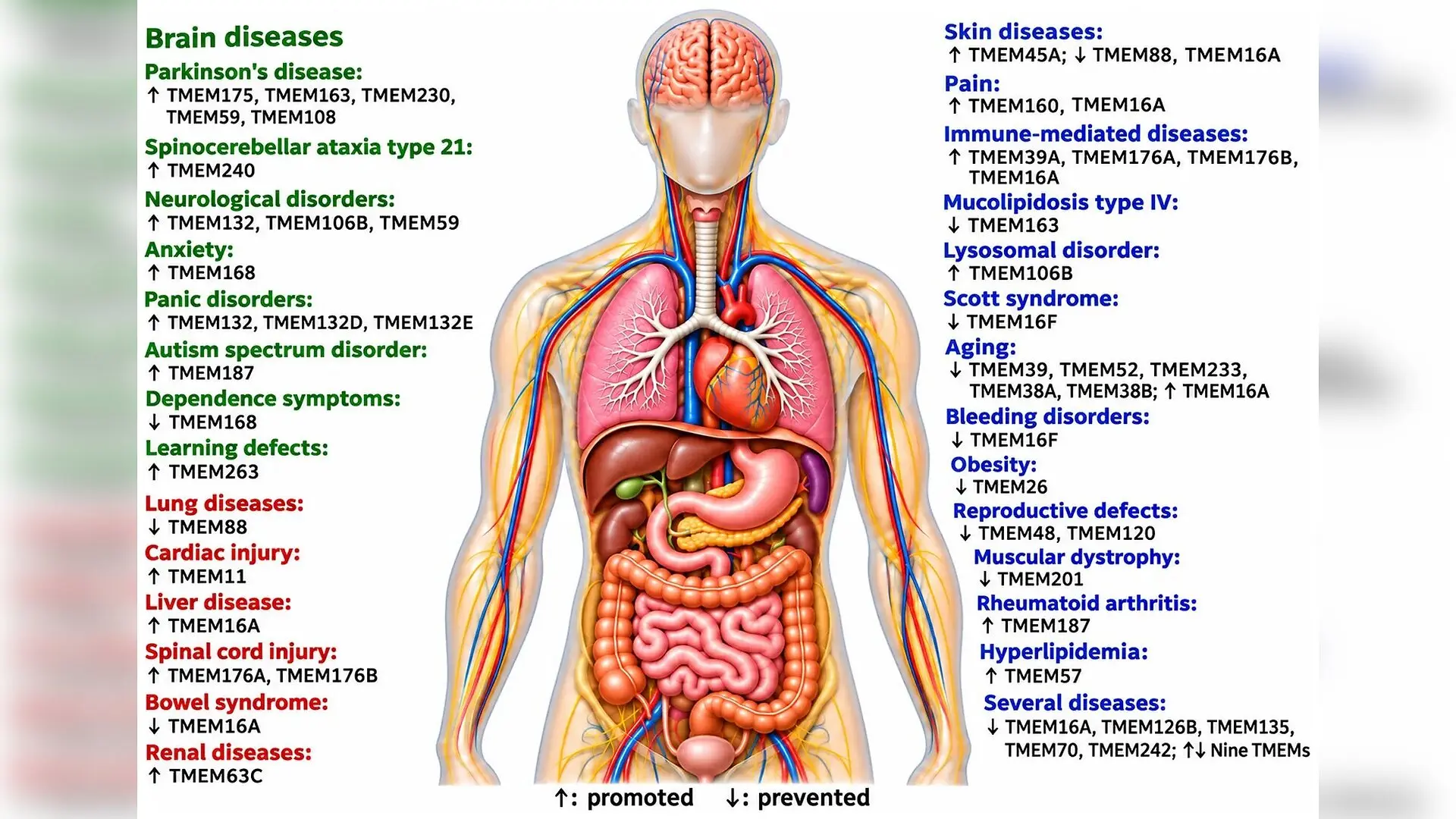
Transmembrane proteins spanning cellular membranes regulate fundamental biological processes, yet their disruptions drive over 20 non-cancerous diseases ranging from rare bleeding disorders to neurodegeneration. A comprehensive review published in the International Journal of Molecular Medicine maps how these poorly understood proteins operate across various cellular compartments to govern everything from calcium signaling to organelle maintenance.
How Over 300 Cellular Gatekeepers Operate Across Compartments
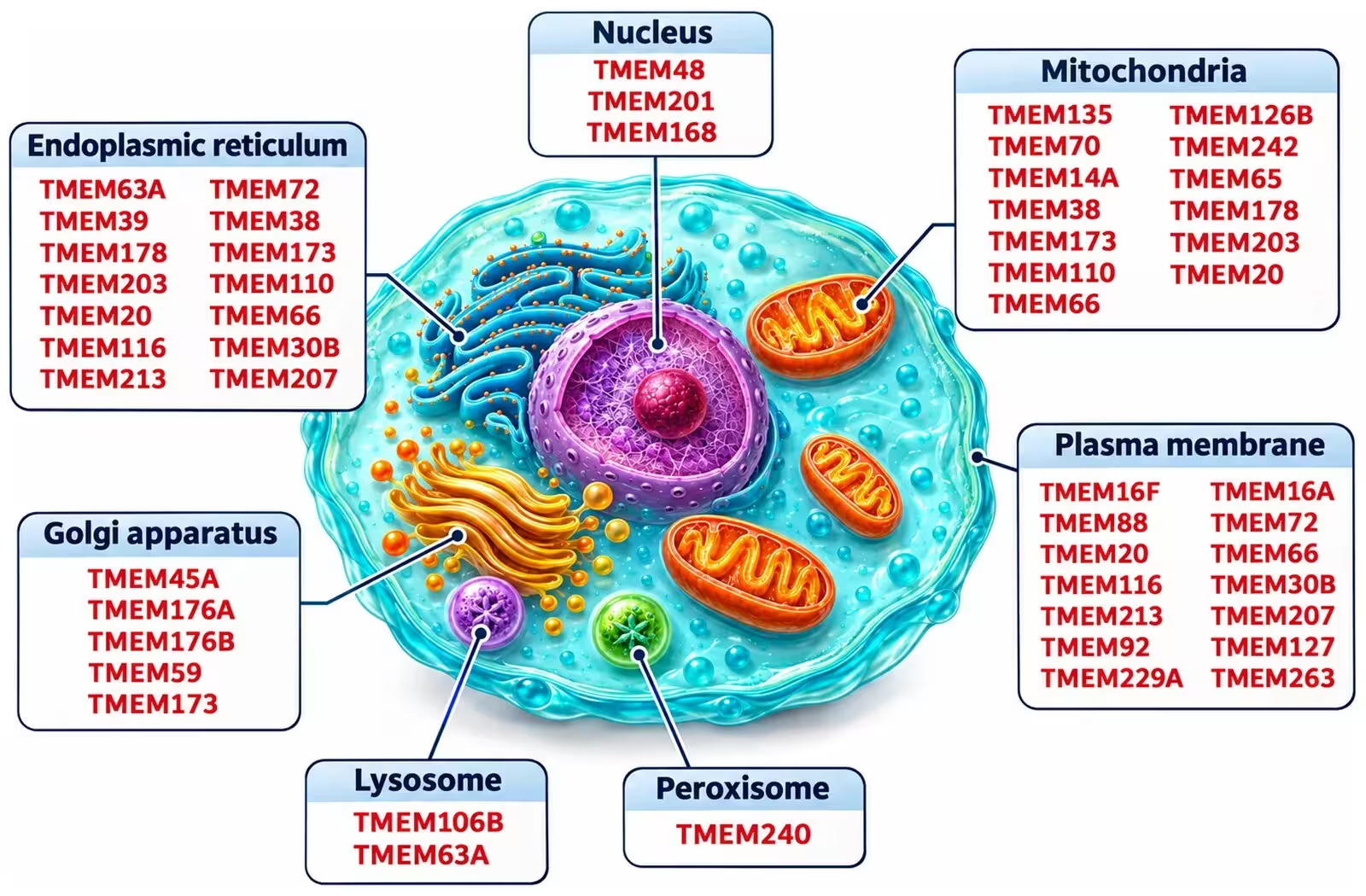
Historically classified as proteins of unknown function based on their hydrophobic membrane-spanning regions, transmembrane proteins are now known to form a massive family exceeding 300 members. Researchers Pei-Feng Liu and colleagues organized these proteins based on their experimentally validated locations, including the plasma membrane, endoplasmic reticulum, Golgi apparatus, mitochondria, lysosomes, and nuclear envelope. Each organelle relies on specific transmembrane proteins to maintain internal stability and manage molecular transport.
For instance, plasma membrane proteins like TMEM16A and TMEM16F act as ion channels and lipid regulators. Inside the endoplasmic reticulum, proteins such as TMEM39 regulate collagen export and stress responses. Meanwhile, mitochondrial variants like TMEM126B and TMEM135 assist in respiratory chain assembly and fission dynamics, proving vital for high-energy tissues like the brain and heart.
Connecting Seemingly Unrelated Illnesses Through Shared Cellular Faults
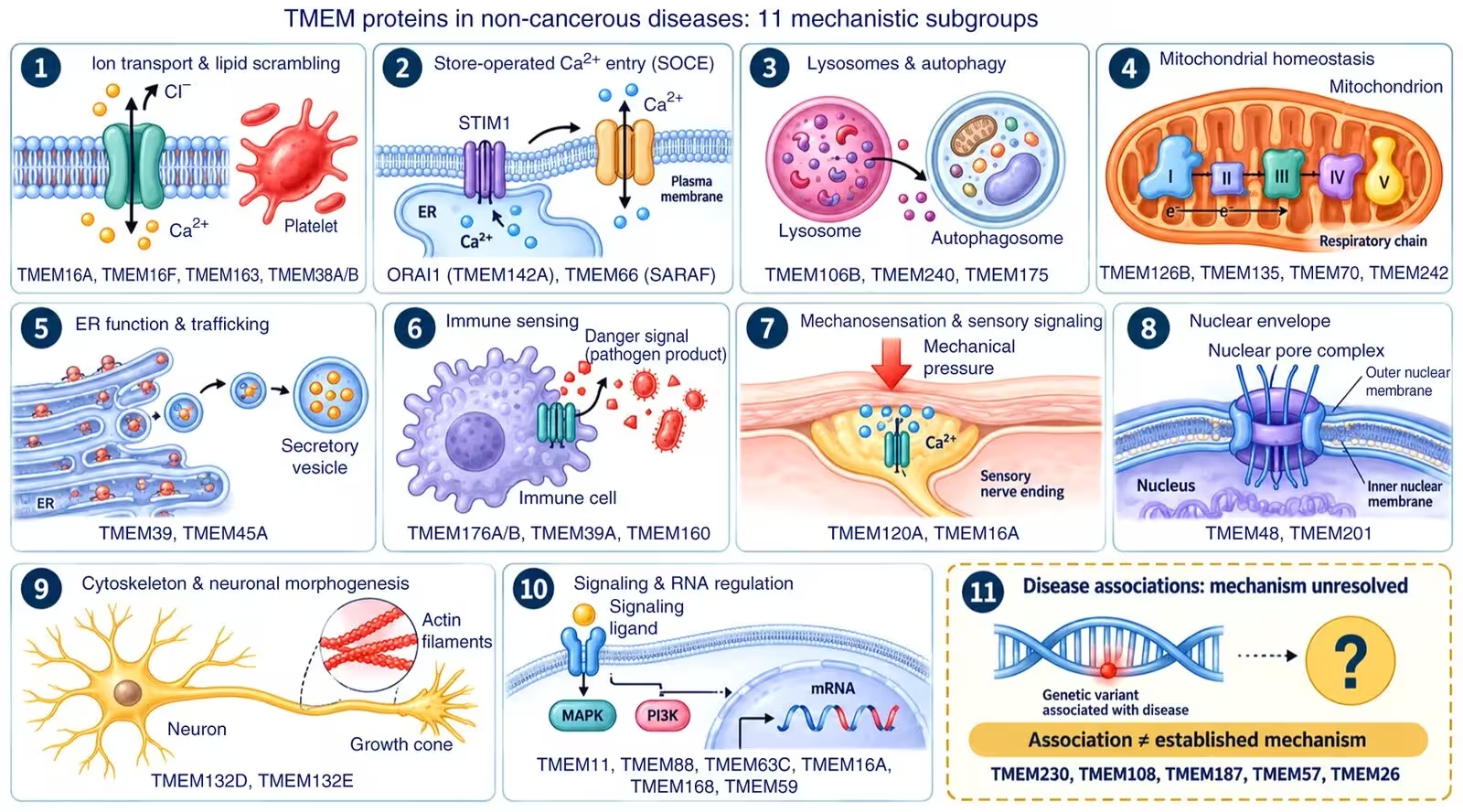
The review reveals that many clinically distinct conditions actually stem from disruptions in identical cellular pathways. Calcium signaling serves as a primary example, where defects at different steps produce wildly different syndromes. Loss of the store-operated calcium entry component ORAI1 causes severe immunodeficiency and stops thermoregulatory sweating by failing to activate downstream chloride channels.

Similarly, mutations in lysosomal transmembrane proteins trigger neurodegenerative conditions. TMEM106B accumulation correlates with frontotemporal lobar degeneration and aging brains, while TMEM240 mutations drive spinocerebellar ataxia type 21 by impairing autophagic protein degradation. These findings demonstrate that seemingly unrelated pathological phenotypes often reflect localized failures within core housekeeping machinery.
Evaluating the Therapeutic Potential and Hurdles Ahead
While these proteins present attractive targets for future drugs, translating findings into clinical treatments poses significant challenges. Proteins like TMEM16A show promise as targets for pain and metabolic disorders, but systemic inhibition carries high toxicity risks due to their widespread normal functions. Furthermore, many family members display functional divergence, meaning closely related paralogs can have opposite physiological roles.
The authors emphasize that future research must move beyond broad animal models and utilize single-cell multi-omics, advanced structural prediction, and larger human cohorts. Clarifying which proteins act as direct disease drivers versus secondary biomarkers will be crucial for developing selective modulators and precision therapies for patients suffering from these diverse conditions.
The research was published in International journal of molecular medicine.
This article has been fact checked for accuracy, with information verified against reputable sources. Learn more about us and our editorial process.
Last reviewed on .
Article history
- Latest version
Reference(s)
- Liu, Pei-Feng., et al. “Transmembrane proteins across cellular membranes: Emerging roles in non‑cancerous diseases (Review).” International Journal of Molecular Medicine, vol. 58, no. 6, November 9, 2026, pp. 1-20. Spandidos Publications, doi: 10.3892/ijmm.2026.6045. <https://doi.org/10.3892/ijmm.2026.6045>.
Cite this page:
- Posted by Priya Sharma