Wearable Eye-Tracking Reveals Why Some Kids With Normal Motor Skills Still Struggle To Write
A new study shows that handwriting difficulties are driven by unstable visual monitoring rather than basic motor deficits.
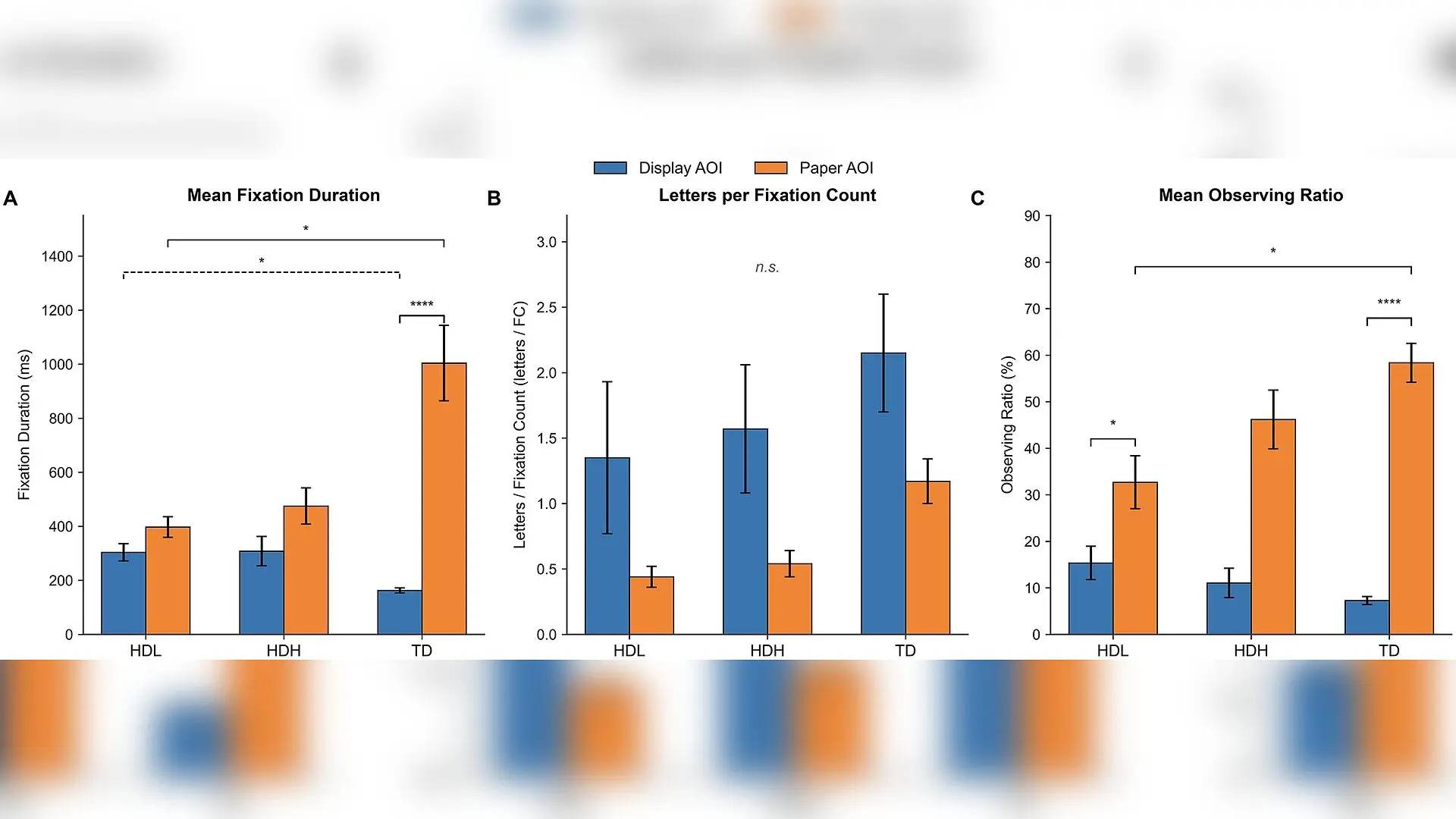
When children struggle with handwriting despite having normal motor skills, the root cause may lie in how their eyes bounce back and forth between the page and the text, according to a study published in PLOS One. Researchers found that students with handwriting difficulties spend significantly less time steadily looking at their own writing, revealing a hidden breakdown in real-time visual-motor coordination.
Why Do Some Students Struggle Despite Normal Motor Skills?
Handwriting is a complex task that requires the brain to seamlessly coordinate visual information, cognitive processing, and physical hand movements. More than 10 percent of elementary school students experience handwriting difficulties, often producing messy text, failing to stay within margins, and taking much longer to complete individual strokes. While children typically develop faster and smoother writing as they age and their motor control stabilizes around nine to ten years of age, a subset of students never achieves handwriting fluency.
Traditional clinical assessments use static tests, such as copying geometric shapes, to measure visual-motor integration. However, these tests often fail to explain why some children with completely normal physical motor scores still struggle immensely with daily writing tasks. To uncover what happens in real time, Kiko Watanabe and Mikimasa Omori from Waseda University investigated the dynamic eye-movement patterns of students during actual sentence-copying tasks.
How Did the Researchers Track Real-Time Eye Movements?
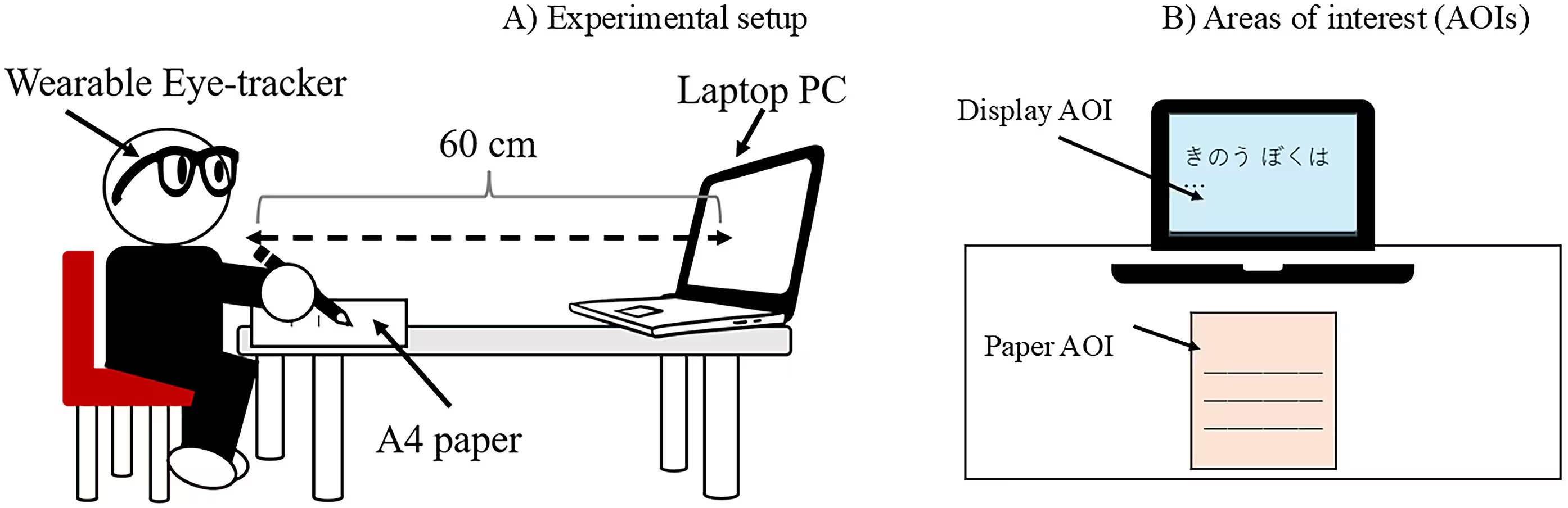
The study involved 36 participants divided into three distinct groups. The first group consisted of 17 students with documented handwriting difficulties, who were further split based on motor coordination scores into a low motor coordination subgroup of 9 participants and a high motor coordination subgroup of 8 participants. The third group comprised 19 typically developing students who served as a control baseline. The researchers used a wearable, calibration-free eye-tracking device connected to a smartphone, allowing participants to move their heads freely while copying Japanese sentences from a laptop screen onto paper.
By analyzing gaze data captured during the transcription process, the team measured how long participants fixated on the display versus their own handwriting surface. Because natural movements in pediatric populations can disrupt automated tracking, trained researchers manually verified approximately 70 percent of the frames for the handwriting difficulty groups to ensure absolute accuracy in mapping gaze transitions.
What Did the Gaze Patterns Reveal About Handwriting Difficulties?
The results showed a striking difference in how students allocated their visual attention. Typically developing students spent more than half of their total task time, nearly 58 percent, steadily observing the paper where they were writing. In sharp contrast, students with handwriting difficulties spent significantly less time monitoring their writing surface, devoting a much smaller fraction of their visual attention to tracking their own pen strokes.
Most notably, students in the high motor coordination subgroup, whose physical motor scores matched those of their typically developing peers, still exhibited the same fragmented, erratic gaze patterns as those with severe motor deficits. Rather than achieving the long, stable fixations seen in skilled writers, these students showed qualitative instability in their visual monitoring. This suggests that their handwriting struggles stem from an inability to maintain steady visual feedback during execution, rather than a lack of physical dexterity.
What Are the Limitations of the Study?
The authors noted several important limitations, including small and unbalanced clinical subgroup sizes that limit the statistical power for pairwise comparisons. The participants also spanned a wide age range from 11 to 17 years, and developmental differences in executive functioning could have influenced their eye-hand coordination strategies. Furthermore, the handwriting difficulty group featured diverse neurodevelopmental profiles, including autism spectrum disorder, attention-deficit hyperactivity disorder, and intellectual disabilities, which may have introduced distinct cognitive variables into the eye-movement data.
How Can These Findings Improve Future Educational Interventions?
Recognizing that handwriting struggles involve a breakdown in dynamic visual monitoring rather than just poor motor control changes how educators might approach support. Instead of relying solely on traditional motor exercises, teachers and clinicians could watch for the erratic looking back and forth pattern as an early behavioral marker. Future educational tools could incorporate structured segment-by-segment stimulus presentations to help students process manageable chunks of text at a time, ultimately reducing cognitive overload and fostering smoother writing habits.
The research was published in PLOS One on November 25, 2026.
This article has been fact checked for accuracy, with information verified against reputable sources. Learn more about us and our editorial process.
Last reviewed on .
Article history
- Latest version
Reference(s)
- Watanabe, Kiko., et al. “Qualitative instability in dynamic eye-movement patterns during handwriting in students with handwriting difficulties: A wearable eye-tracking study.” PLOS One, vol. 21, no. 11, November 25, 2026, pp. e0361909 Public Library of Science (PLoS), doi: 10.1371/journal.pone.0361909. <https://doi.org/10.1371/journal.pone.0361909>.
Cite this page:
- Posted by Hassan Raza