Synthetic Hydrogels Successfully Support Human Kidney Tubuloid Growth
Biology

Synthetic Hydrogels Successfully Support Human Kidney Tubuloid Growth

Defined molecular matrices offer an animal-free alternative for growing patient-derived kidney organoids and modeling tubular diseases.
By Hassan Raza
Published:
Email this Article
Synthetic Hydrogels Successfully Support Human Kidney Tubuloid Growth
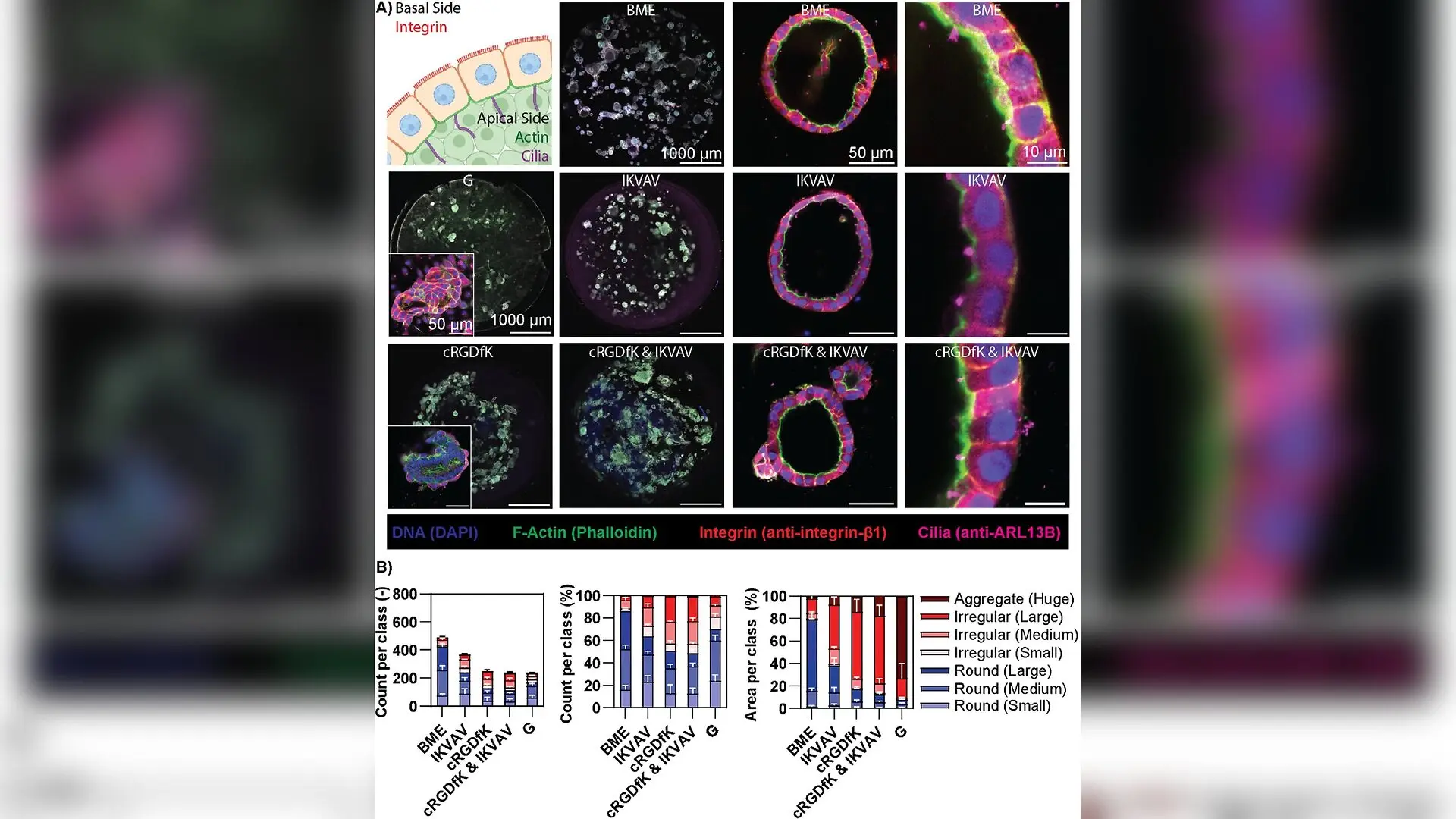
Overview of tubuloids cultured in supramolecular UPy hydrogels and BME. (A) Tubuloids were stained for nuclei (DAPI, blue), F-actin (phalloidin, green), integrin β1 (anti-integrin-β1, red), and cilia (anti-ARL13B, magenta). The first panel shows a schematic cross-section of a correctly polarized tubuloid (apical-in/basal-out), created with BioRender.com. For G and cRGDfK, representative full-well overviews are shown with higher-magnification insets. For BME, IKVAV, and cRGDfK & IKVAV, each condition is shown as a full-well overview, a single-tubuloid view, and a cross-section zoom to visualize apical–basal marker localization. Scale bars: 1000 µm (overview), 50 µm (single tubuloid/insets), and 10 µm (cross-section). UPy hydrogels were formulated at 80 : 1 M : B with UPy-G and 0–2 mM UPy-peptide (10.66 mol% each when present); solids were matched to a 1.25% (w/v) UPy-G reference gel. All images represent donor 1. (B) Distribution of count per class (absolute and %) and area per class fo Aurelius J C Roskothen-Shevchuk et al. / Biomaterials science

Kidney tubuloids derived from human urine or tissue form microscopic tubular structures in the laboratory, but growing them requires an animal-derived tumor extract whose batch variations complicate medical research. A team of scientists recently evaluated defined synthetic supramolecular ureido-pyrimidinone or UPy hydrogels as a controllable alternative to basement membrane extract for human tubuloid culture. The study, published in Biomaterials Science, reveals that UPy hydrogels functionalized with the laminin-derived IKVAV motif successfully support the growth of correctly polarized, cystic kidney organoids across multiple donor lines.

Understanding Integrin Signatures in Kidney Tubuloids

To design a synthetic matrix that mimics the natural environment, the researchers re-analyzed a published single-cell RNA-sequencing dataset of human kidney tubuloids. This genetic profiling identified which integrin receptors the cells deploy to anchor themselves to their surroundings. Among the beta subunits, ITGB1 showed the highest average expression, while ITGA3 led the alpha subunits. These findings guided the selection of specific peptide sequences for functionalizing the UPy hydrogel network.

The team chose two specific binding motifs for testing, namely the cyclic RGD peptide cRGDfK, which primarily targets alpha-V beta-3 integrins, and the laminin-111-derived IKVAV motif, which engages beta-1 integrins. These peptides were incorporated into modular UPy hydrogels at fixed concentrations. By maintaining a constant total monofunctional UPy concentration, the investigators could isolate the specific behavioral effects of each biochemical cue without altering the overall physical scaffold.
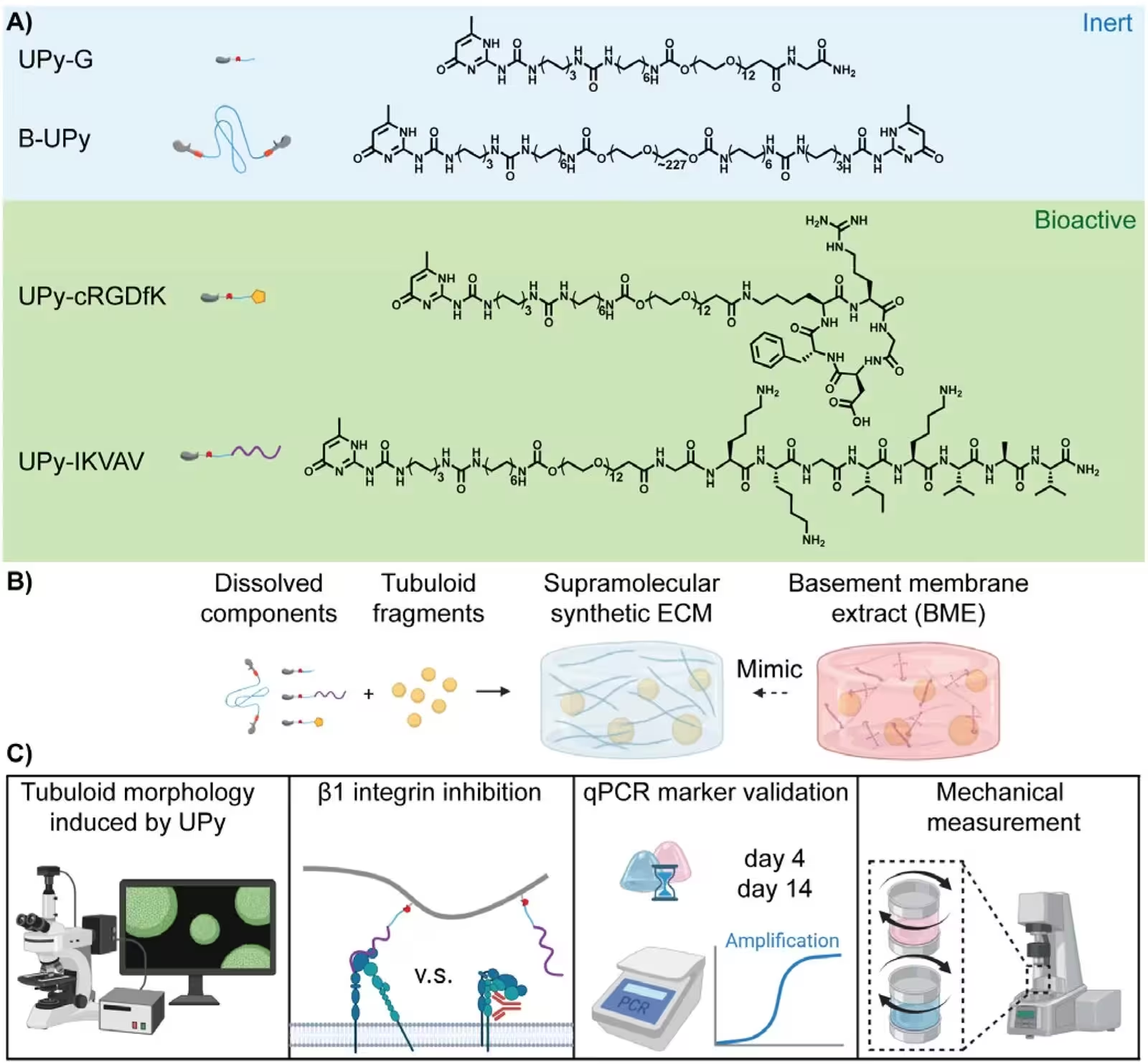
Fig. 1: Overview of the approach used in this study to create ECM mimicking hydrogels. (A) Supramolecular components used to formulate the hydrogels, including peptide sequences that are attached to inert UPy units to mimic a bioactive response. (B) Schematic showing how dissolved monomers are mixed with tubuloid fragments. The mixture is then crosslinked to form a supramolecular ECM that encapsulates the tubuloid fragments (created with BioRender.com). (C) Overview of the approach used to develop BME-mimicking materials. UPy hydrogels were first screened for their ability to support cystic tubuloid morphology, after which the best-performing formulations were selected for further study. These were then evaluated for integrin β1-mediated interactions, kidney marker-gene expression, and mechanical properties in comparison with BME.
Overview of the approach used in this study to create ECM mimicking hydrogels. (A) Supramolecular components used to formulate the hydrogels, including peptide sequences that are attached to inert UPy units to mimic a bioactive response. (B) Schematic showing how dissolved monomers are mixed with tubuloid fragments. The mixture is then crosslinked to form a supramolecular ECM that encapsulates the tubuloid fragments (created with BioRender.com). (C) Overview of the approach used to develop BME-mimicking materials. UPy hydrogels were first screened for their ability to support cystic tubuloid morphology, after which the best-performing formulations were selected for further study. These were then evaluated for integrin β1-mediated interactions, kidney marker-gene expression, and mechanical properties in comparison with BME. Credit: Aurelius J C Roskothen-Shevchuk et al. / Biomaterials science

Evaluating Morphology and Matrix Mimicry

When cultured without any bioactive peptides, tubuloids failed to maintain their three-dimensional architecture, flattening into two-dimensional cell sheets within four days. Hydrogels functionalized with the cRGDfK peptide alone produced large, irregular structures that lacked proper cystic morphology and basal-out polarity. In contrast, the IKVAV-functionalized UPy hydrogels consistently supported the formation of round, cystic tubuloids with correct apical-in and basal-out organization.

Quantitative image classification showed that the IKVAV-containing gels closely matched the structural distribution seen in traditional basement membrane extract controls. Combining both peptides in a dual-ligand gel did not improve morphological outcomes over the IKVAV-only condition. Furthermore, rheological measurements demonstrated that both UPy hydrogel variations shared the elastic-dominated behavior and soft mechanical properties of traditional extracts, confirming that the phenotypic differences stemmed from biochemical signaling rather than bulk stiffness.
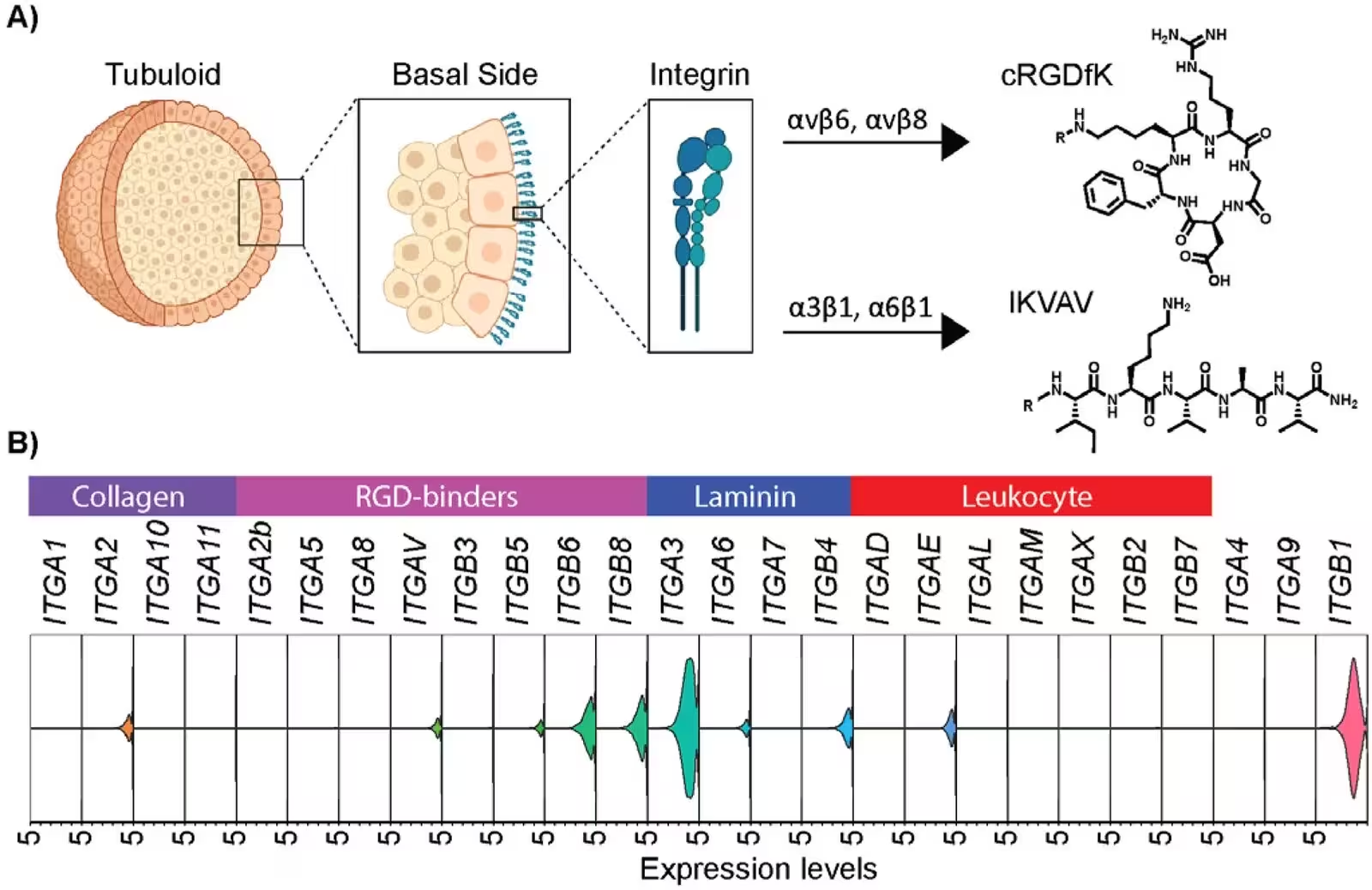
Fig. 2: Integrin-guided selection of peptides for hydrogel functionalization. (A) Overview of integrin localization in tubuloids as well as integrin binding peptide sequences and their targets (created with BioRender.com). (B) Stacked violin plots showing transcript expression of integrin subunits based on re-analysis of a previously published tubuloid scRNA-seq dataset in expansion medium.4 Genes are grouped by ligand classes (collagen, RGD-binders, laminin, leukocyte) according to Pang et al.16
Integrin-guided selection of peptides for hydrogel functionalization. (A) Overview of integrin localization in tubuloids as well as integrin binding peptide sequences and their targets (created with BioRender.com). (B) Stacked violin plots showing transcript expression of integrin subunits based on re-analysis of a previously published tubuloid scRNA-seq dataset in expansion medium.4 Genes are grouped by ligand classes (collagen, RGD-binders, laminin, leukocyte) according to Pang et al.16 Credit: Aurelius J C Roskothen-Shevchuk et al. / Biomaterials science

Investigating Integrin Beta-1 and Long-Term Stability

To verify the role of cell-matrix adhesion, the authors introduced an integrin beta-1 blocking antibody into the culture medium. This intervention disrupted lumen integrity in both traditional extracts and UPy-IKVAV hydrogels, causing multi-lumen phenotypes and structural defects. This shared response confirms that beta-1-dependent adhesion actively contributes to lumen maintenance in the synthetic matrix.

Long-term transcriptional profiling over 14 days revealed that tubuloids in UPy-IKVAV hydrogels maintained a stable kidney marker expression profile comparable to basement membrane extracts. Over time, the synthetic cultures showed a significant downregulation of CD24, a marker associated with kidney progenitors and injury responses, alongside an upregulation of the collecting duct marker SCNN1A. These defined matrices provide a reproducible platform for studying renal tubulopathies and ciliopathies without the confounding variables of animal-derived substrates.

The research was published in Biomaterials science on November 9, 2026.

Fact Checked

This article has been fact checked for accuracy, with information verified against reputable sources. Learn more about us and our editorial process.

Last reviewed on .

Article history

  • Latest version

Reference(s)

  1. Roskothen-Shevchuk, Aurelius J. C.., et al. “Integrin-guided development of defined supramolecular hydrogels for human kidney tubuloid culture.” Biomaterials Science, January 1, 2026 Royal Society of Chemistry (RSC), doi: 10.1039/d6bm01010e. <https://doi.org/10.1039/d6bm01010e>.

Cite this page:

Raza, Hassan. “Synthetic Hydrogels Successfully Support Human Kidney Tubuloid Growth.” BioScience. BioScience ISSN 2521-5760, 11 November 2026. <https://www.bioscience.com.pk/en/subject/biology/integrin-guided-development-of-defined-supramolecular-hydrogels-for-human-kidney-tubuloid-culture>. Raza, H. (2026, November 11). “Synthetic Hydrogels Successfully Support Human Kidney Tubuloid Growth.” BioScience. ISSN 2521-5760. Retrieved November 11, 2026 from https://www.bioscience.com.pk/en/subject/biology/integrin-guided-development-of-defined-supramolecular-hydrogels-for-human-kidney-tubuloid-culture Raza, Hassan. “Synthetic Hydrogels Successfully Support Human Kidney Tubuloid Growth.” BioScience. ISSN 2521-5760. https://www.bioscience.com.pk/en/subject/biology/integrin-guided-development-of-defined-supramolecular-hydrogels-for-human-kidney-tubuloid-culture (accessed November 11, 2026).
End of the article