Artificial Intelligence Reveals How Pathogens Mimic Human Proteins to Hijack Our Cells
Biology

Artificial Intelligence Reveals How Pathogens Mimic Human Proteins to Hijack Our Cells

Computational modeling of thousands of host-pathogen protein pairs uncovers structural mimicry and shared infection interfaces.
By Hassan Raza
Published:
Email this Article
Artificial Intelligence Reveals How Pathogens Mimic Human Proteins to Hijack Our Cells
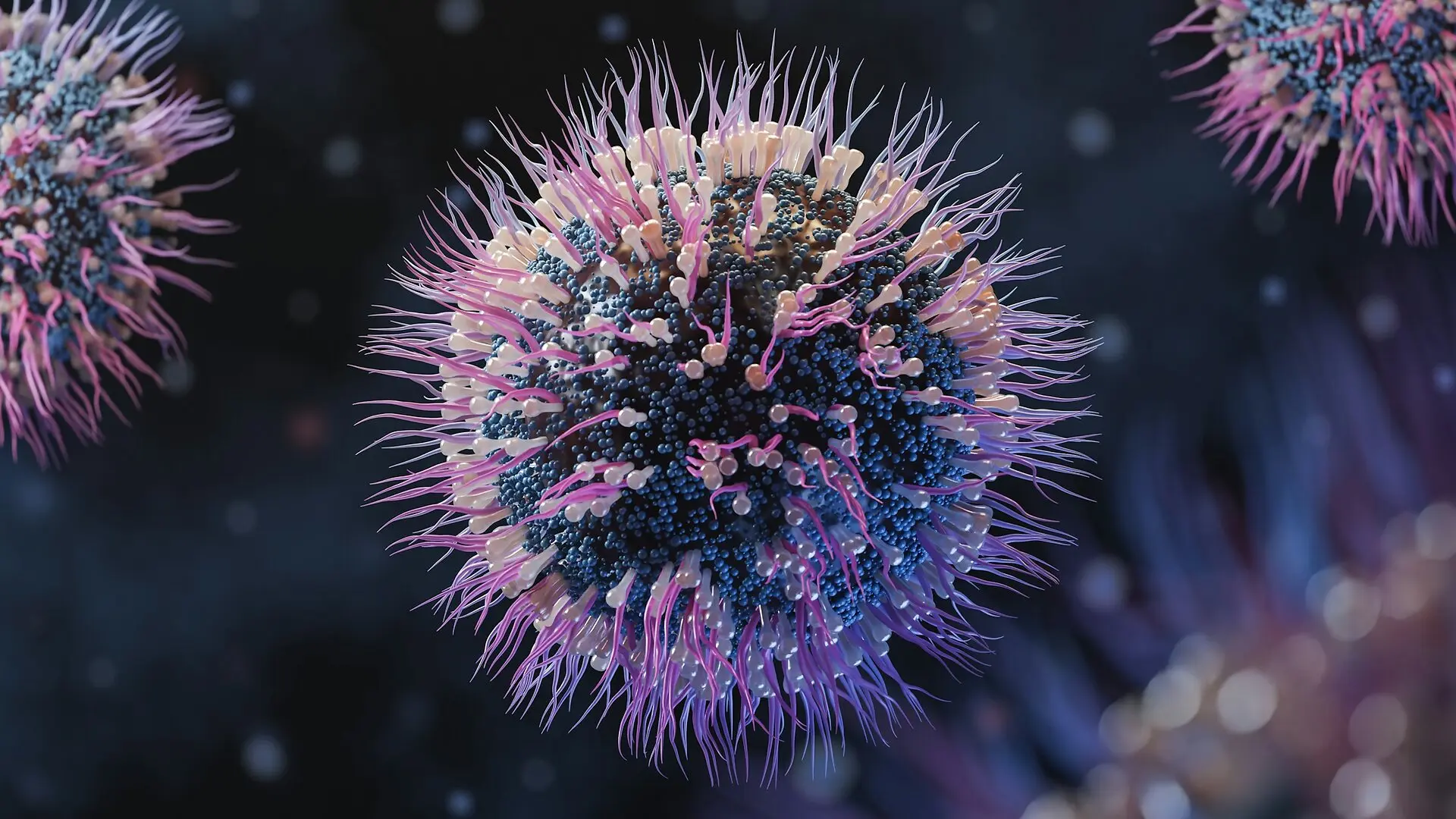
Photo by Warren Umoh on Unsplash

Viruses and bacteria survive inside human cells by deploying microscopic molecular keys that mimic our own proteins to hijack cellular machinery. A team of scientists used advanced artificial intelligence models to predict the three-dimensional structures of nearly seven thousand host-pathogen protein interactions, revealing how diverse infectious agents repeatedly target the same vulnerable sites on human proteins.

The research, published in PLOS Computational Biology, was led by Pedro Beltrao alongside Delora Baptista and their colleagues at the European Molecular Biology Laboratory and Karolinska Institutet. While previous studies have cataloged thousands of physical contacts between pathogens and hosts, structural blueprints for these interactions have remained largely unknown. To bridge this gap, the researchers benchmarked artificial intelligence tools including AlphaFold-multimer and AlphaFold3 against hundreds of experimentally resolved protein pairs from the Protein Data Bank.

How Well Can Artificial Intelligence Predict Infection Interfaces?

To test the reliability of these computational systems, the authors evaluated over four hundred known host-pathogen complexes. They discovered that while predicting exact atomic contacts remains challenging, the confidence score known as interface predicted template-modeling score effectively filters for accurate models. When setting a confidence threshold of zero point five, more than eighty percent of the selected AlphaFold-multimer predictions matched experimental quality standards.
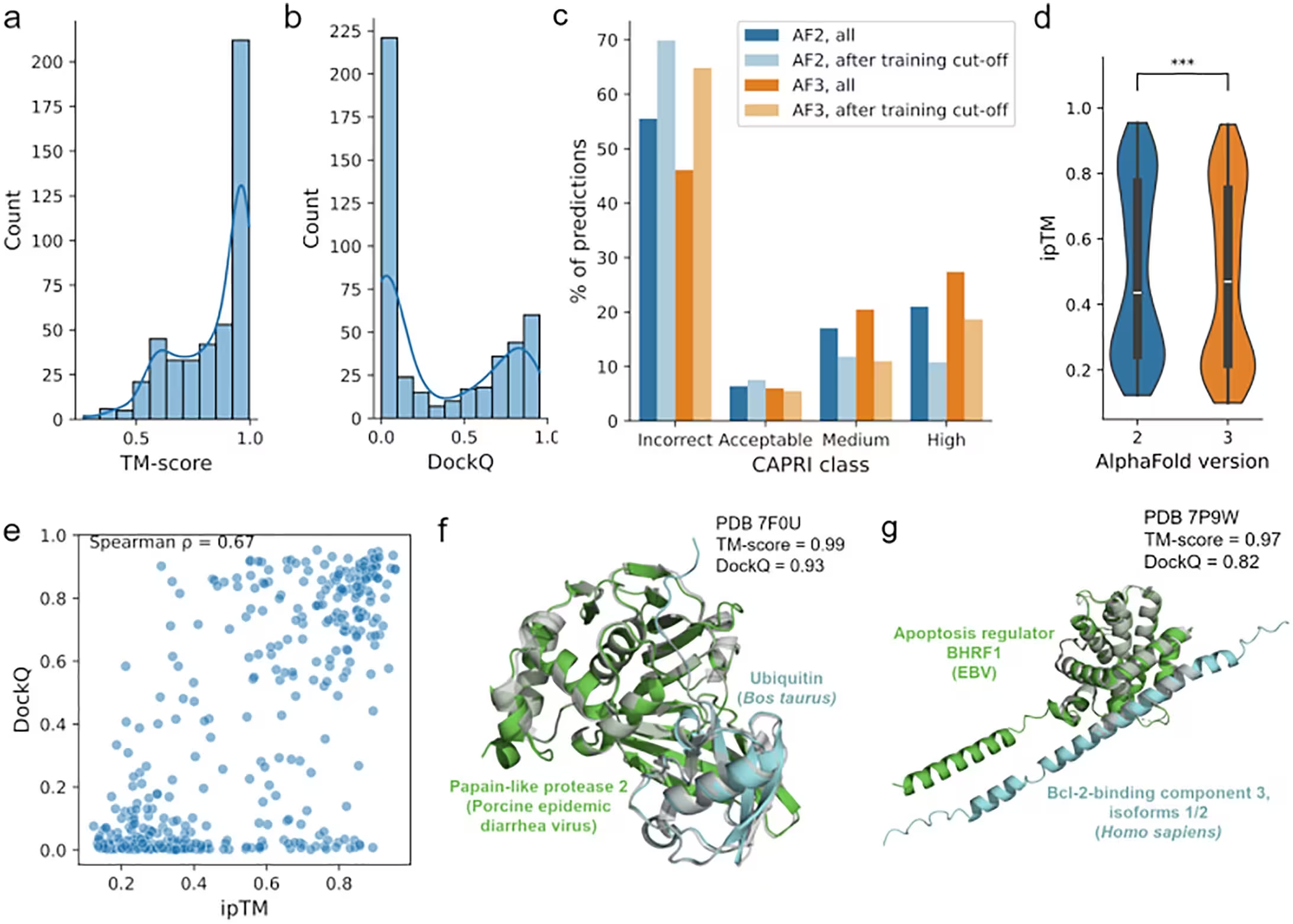
Fig 1: Results for the benchmark datasets. a) Distribution of TM-scores for AF-multimer predictions. b) Distribution of DockQ scores for AF-multimer predictions. c) Number of predicted structures per CAPRI model quality category. Results are shown for structures predicted using either AF-multimer or AF3, and considering all protein pairs in the benchmark dataset or only those with experimental structures released after the AF-multimer v. 2.3.0 and AF3 training data cutoff date (2021-09-30). Models were classified based on their DockQ scores (Acceptable: 0.23 <= DockQ < 0.49; Medium: 0.49 <= DockQ < 0.8; High: DockQ > 0.8). d) Comparison between AF-multimer and AF3, in terms of ipTM scores (Wilcoxon signed-rank test p-value = 1.58 x 10⁻⁶). e) Relationship between the ipTM and DockQ scores (Spearman’s ρ = 0.67, p-value = 2 × 10-4), for AF-multimer predictions. f, g) Examples of well-modeled structures of viral-human PPIs (colored by chain), superposed onto the corresponding experimental structu
Results for the benchmark datasets. a) Distribution of TM-scores for AF-multimer predictions. b) Distribution of DockQ scores for AF-multimer predictions. c) Number of predicted structures per CAPRI model quality category. Results are shown for structures predicted using either AF-multimer or AF3, and considering all protein pairs in the benchmark dataset or only those with experimental structures released after the AF-multimer v. 2.3.0 and AF3 training data cutoff date (2021-09-30). Models were classified based on their DockQ scores (Acceptable: 0.23 <= DockQ < 0.49; Medium: 0.49 <= DockQ < 0.8; High: DockQ > 0.8). d) Comparison between AF-multimer and AF3, in terms of ipTM scores (Wilcoxon signed-rank test p-value = 1.58 x 10⁻⁶). e) Relationship between the ipTM and DockQ scores (Spearman’s ρ = 0.67, p-value = 2 × 10-4), for AF-multimer predictions. f, g) Examples of well-modeled structures of viral-human PPIs (colored by chain), superposed onto the corresponding experimental structu Credit: Delora Baptista et al. / PLOS Computational Biology

Armed with this validation, the team modeled six thousand seven hundred eighty-two high-confidence protein pairs from previous affinity purification and database studies. This massive computational screen yielded eight hundred and three high-confidence structural models involving viral, bacterial, and eukaryotic pathogens. These models allowed the investigators to analyze whether different pathogens converge on identical human binding sites during infection.

Why Do Unrelated Pathogens Attack the Exact Same Human Proteins?

The structural analysis showed that when multiple pathogen proteins interact with a single human target, they almost always aim for the same interface region. For instance, the human Ras-related protein Rab-7a, which governs endolysosomal trafficking, was found to bind three completely unrelated viral proteins. These include proteins from the Coxsackievirus B3, Severe Acute Respiratory Syndrome Coronavirus 2, and Kaposi sarcoma-associated herpesvirus.

Despite belonging to different viral families with positive-sense RNA, negative-sense RNA, and DNA genomes, these pathogens evolved to target overlapping pockets on the human protein. The researchers observed similar convergence in human nuclear import proteins and cell cycle regulators, pointing to widespread evolutionary pressure on pathogens to hijack specific cellular hubs.
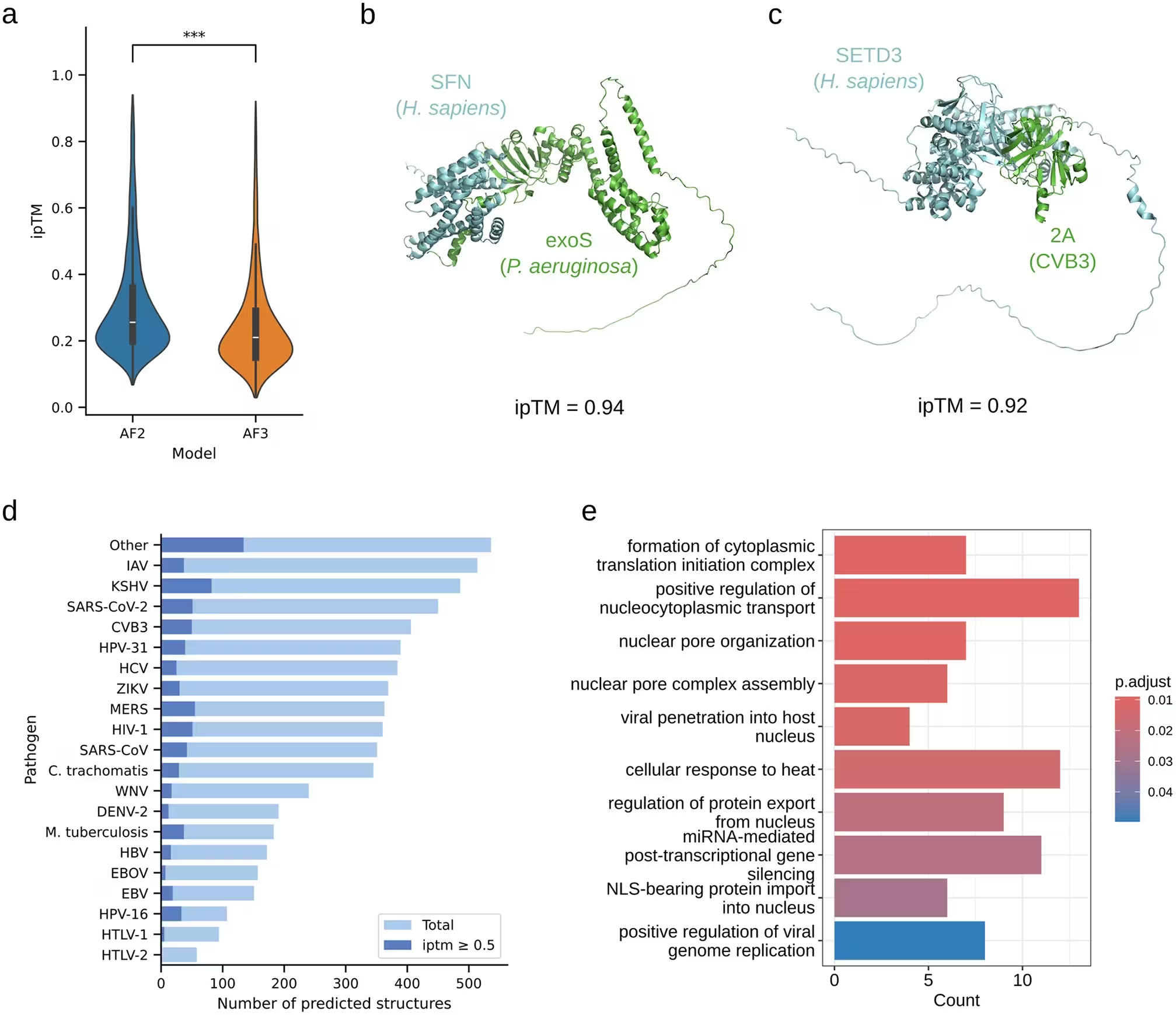
Fig 2: Results for human-pathogen protein pairs from affinity purification-mass spectrometry studies and HPIDB. a) Comparison between AF-multimer and AF3, in terms of ipTM scores. b) AF-multimer (ColabFold) prediction for the interaction between human 14-3-3 protein sigma (SFN), in blue, and Exoenzyme S (exoS) from Pseudomonas aeruginosa, in green. c) AF-multimer prediction for the interaction between human protein actin-histidine N-methyltransferase (SETD3), in blue, and protein 2A from Coxsackievirus B3 (CVB3), in green. d) Number of predicted structures (light blue) and structures with an ipTM score >= 0.5 (dark blue), per pathogen. The “Other” category includes viral, bacterial and eukaryotic (protozoa and yeast) pathogens for which only a small number of structures were predicted. e) GO enrichment analysis results for the human proteins from structures with ipTM >= 0.5, showing the biological processes that are over-represented among this set of proteins. Bars are colored according to th
Results for human-pathogen protein pairs from affinity purification-mass spectrometry studies and HPIDB. a) Comparison between AF-multimer and AF3, in terms of ipTM scores. b) AF-multimer (ColabFold) prediction for the interaction between human 14-3-3 protein sigma (SFN), in blue, and Exoenzyme S (exoS) from Pseudomonas aeruginosa, in green. c) AF-multimer prediction for the interaction between human protein actin-histidine N-methyltransferase (SETD3), in blue, and protein 2A from Coxsackievirus B3 (CVB3), in green. d) Number of predicted structures (light blue) and structures with an ipTM score >= 0.5 (dark blue), per pathogen. The “Other” category includes viral, bacterial and eukaryotic (protozoa and yeast) pathogens for which only a small number of structures were predicted. e) GO enrichment analysis results for the human proteins from structures with ipTM >= 0.5, showing the biological processes that are over-represented among this set of proteins. Bars are colored according to th Credit: Delora Baptista et al. / PLOS Computational Biology

What Are the Three Main Categories of Molecular Mimicry?

By comparing the predicted host-pathogen complexes with human-human interaction models, the team classified molecular mimicry into three distinct structural mechanisms. First, domain-level mimicry involves whole protein domains nearly identical to human counterparts, likely acquired through horizontal gene transfer in DNA viruses. Second, local structured motifs involve convergent evolution where independent protein folds create similar binding interfaces.

Third, linear peptide mimicry involves short disordered stretches of amino acids that slip into host binding grooves. The authors predicted that short linear motifs located within intrinsically disordered regions represent the most prevalent form of molecular mimicry. These deceptive sequences allow viruses to exploit host transport proteins, enzyme regulatory subunits, and ubiquitin ligases.
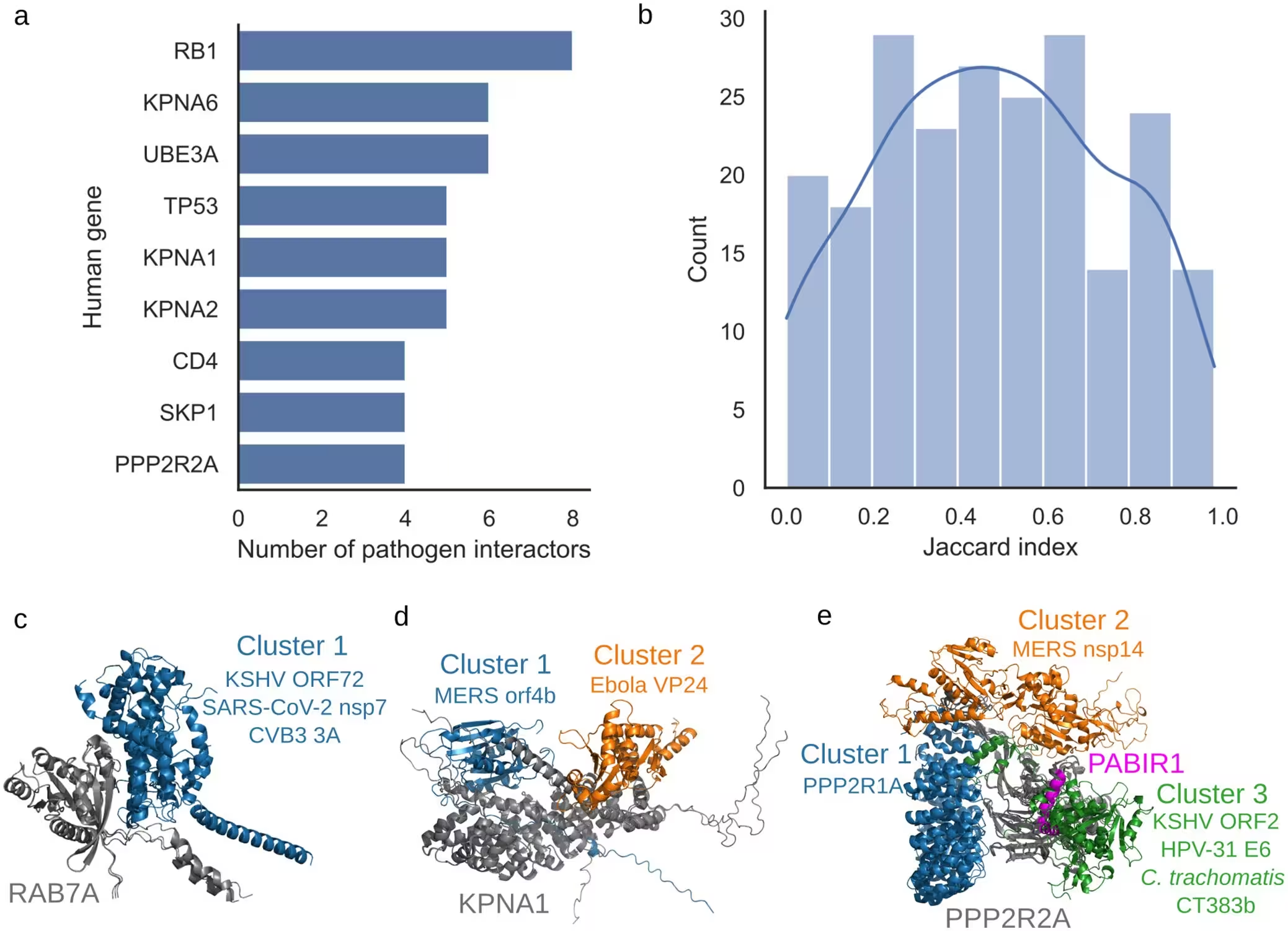
Fig 3: Pathogen interactors targeting the same interface. a) Number of pathogen interactors per human protein (identified by gene symbols). Only human proteins targeted by 4 or more pathogen proteins in our datasets are shown. b) The distribution of Jaccard index values calculated between all pairs of human-pathogen PPIs sharing the same human protein. c), d) and e) Examples of pathogen proteins that target the same interface in the same human protein. c) AF-multimer predicted structures showing viral proteins Kaposi's sarcoma-associated herpesvirus (KSHV) ORF72, Severe acute respiratory syndrome coronavirus 2 (SARS-CoV-2) nsp7 and CVB3 3A targeting a similar interface in human Ras-related protein Rab-7a (RAB7A). d) AF-multimer structures of Middle east respiratory syndrome coronavirus (MERS) orf4b and Ebola virus VP24 which target different interfaces in importin subunit alpha-5 (KPNA1). For ease of visualization, MERS orf4b was used as the sole representative of cluster 1, which also includ
Pathogen interactors targeting the same interface. a) Number of pathogen interactors per human protein (identified by gene symbols). Only human proteins targeted by 4 or more pathogen proteins in our datasets are shown. b) The distribution of Jaccard index values calculated between all pairs of human-pathogen PPIs sharing the same human protein. c), d) and e) Examples of pathogen proteins that target the same interface in the same human protein. c) AF-multimer predicted structures showing viral proteins Kaposi's sarcoma-associated herpesvirus (KSHV) ORF72, Severe acute respiratory syndrome coronavirus 2 (SARS-CoV-2) nsp7 and CVB3 3A targeting a similar interface in human Ras-related protein Rab-7a (RAB7A). d) AF-multimer structures of Middle east respiratory syndrome coronavirus (MERS) orf4b and Ebola virus VP24 which target different interfaces in importin subunit alpha-5 (KPNA1). For ease of visualization, MERS orf4b was used as the sole representative of cluster 1, which also includ Credit: Delora Baptista et al. / PLOS Computational Biology

How Did the Team Validate These Predictions Experimentally?

To confirm their computational findings, the researchers performed SPOT peptide binding assays on twelve predicted interaction interfaces involving human proteins such as SIAH1, Protein Phosphatase 1, and Sorting Nexin-17. Laboratory tests successfully validated eight of these predicted binding interactions, including viral peptides from Herpes simplex virus 1 and Epstein-Barr virus.

Alanine scanning mutagenesis further confirmed that specific amino acid residues within the predicted viral peptides are essential for binding. However, the authors noted that experimental validation success was lower for host-pathogen interfaces compared to human-human controls, underscoring the necessity of laboratory verification for computational models. These structural insights could eventually aid in the design of broad-spectrum antimicrobial therapies that disrupt shared pathogen interfaces.

The research was published in PLOS Computational Biology on November 23, 2026.

Fact Checked

This article has been fact checked for accuracy, with information verified against reputable sources. Learn more about us and our editorial process.

Last reviewed on .

Article history

  • Latest version

Reference(s)

  1. Baptista, Delora., et al. “AlphaFold models of host-pathogen interactions elucidate the prevalence and structural modes of molecular mimicry.” PLOS Computational Biology, vol. 22, no. 11, November 23, 2026, pp. e1014932 Public Library of Science (PLoS), doi: 10.1371/journal.pcbi.1014932. <https://doi.org/10.1371/journal.pcbi.1014932>.

Cite this page:

Raza, Hassan. “Artificial Intelligence Reveals How Pathogens Mimic Human Proteins to Hijack Our Cells.” BioScience. BioScience ISSN 2521-5760, 24 November 2026. <https://www.bioscience.com.pk/en/subject/biology/alphafold-models-of-host-pathogen-interactions-elucidate-the-prevalence-and-structural-modes-of-molecular-mimicry>. Raza, H. (2026, November 24). “Artificial Intelligence Reveals How Pathogens Mimic Human Proteins to Hijack Our Cells.” BioScience. ISSN 2521-5760. Retrieved November 24, 2026 from https://www.bioscience.com.pk/en/subject/biology/alphafold-models-of-host-pathogen-interactions-elucidate-the-prevalence-and-structural-modes-of-molecular-mimicry Raza, Hassan. “Artificial Intelligence Reveals How Pathogens Mimic Human Proteins to Hijack Our Cells.” BioScience. ISSN 2521-5760. https://www.bioscience.com.pk/en/subject/biology/alphafold-models-of-host-pathogen-interactions-elucidate-the-prevalence-and-structural-modes-of-molecular-mimicry (accessed November 24, 2026).
End of the article