New Glenn’s Third Flight Ends In Setback As Upper Stage Failure Raises New Questions
Blue Origin’s New Glenn rocket encountered a significant malfunction in its upper stage during its third flight, sparking renewed doubts about its dependability and upcoming missions.
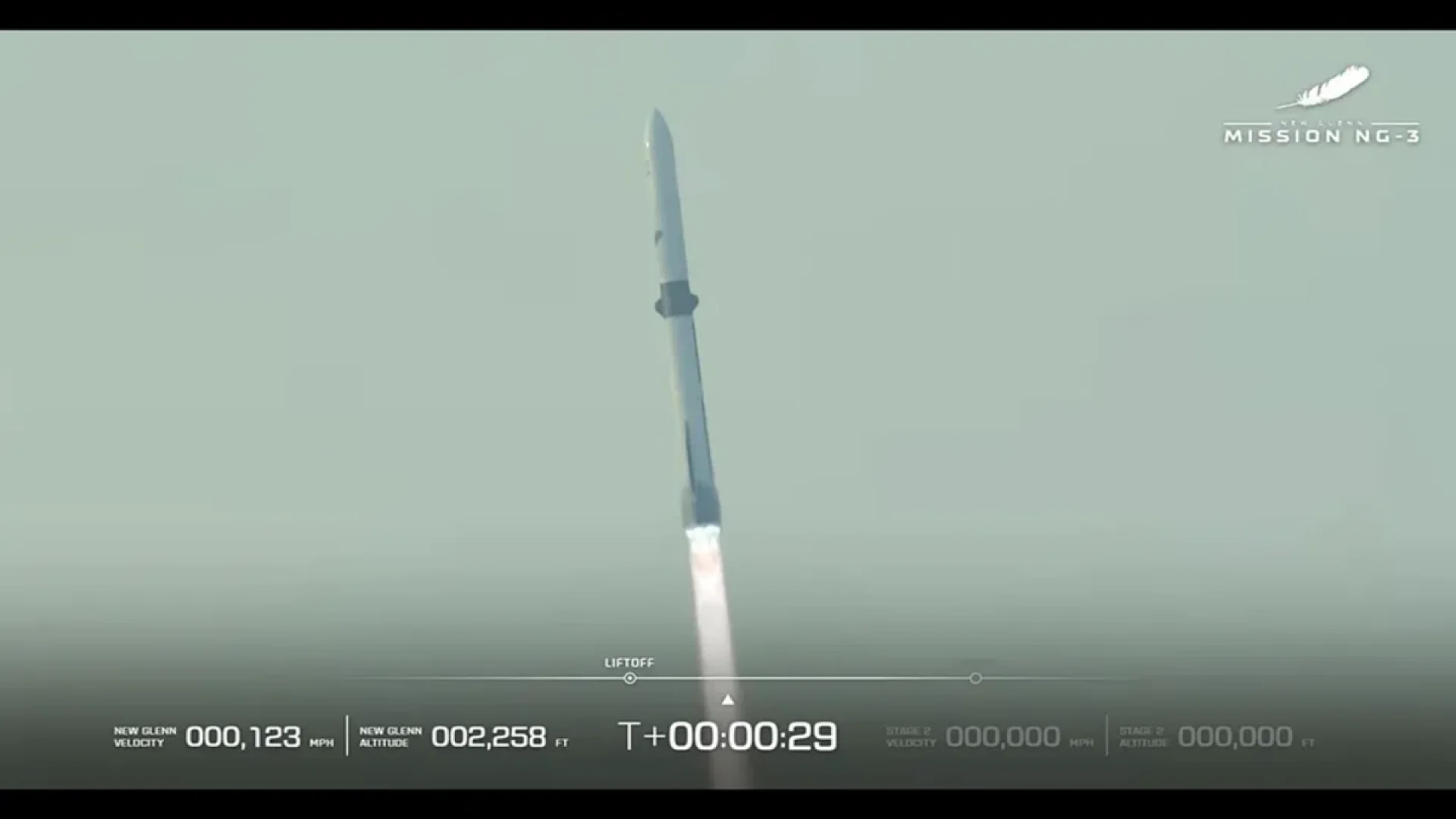
Blue Origin’s pursuit of heavy-lift capabilities has hit a snag, as its New Glenn rocket encountered a critical upper stage malfunction during its third flight, abruptly ending a mission that had shown promising signs of progress and raising fresh concerns about the rocket’s path to operational reliability.
A Promising Mission Cut Short By Upper Stage Failure
The third launch of New Glenn initially demonstrated significant progress, bolstering hopes that Blue Origin was closing the gap with established competitors in orbital launch services. According to Space news, the rocket successfully lifted off and completed early phases of the mission, including separation events that are typically among the most complex in any launch sequence. However, the mission ultimately fell short due to a malfunction in the upper stage, a critical component responsible for delivering payloads into their intended orbits.
The payload itself managed to separate and activate, but its trajectory quickly became unsustainable. As the company explained, “While the satellite separated from the launch vehicle and powered on, the altitude is too low to sustain operations with its on-board thruster technology and will de-orbit,” the company stated. “The cost of the satellite is expected to be recovered under the company’s insurance policy.” This outcome highlights a partial success scenario often seen in early launch campaigns, where certain systems perform nominally while others reveal underlying engineering vulnerabilities.
Engineering Changes And Reusability Strategy Under The Spotlight
Beyond the immediate failure, attention is now shifting to the broader design and testing strategy behind New Glenn. The rocket represents a major investment in reusability and scalability, with Blue Origin aiming to compete directly with other reusable launch systems already operating at high cadence.
In a recent statement, CEO Dave Limp provided insight into some of the engineering decisions made ahead of this flight. “With our first refurbished booster we elected to replace all seven engines and test out a few upgrades including a thermal protection system on one of the engine nozzles,” he said in an April 13 social media post. “We plan to use the engines we flew for NG-2 on future flights.” These upgrades signal an aggressive iteration cycle, where hardware is rapidly modified and redeployed to accelerate development timelines.
While such an approach can drive innovation, it also introduces additional variables that can complicate mission reliability. Each modification, even when intended as an improvement, requires extensive validation under real flight conditions. The upper stage anomaly may not be directly tied to these upgrades, but it reinforces how interconnected rocket systems are—where performance in one area can influence outcomes elsewhere.
Scaling Ambitions Meet Market Pressure
Despite the setback, Blue Origin continues to emphasize its long-term vision of scaling launch operations to meet growing demand. The commercial space sector is experiencing a surge in satellite deployments, driven by communications constellations, Earth observation platforms, and national security needs.
Speaking at the Satellite 2026 conference, Laura Maginnis, vice president of New Glenn mission management, highlighted the company’s readiness to expand operations. “We’re looking at increasing our resources, our tooling, our processes, obviously leveraging a lot of great systems engineering and innovation that we put into the system to allow us to scale very quickly at this point,” she said during a March 24 panel discussion.
She also pointed to strong market demand, adding: “The market demand, as everyone has said, is significant, and we’re excited to meet it,” she said, while stopping short of specifying how many launches the company plans to conduct this year. This cautious optimism reflects a broader industry dynamic, where demand is clear but execution remains the defining challenge.
The latest anomaly complicates these scaling ambitions, as each failure can introduce delays, require additional testing, and affect customer confidence. Launch providers operate in an environment where reliability is not just a technical metric but a commercial necessity.
This content has been reviewed by subject-matter experts to ensure scientific accuracy. Learn more about us and our editorial process.
Last reviewed on .
Article history
- Latest version
- Last updated by Dayyal Dungrela, MLT, BSc, BS
Cite this page:
- Posted by Aisha Ahmed