Astronomers Spot Mysterious Arc in Cosmic Hamburger That May Reveal a Giant Planet Being Born
Astronomers have discovered a mysterious chemical arc in a massive disk around a young star, potentially signaling the birth of a giant planet.
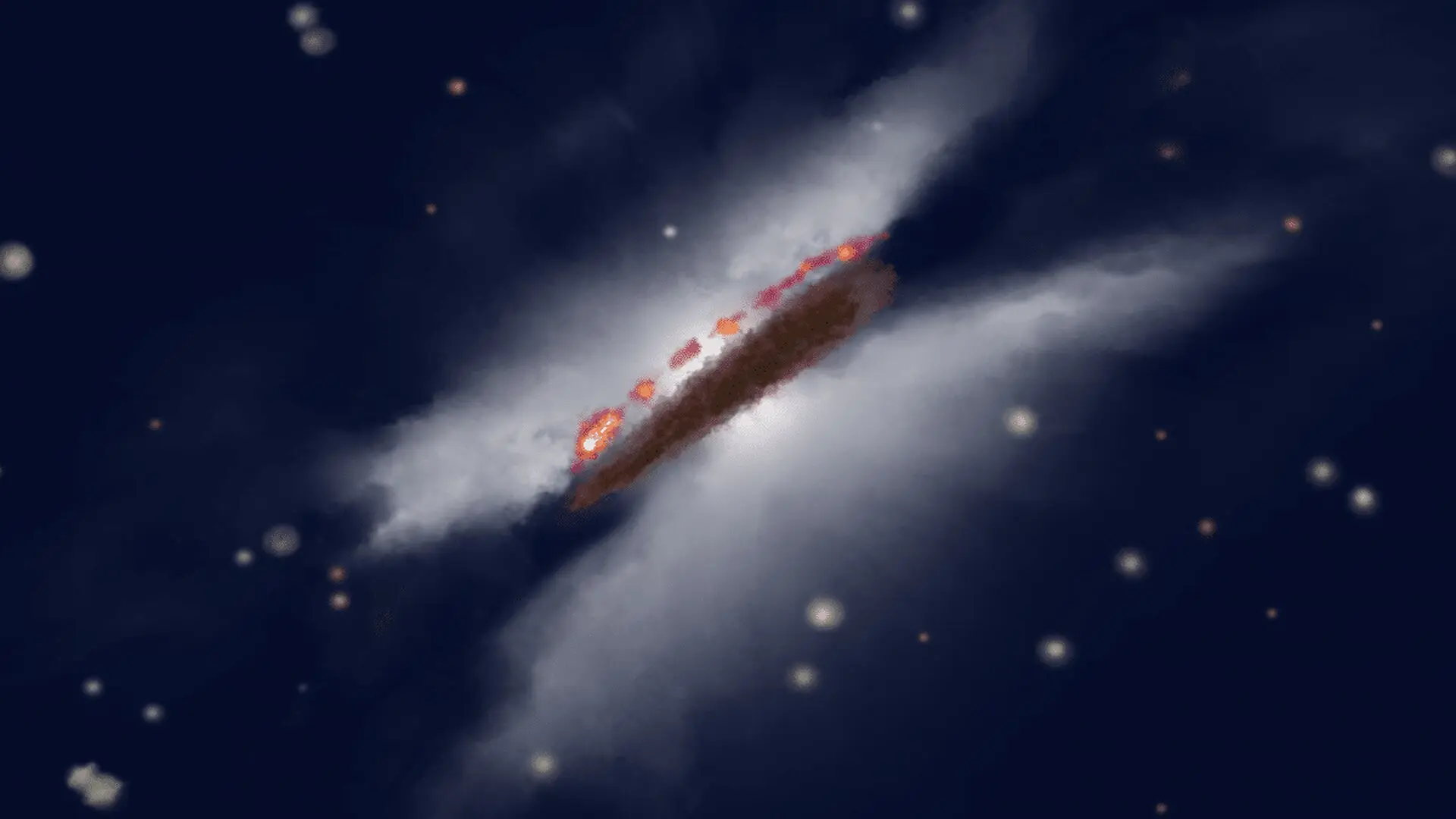
Astronomers have identified a potential giant planet in the process of formation, hidden deep within a massive, dusty disk surrounding a young star. Using the Atacama Large Millimeter/submillimeter Array (ALMA), researchers mapped a unique chemical landscape that may capture one of the earliest observable moments in the birth of a massive world.
A Unique Perspective on a Cosmic Nursery
The system, colloquially known as Gomez’s Hamburger or GoHam, has become a primary target for study due to its rare orientation. While most planet-forming disks are observed at an angle or face-on from our vantage point, GoHam appears nearly edge-on. This vertical alignment provides a clear view of the disk’s internal architecture, allowing scientists to distinguish how gas and dust are layered around the central star.
The research, led by University of Minnesota assistant professor Charles Law, was recently presented at the 247th meeting of the American Astronomical Society and has been accepted for publication in The Astrophysical Journal. The study is currently available via the arXiv preprint server.
“GoHam gives us a rare and clear view of the vertical and radial structure of a very large, nearly edge-on disk,” Law noted.
Chemical Clues Suggest a Developing Planet
The data revealed a striking anomaly: a one-sided arc of sulfur monoxide (SO) emission located just beyond the densest region of the disk. This feature coincides with a previously discovered clump of material designated as GoHam b. The alignment suggests that this localized region may be undergoing gravitational collapse, potentially marking the initial assembly of a massive planetary object.
While the sulfur monoxide arc is a compelling indicator of an active environment, researchers caution that it does not confirm the presence of a fully formed planet. The clump remains a candidate, and further investigation is required to determine whether the material is collapsing into a stable, bound object or if it is the result of other chaotic disk dynamics.
Mapping the Anatomy of a Protoplanetary Disk
The ALMA data provided a sophisticated breakdown of the disk’s internal layering. Astronomers observed that molecules like carbon monoxide (¹²CO) exist in the upper regions, while heavier particles settle closer to the midplane, where carbon monosulfide (CS) and millimeter-sized dust grains concentrate. This vertical stratification matches theoretical models, yet the disk exhibits significant asymmetries.
Discrepancies in dust distribution between the northern and southern sides of the disk suggest the presence of large-scale disturbances or vortices. These areas are critical, as they act as particle traps that prevent dust from drifting into the star, potentially accelerating the growth of planetary cores. Additionally, faint emissions detected at high altitudes may indicate photoevaporative winds, where high-energy stellar radiation strips gas away from the disk entirely.
Challenging Conventional Formation Theories
GoHam is notable for its immense scale. Its gaseous disk spans nearly 1,000 astronomical units (AU), far exceeding the boundaries of our own solar system. With a dust reservoir significantly heavier than that of typical young stars, the system possesses the raw material to build multiple giant worlds.
The discovery forces a re-examination of planetary formation models. Standard core accretion theories often struggle to explain how planets grow at such extreme distances from a host star, where material density is lower. The possibility of gravitational instability—where large pockets of gas and dust collapse directly—could provide an answer. As astronomers continue to analyze the data, GoHam stands as a premier laboratory for understanding how the most distant giants in our universe begin their existence.
This article has been fact checked for accuracy, with information verified against reputable sources. Learn more about us and our editorial process.
Last reviewed on .
Article history
- Latest version
Reference(s)
- Law, Charles. “The ALMA View of the Edge-on Gomez's Hamburger System: A Highly-Dynamic, Asymmetric Protoplanetary Disk Reveals the Earliest Phases of Giant Planet Formation.” arXiv.org <https://arxiv.org/abs/2609.09290?utm_source=chatgpt.com>.
Cite this page:
- Posted by Aisha Ahmed