Historic Town Resilience Study Reveals Critical Gaps Between Physical Conservation and Cultural Continuity
A new dual-diagnostic framework applied to Shuhe Ancient Town exposes how rapid tourism expansion strains community participation and cultural vitality despite strong physical-spatial scores
Heritage towns face mounting pressures from rapid urbanization and climate change, but translating town-level diagnoses into actionable urban policies remains a persistent challenge.
Can a Dual Diagnostic Framework Reveal Hidden Vulnerabilities in Historic Settlements?
To understand how historic settlements withstand economic and environmental shocks, Xinyi Chen and colleagues at Yunnan University developed an assessment tool combining Importance-Performance Analysis and an Obstacle Degree Model. Published in PLOS One, the study evaluated the resilience of Shuhe Ancient Town in Lijiang, a tourism-driven historic settlement in southwest China covering roughly one square kilometre with a resident population of nearly thirty-four thousand people.
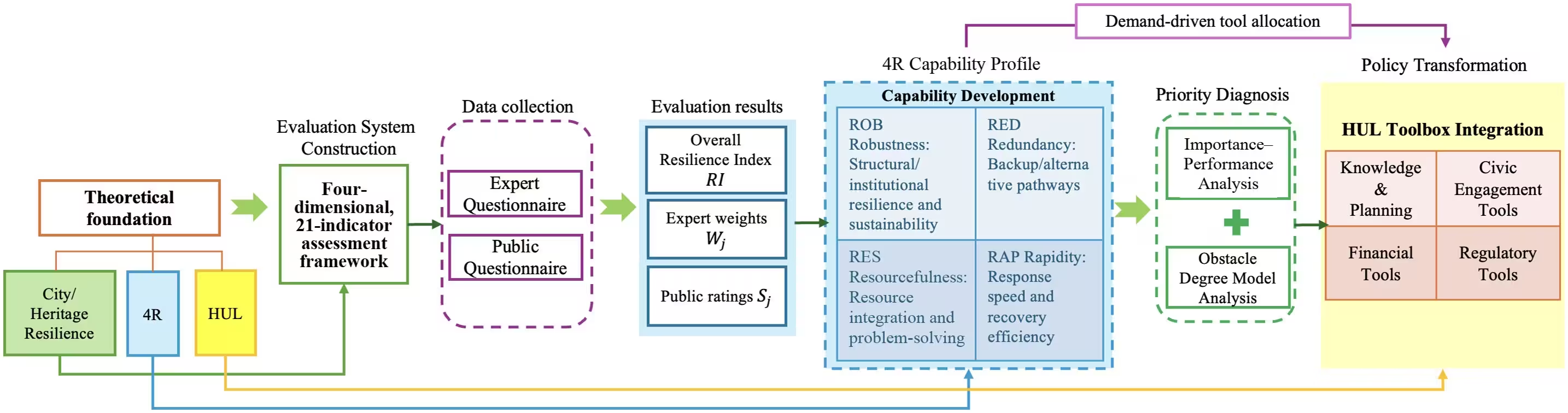
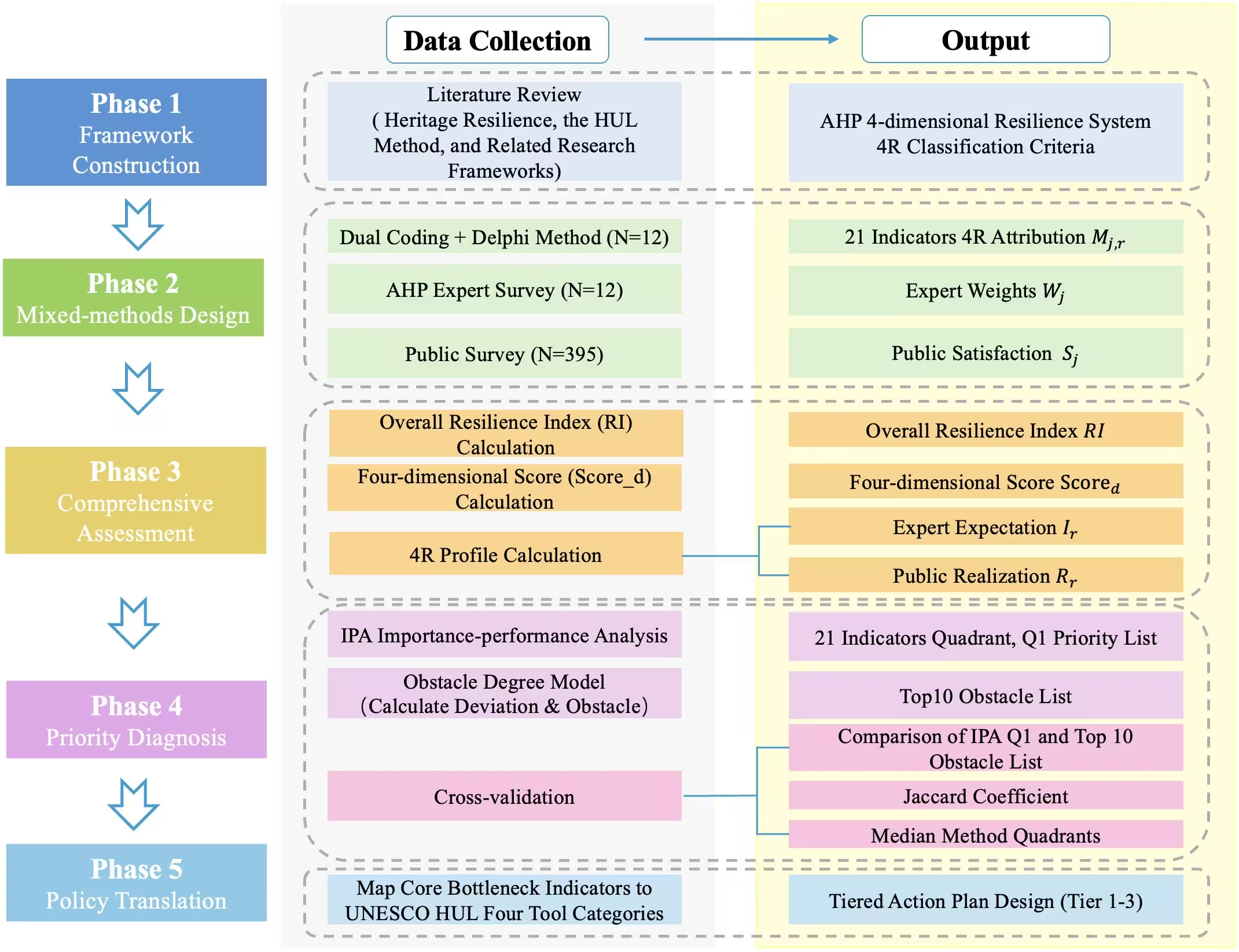
The research team established a twenty-one-indicator system across four core dimensions, social-cultural, ecological-spatial, economic-functional, and governance-institutional. Public surveys involving 395 local residents, merchants, administrators, and visitors were combined with expert analytical hierarchy process weightings to calculate performance scores and capability profiles.
Why Does Physical Conservation Outperform Cultural Continuity in Tourist Towns?
The overall resilience index for Shuhe Ancient Town reached 0.525, placing it at a medium-low level with sharp internal contradictions. While the ecological-spatial dimension scored highest at 0.641, driven by strong settlement planning harmony and spatial authenticity, the social-cultural dimension lagged significantly behind at 0.392. Traditional cultural activities continuity recorded the lowest public satisfaction and the highest obstacle degree at 22.61 percent, signaling a risk of cultural hollowing amid commercial tourism expansion.
The study found that resourcefulness capabilities, which measure a community’s ability to mobilize resources and participate in collaborative management, ranked second in expert expectations at 32.9 percent but lowest in actual public realization at 0.408. Conversely, physical robustness indicators achieved high performance scores, illustrating a common urban governance bias toward visible infrastructure projects over less tangible social capital accumulation.
What Are the Priority Pathways for Sustainable Urban Heritage Governance?
Dual diagnostic cross-validation identified three core bottlenecks that require urgent intervention, including traditional cultural activities continuity, natural ecological protection, and resident co-creation levels. These indicators accounted for nearly half of the total system obstacle degree. The authors mapped these priority constraints to UNESCO Historic Urban Landscape governance tools to formulate a tiered action plan spanning short-term civic engagement initiatives and long-term regulatory monitoring.
The authors note limitations in their cross-sectional design and the need for longitudinal tracking to measure how policy interventions influence resilience over time. These findings offer practical references for historic districts balancing tourism economies with resident well-being.
The research was published in PLOS One on November 23, 2026.
This article has been fact checked for accuracy, with information verified against reputable sources. Learn more about us and our editorial process.
Last reviewed on .
Article history
- Latest version
Reference(s)
- Chen, Xinyi., et al. “A dual-diagnostic framework for assessing heritage town resilience: Combining Importance-Performance Analysis (IPA) and Obstacle Models.” PLOS One, vol. 21, no. 11, November 23, 2026, pp. e0338117 Public Library of Science (PLoS), doi: 10.1371/journal.pone.0338117. <https://doi.org/10.1371/journal.pone.0338117>.
Cite this page:
- Posted by Ali Farooqui