Inside a Mine in India, Scientists Unearth 15-Meter-Long Snake Fossil, Rivalling Titanoboa in Size
Recent findings indicate that Titanoboa, long celebrated as the largest snake ever recorded, may soon lose its crown to a newly discovered giant.
Scientists have unearthed a remarkable prehistoric snake fossil that could potentially outdo Titanoboa, the largest snake ever known. The newly discovered species, named Vasuki indicus, was a massive constrictor that roamed the marshy swamps of western India around 56 million years ago.
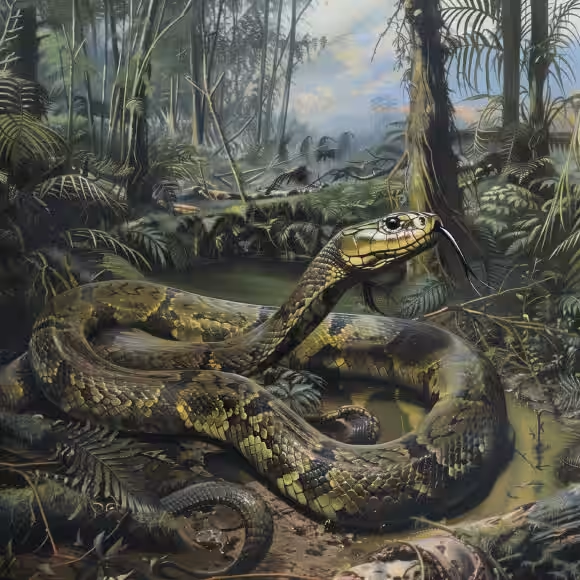
For over a decade, Titanoboa has held the title of the largest snake to have ever existed, measuring approximately 13 meters in length and weighing over a tonne. However, the recent discovery of Vasuki indicus challenges this notion, with estimates suggesting it may have reached up to 15 meters in length. The Vasuki fossil, found in a lignite mine in Gujarat, India, is the latest in a series of discoveries that shed light on the colossal creatures that inhabited the Earth after the age of dinosaurs.
A New Giant Emerges
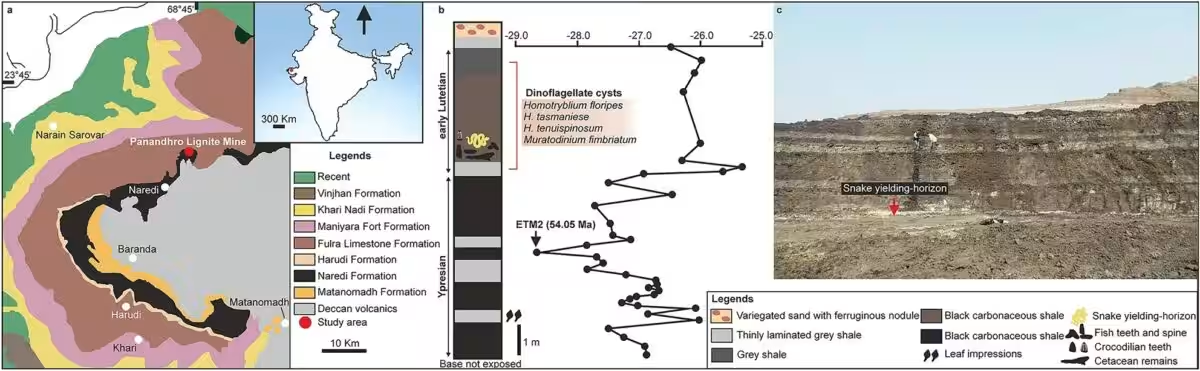
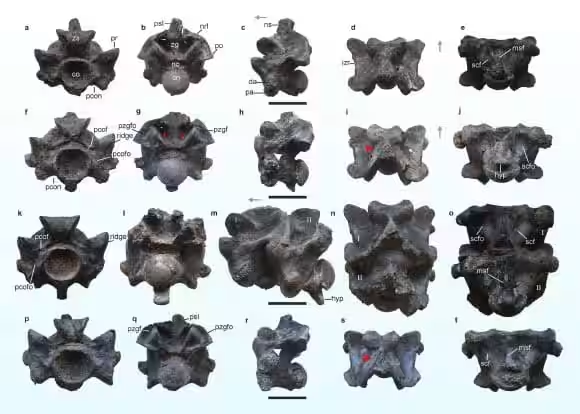
The Vasuki indicus fossil was discovered in the Panandhro region of Gujarat, India, in a lignite mine. Researchers found 27 vertebrae, some of which are still in their original anatomical alignment. According to the study published in Scientific Reports, the remains suggest a snake that may have grown as long as 15 meters and weighed up to one tonne. These estimates place Vasuki in direct competition with Titanoboa, which was previously considered the largest snake ever discovered.
“This is comparable in size to the longest known snake to have ever lived, the extinct Titanoboa,” the authors said.
This discovery is significant not only because of the snake’s enormous size but also because it challenges previously held assumptions about the prehistoric creatures that lived during the Paleocene epoch, a time following the mass extinction of dinosaurs.
The fossil’s location in India, a continent far from where Titanoboa was found in South America, suggests that such massive snakes were not restricted to one region of the world.
The Ambush Predator
While Titanoboa was known for its immense size and possible semi-aquatic lifestyle, the newly discovered Vasuki indicus is believed to have had a similar mode of hunting. As stated by Debajit Datta, a postdoctoral researcher at the Indian Institute of Technology Roorkee and lead author of the study:
“Considering its large size, Vasuki was a slow-moving ambush predator that would subdue its prey through constriction like anacondas and pythons,” adding that, “this snake lived in a marshy swamp near the coast at a time when global temperatures were higher than today.”
This suggests that, although the snake was enormous, it would not have been fast or agile. The broad, cylindrical body of Vasuki is evident in the fossilized vertebrae, which measure up to 11 cm wide. The body was likely about 44 cm across, enough to knock down small trees or wedge itself between boulders. Interestingly, the lack of a skull in the fossil makes it difficult to draw definitive conclusions about its behavior.
However, researchers believe that Vasuki did not rely on venom but instead used its sheer size and strength to constrict its prey in a slow, suffocating grip.
A Challenger Emerges
For over a decade, Titanoboa has held the title of the largest snake to have ever lived. Discovered in a Colombian coal mine in 2009, this massive reptile was estimated to grow up to 13 meters long and weigh over a tonne. However, Vasuki indicus may have rivaled or even exceeded that length, according to the fossil evidence. Although it is still unclear whether Vasuki was more massive or more slender than Titanoboa, the discovery complicates the previously simple narrative of the largest snake ever.
The possibility that such a giant snake existed in India rather than South America also raises new questions about the global distribution of these prehistoric giants.
“The estimated body length of Vasuki is comparable to that of Titanoboa, although the vertebrae of Titanoboa are slightly larger than those of Vasuki. However, at this point, we cannot say if Vasuki was more massive or slender compared to Titanoboa.”
The discovery of Vasuki suggests that massive constrictor snakes may have been far more widespread across different continents than initially believed.
This article has been fact checked for accuracy, with information verified against reputable sources. Learn more about us and our editorial process.
Last reviewed on .
Article history
- Latest version
Reference(s)
- Datta, Debajit. “Largest known madtsoiid snake from warm Eocene period of India suggests intercontinental Gondwana dispersal - Scientific Reports.”, vol. 14, no. 1, April 18, 2024, pp. 8054 Nature, doi: 10.1038/s41598-024-58377-0. <https://www.nature.com/articles/s41598-024-58377-0>.
Cite this page:
- Posted by Zara Tariq