Over Eighty Percent of Women in Japan Stay on Initial Hormonal Regimen for Menstrual Pain and Endometriosis
A nationwide claims database analysis reveals treatment consistency and switching patterns across six hormonal therapies over twelve months.

About four in five women in Japan who newly start hormonal treatments for menstrual pain or endometriosis stay on their initial medication type for a full year without switching regimens, according to a nationwide study. Researchers evaluated health insurance claims data for more than 16,000 patients under the age of 40 to understand real-world prescription patterns for common hormonal therapies.
The retrospective cohort study, published in PLOS One by Akiko Nakagomi and colleagues at several Japanese medical institutions, examined women who newly initiated low-dose estrogen-progestin combinations or dienogest between January and June 2023. Hormonal therapy is the primary medical treatment for dysmenorrhea, which involves severe menstrual cramps, and endometriosis, a condition where tissue similar to the lining of the uterus grows outside it. Both conditions cause chronic pain and menstrual abnormalities that can significantly disrupt daily life and work productivity.
How Do Real-World Prescribing Patterns Break Down Across Six Common Regimens?
The investigators classified the study medications into six categories based on drug type and dosage. These included four low-dose estrogen-progestin combinations, subclassified by their progestin generation and estrogen dose, and two doses of the progestin-only medication dienogest at one milligram or two milligrams per day. Among the 16,159 patients included in the transition analysis, the fourth-generation ultra-low-dose estrogen-progestin combination containing drospirenone was the most common starting treatment, prescribed to 44.2 percent of the cohort.
The underlying diagnoses varied markedly across the initial treatments. Specifically, 52 percent of patients initiating the higher two-milligram daily dose of dienogest had a diagnosis of endometriosis. In contrast, dysmenorrhea diagnoses predominated among patients starting estrogen-progestin combinations, accounting for roughly 69 to 75 percent of those groups.
What Proportion of Patients Stay on Their Initial Regimen for Twelve Months?
Throughout the 12-month follow-up period, 84.3 percent of the patients experienced no regimen transitions and remained within a single dose-based treatment category. Only 15.7 percent of the women experienced at least one switch to a different regimen category. The proportion of patients remaining on a single regimen was highest for the two-milligram dienogest group at 89.4 percent and the fourth-generation ultra-low-dose estrogen-progestin group at 87.9 percent, while the lowest was observed in the first-generation ultra-low-dose estrogen-progestin group at 76.4 percent.
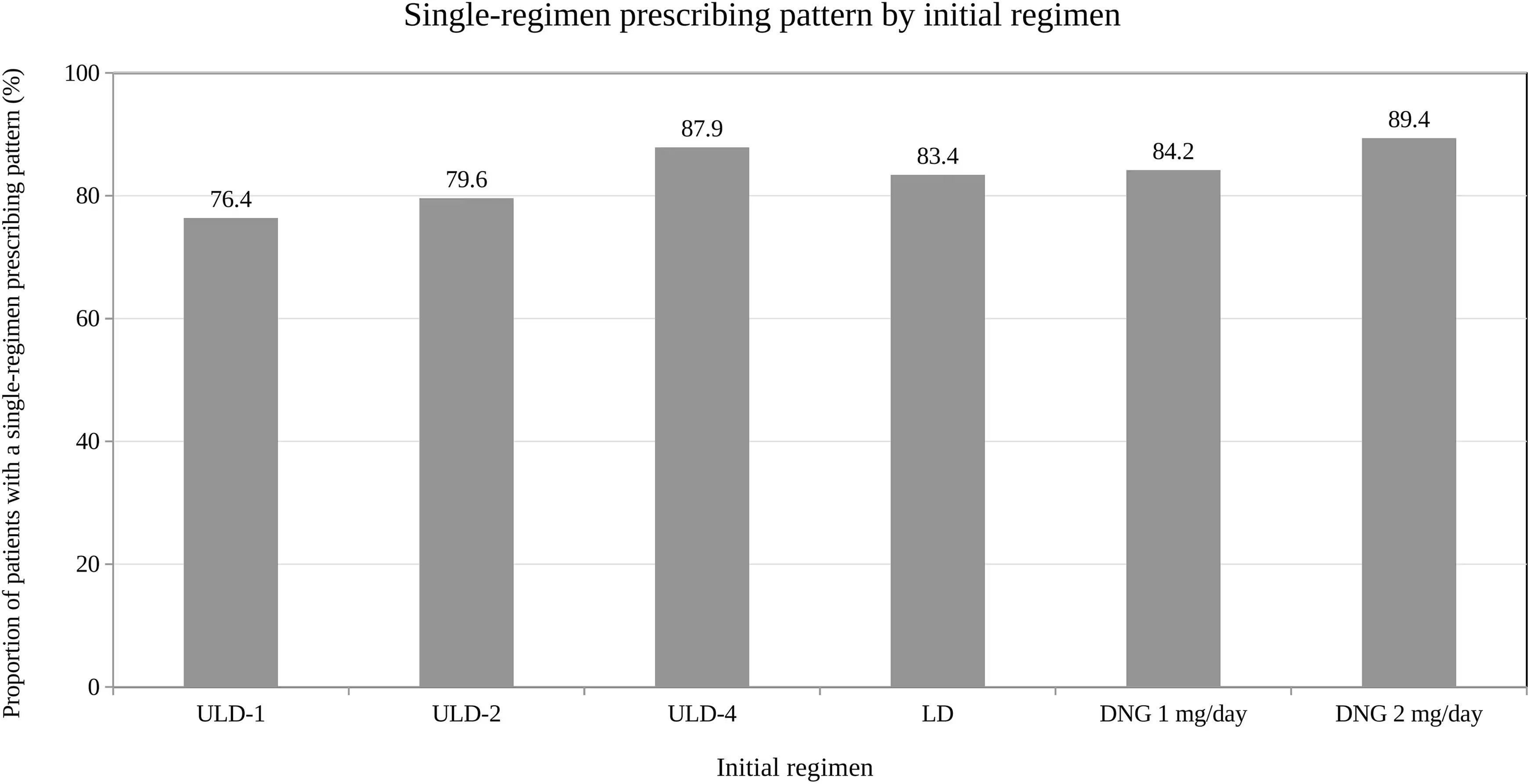
When patients did switch medications, the patterns varied depending on their starting treatment. For instance, among patients who began on one milligram of dienogest daily and switched, more than half escalated their dose to two milligrams per day. Meanwhile, among patients initiating low-dose estrogen-progestin formulations who changed treatments, more than 80 percent transitioned to ultra-low-dose formulations.
Why Does Consistent Prescribing Not Always Mean Continuous Treatment?
To better understand prescription consistency, the researchers also calculated the proportion of days covered by medication refills over the year. The overall mean coverage was 64.8 percent, meaning that prescriptions covered roughly two-thirds of the follow-up year on average. Approximately 23.6 percent of all patients had a prescription coverage score of less than 30 percent, indicating that nearly one in four women had limited medication coverage during the observation window.
The authors note that insurance claims data reflect prescription refills rather than actual medication intake, and the database cannot capture clinical reasons for stopping treatment, such as pregnancy planning, menopause, symptom resolution, or adverse effects. Furthermore, because the study relied on an anonymized insurance claims database, the findings may not fully represent women covered by different insurance systems, such as the national health insurance scheme for self-employed individuals and part-time workers.
The research was published in PLOS One on November 25, 2026.
This article has been fact checked for accuracy, with information verified against reputable sources. Learn more about us and our editorial process.
Last reviewed on .
Article history
- Latest version
Reference(s)
- Nakagomi, Akiko., et al. “Real-world prescribing patterns of hormonal therapy for dysmenorrhea and endometriosis in Japan: A retrospective cohort study using a nationwide claims database.” PLOS One, vol. 21, no. 11, November 25, 2026, pp. e0363538 Public Library of Science (PLoS), doi: 10.1371/journal.pone.0363538. <https://doi.org/10.1371/journal.pone.0363538>.
Cite this page:
- Posted by Tariq Hassan