New Software Automates Shorter Radiation Schedules For Head And Neck Cancer Plans
Researchers demonstrate a planning framework that reduces treatment fractions while preserving tumor coverage and organ safety limits.
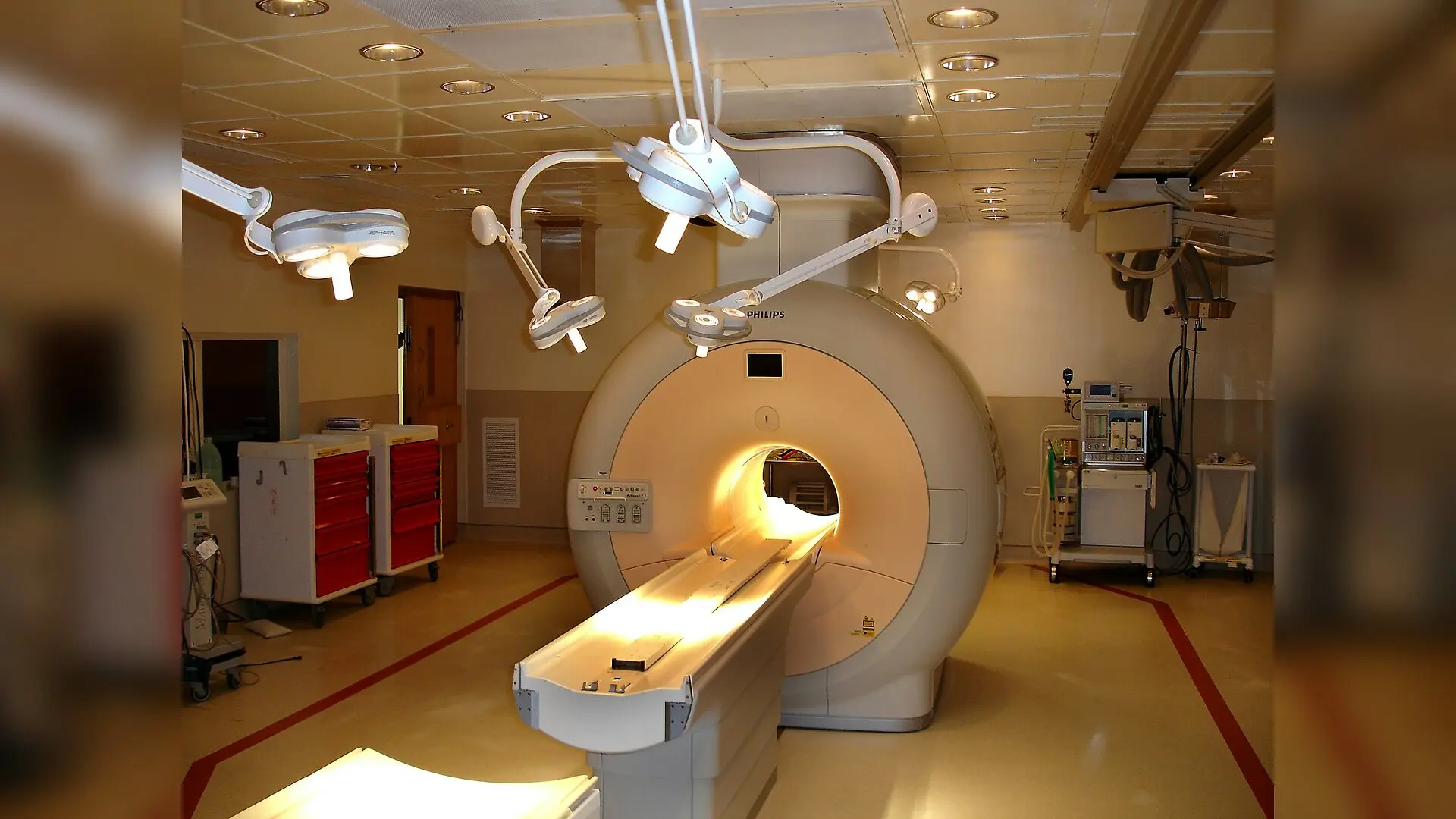
Shorter radiation therapy schedules could become much easier to design safely for cancer patients thanks to a new software framework that automates complex biological dose calculations. By reducing the total number of treatment visits, medical centers can potentially improve patient comfort and expand machine access while keeping healthy tissues protected.
Radiation treatments are traditionally delivered in many small installments called fractions over several weeks. While this standard schedule limits damage to healthy tissue, shrinking the number of visits requires higher doses per fraction, which complicates planning due to non-linear biological effects. Writing in arXiv, researchers describe a system that integrates an equieffective dose metric directly into treatment planning software to streamline these adjustments.
How Does Direct Biological Optimization Work in Practice?
Led by Suryakant Kaushik at RaySearch Laboratories in Stockholm, Sweden, the research team developed an extension within a research build of the RayStation treatment planning system. Instead of manually recalculating prescriptions and organ dose limits for every new schedule, the software automatically optimizes plans based on an equivalent reference dose across different fraction counts.
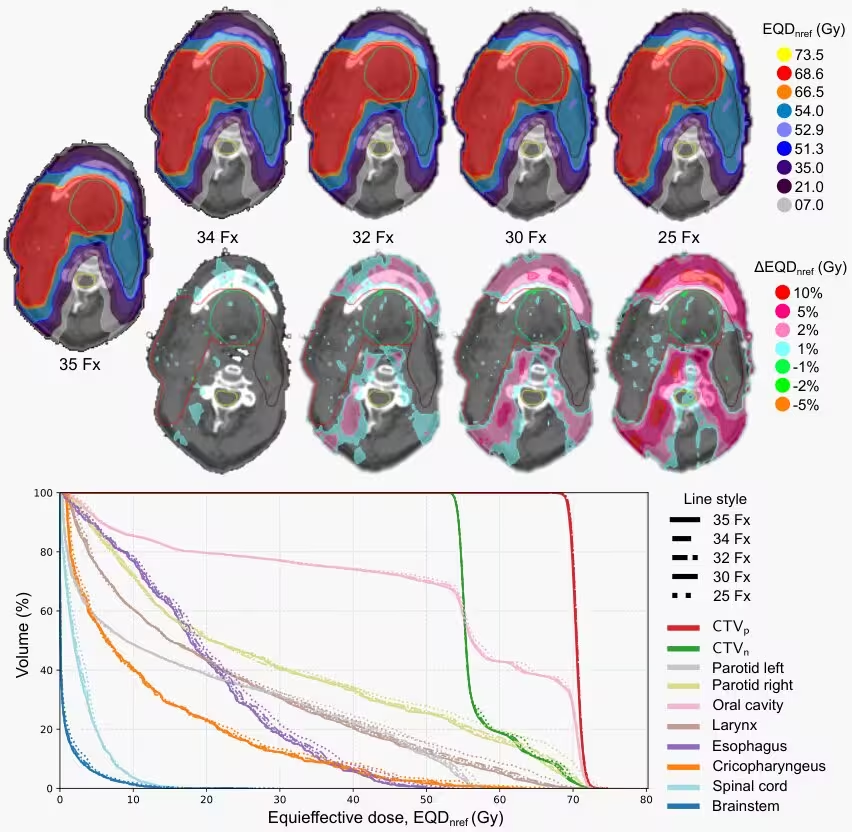
To test the framework, the investigators used anonymized clinical data from three head and neck cancer patients. Conventional plans for these patients involved thirty-five fractions delivering a primary target dose of seventy grays alongside fifty-four grays to a secondary target. The software then generated alternative plans using thirty-four, thirty-two, thirty, and twenty-five fractions without changing other parameters.
What Did the Patient Plan Comparisons Reveal?
The team evaluated the resulting radiation distributions across twenty-seven different scenarios per plan, accounting for potential patient setup shifts of three millimeters and tissue density variations of three and a half percent. Across all tested schedules, the automated plans successfully maintained target coverage and respected safety thresholds for nearby healthy structures.
When evaluated using the equivalent reference dose, the mean dose to the primary tumor target remained steady at seventy and a half grays with a standard deviation of just zero point zero eight grays across the various fractionation schemes. Furthermore, doses delivered to parallel organs at risk showed median differences of less than one percent of the prescribed dose compared to standard thirty-five fraction schedules.
Why Do Radiobiological Uncertainties Matter for Shorter Regimens?
The study also examined how uncertainties in the linear-quadratic model parameter governing tissue fractionation sensitivity, known as the alpha-beta ratio, impact the final dose distribution. When the team varied this radiobiological parameter by twenty-five percent, the resulting variations in equivalent dose grew larger as the number of fractions decreased.
For the most aggressive twenty-five fraction regimen, alpha-beta uncertainties led to absolute equivalent dose variations of up to zero point eight-eight grays for target volumes and up to zero point sixty-three grays for sensitive serial structures like the brainstem and spinal cord. These findings highlight that while mild hypofractionation down to thirty fractions introduces minimal deviation, more extreme schedule reductions demand careful clinical evaluation of tissue sensitivity parameters.
What Are the Limitations of This Preliminary Study?
Because the investigation relied on data from only three patients, the authors emphasize that the work serves as a proof-of-concept rather than a definitive clinical trial. Additionally, the underlying mathematical model focuses strictly on fractionation sensitivity and does not explicitly account for tumor cell repopulation during overall treatment time.
Despite these caveats, the automated framework successfully bypassed the need for manual prescription recalculation. By streamlining the generation of biologically equivalent plans, the approach offers a practical pathway for clinics seeking to optimize radiotherapy workflows without compromising safety protocols.
The study was posted to the arXiv preprint server on November 25, 2026.
This article has been fact checked for accuracy, with information verified against reputable sources. Learn more about us and our editorial process.
Last reviewed on .
Article history
- Latest version
Reference(s)
- Kaushik, Suryakant. “Fewer Fractions, Equieffective Plans: An optimization framework based on equieffective dose.” arXiv.org <http://arxiv.org/abs/2611.34605v1>.
Cite this page:
- Posted by Susan White