New AI Architecture Maps Indoor Spaces Faster and More Accurately Than Ever
By combining linear-speed local scanning with attention-driven global reasoning, a hybrid neural network significantly improves room reconstruction accuracy.
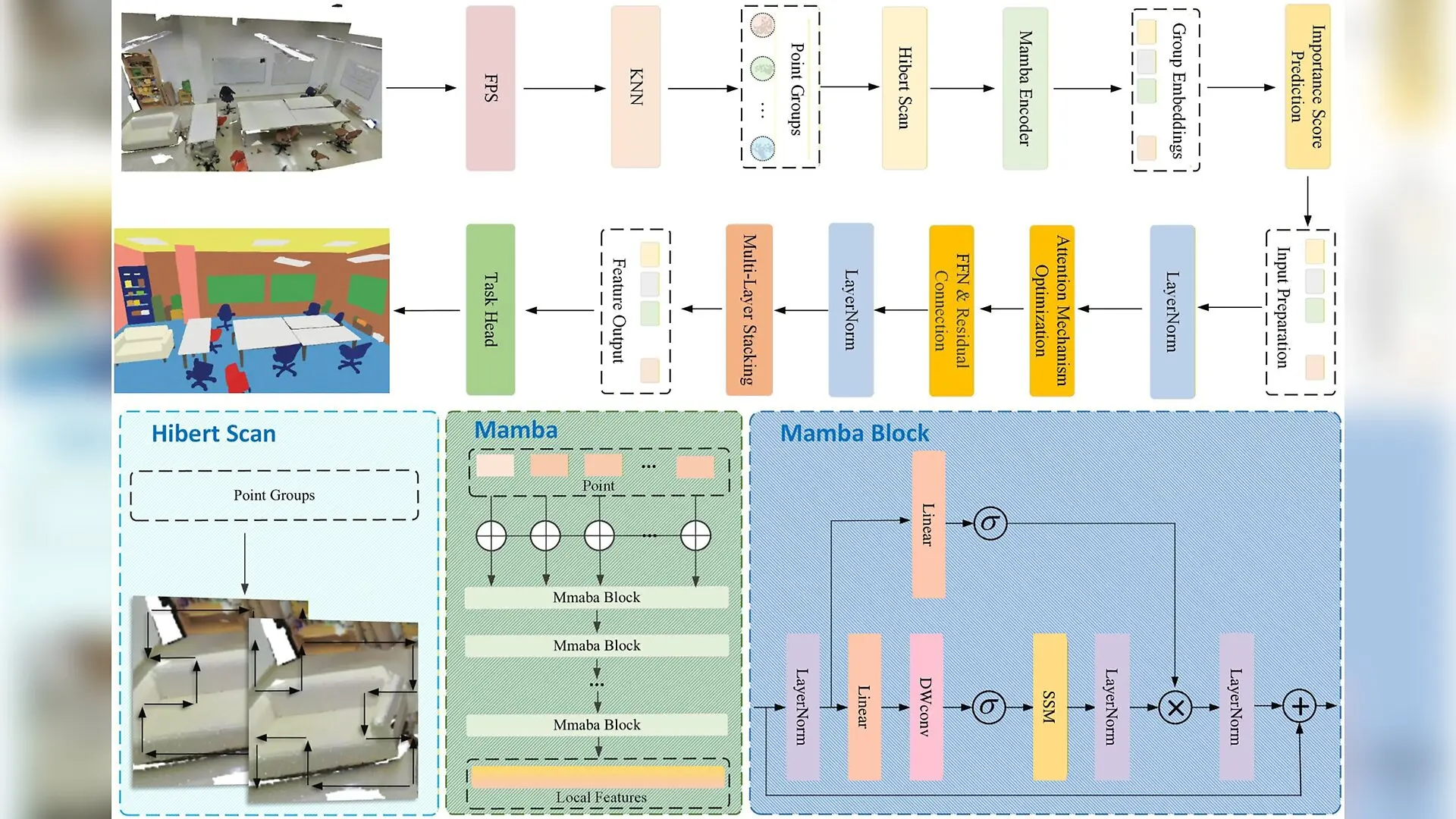
Converting chaotic clouds of laser-scanned points into clean digital rooms usually forces computers to choose between seeing every fine furniture detail and finishing the calculation before tomorrow morning. Traditional artificial intelligence models either get bogged down by the sheer volume of data or miss the subtle shapes of chairs and tables when they try to speed up.
To solve this spatial puzzle, researchers designed a hybrid neural network that braids together two distinct computational engines. The resulting architecture cuts down heavy computer processing while boosting indoor room mapping accuracy to new heights on major architectural benchmark tests.
How Can a Single Curve Untangle Jumbled Room Scans?
Laser scanners capture millions of floating dots that represent walls, beams, and furniture, but this raw data arrives without any order or connection. Feeding this unorganized chaos directly into high-speed neural networks usually causes the system to lose track of which points sit next to each other in physical space.
To fix this disconnection, the team implemented a clever space-filling mathematical path known as a Hilbert curve. This curving line snakes through small clusters of points, folding the irregular three-dimensional cloud into a continuous one-dimensional sequence without breaking neighborhood relationships.
By preserving local geometric continuity, the system allows a selective state space model called Mamba to process local features at lightning speed. Because Mamba scales linearly rather than quadratically as data grows, it bypasses the heavy bottlenecks that normally slow down traditional attention-based models during fine-grained feature extraction.
Why Do Point Clouds Need an Importance Score After Grouping?
After local clusters are processed, a computer model still needs to understand how a chair relates to a distant desk or how a ceiling connects to the floor across an entire room. The researchers developed a dual-path scoring module that calculates an exact structural importance rating for every single point group.
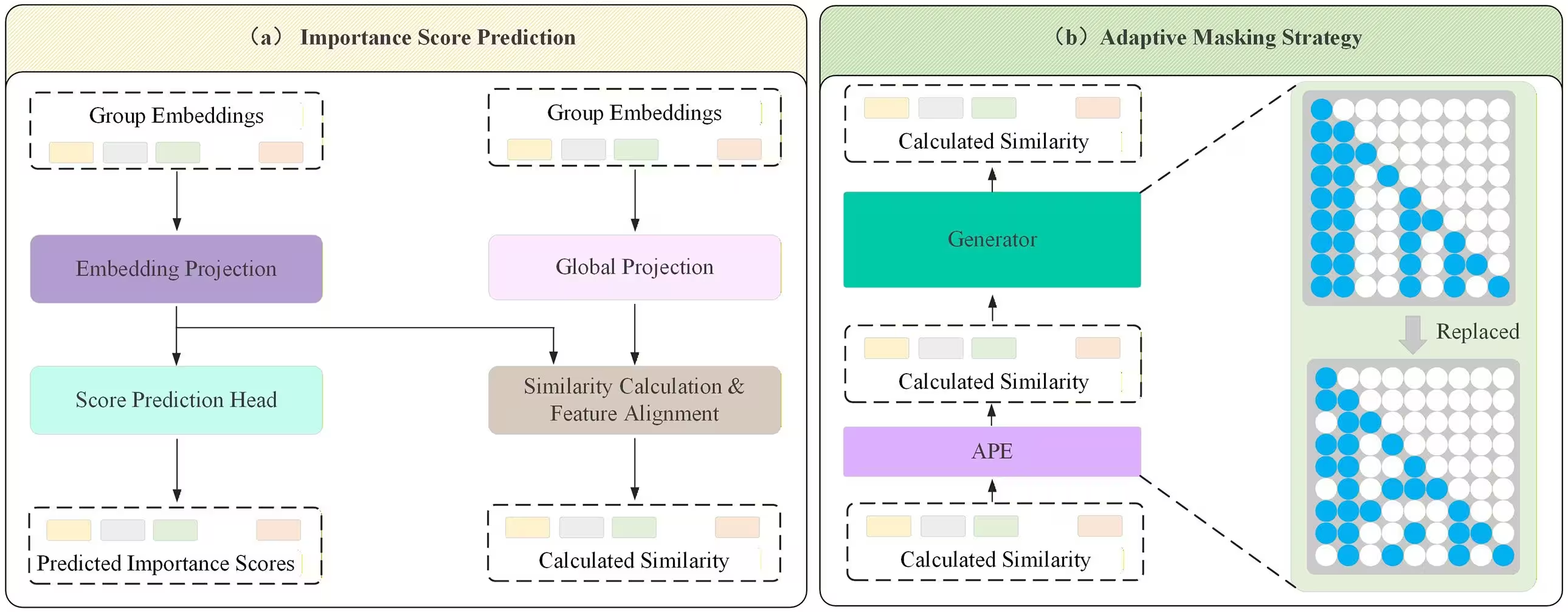
The main path evaluates each group individually, while an auxiliary path checks the global mean similarity to prevent local biases. Once the algorithm assigns these priority scores, it sorts the scattered point groups into a meaningful hierarchical sequence.
This ordered sequence is then handed off to a Transformer encoder, which excels at capturing long-range dependencies across distant objects. By weighting queries and keys using these importance scores, the system focuses its processing power where it matters most, filtering out redundant information through an adaptive masking strategy based on information gain.
What Kind of Performance Leap Did the Framework Achieve?
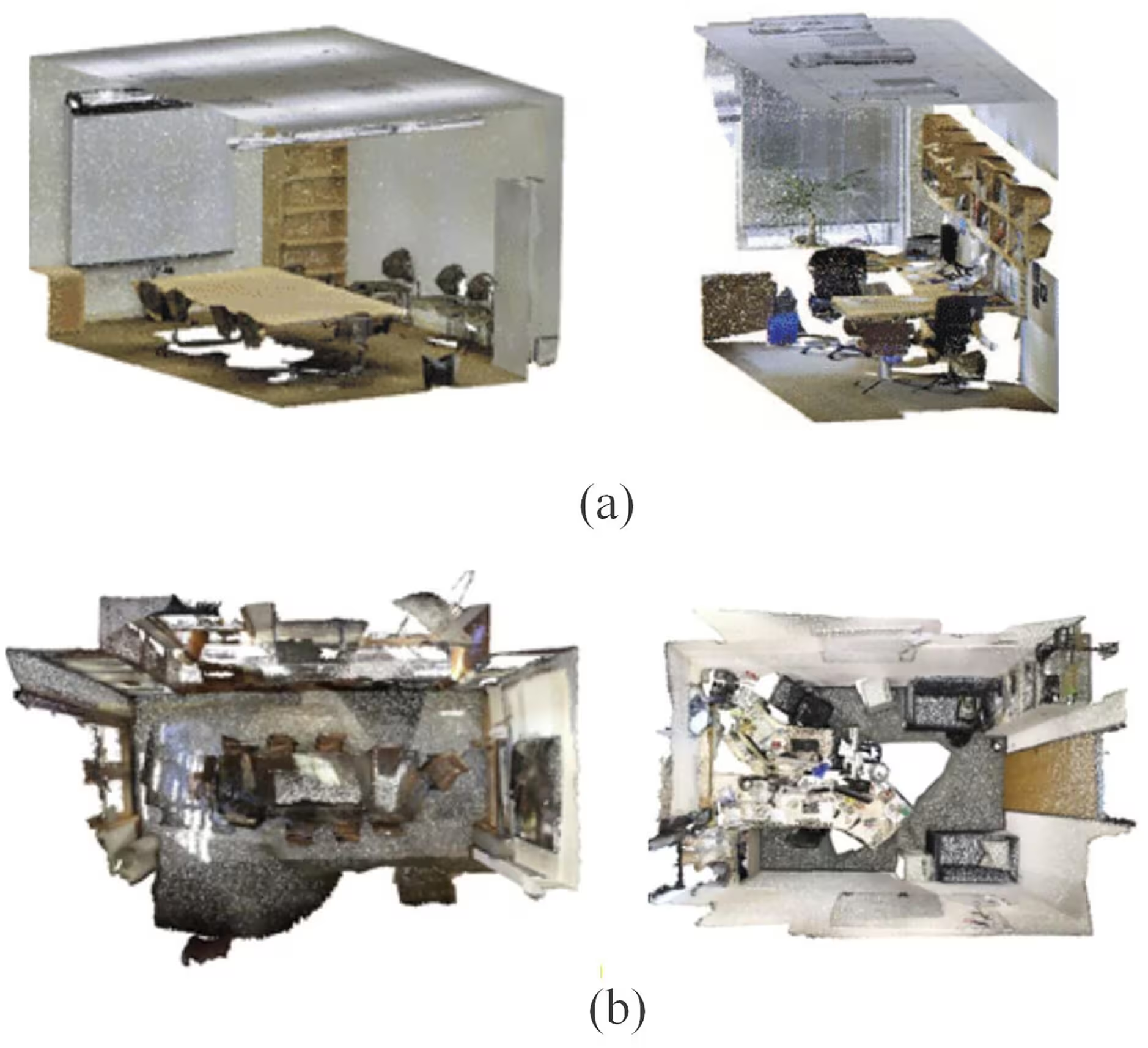
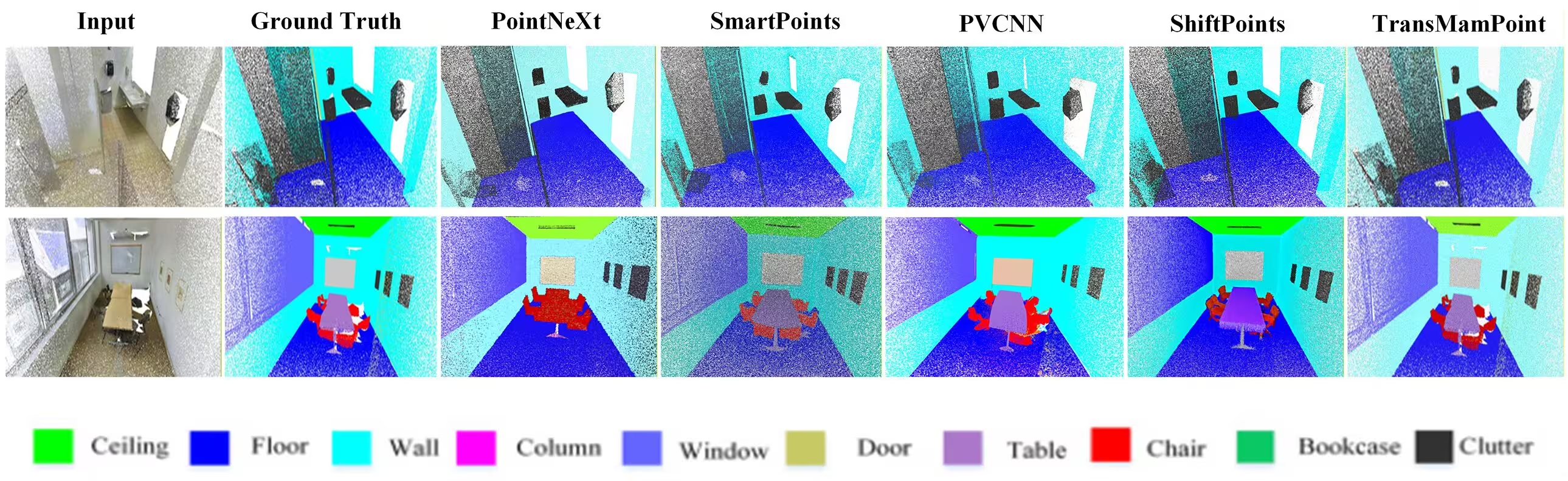
The research team tested their model, named TransMamPoint, on two widely used indoor benchmarking datasets, the Stanford 3D Indoor Spaces Dataset and ScanNetV2. The findings were published in PLOS One by first author ShiZhi Li and colleagues at their institution.
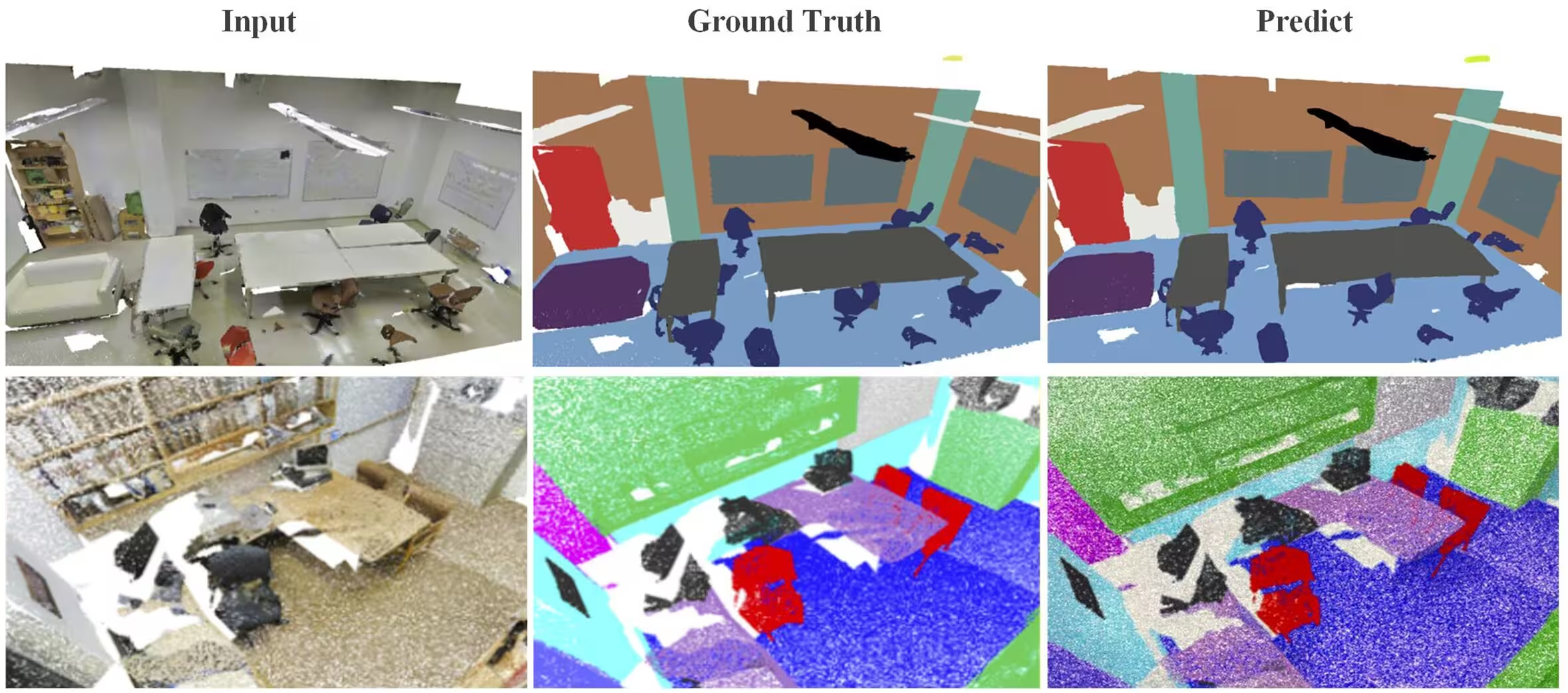
On the Stanford indoor dataset, the hybrid framework reached an overall accuracy of 92.5 percent and a mean intersection-over-union of 73.5 percent, outperforming several older vision models by clear margins. At the individual object level, the system achieved a 91.7 percent score for recognizing chairs and 92.9 percent for tables.
Computational efficiency tests showed equally striking improvements. Compared to standard attention models, the hierarchical design trimmed floating-point operations by nearly a third and reduced GPU memory consumption, proving that high precision does not require unmanageable hardware demands.
What Are the Current Limitations of the Hybrid Approach?
Despite these strong results, the authors noted a few boundary conditions for their architecture. When processing ultra-large-scale scenes containing tens of millions of points, the initial grouping and sequence transformation steps still demand significant memory resources.
Furthermore, the current framework was tailored specifically for indoor environments and has not yet been tested against the severe noise and weather interference found on outdoor building facades or irregular terrain. Future work will likely explore lighter preprocessing steps and multimodal data fusion to extend the model into an all-scenario architectural analysis tool.
The research was published in PLOS One on November 25, 2026.
This article has been fact checked for accuracy, with information verified against reputable sources. Learn more about us and our editorial process.
Last reviewed on .
Article history
- Latest version
Reference(s)
- Li, ShiZhi., et al. “TransMamPoint: An efficient framework for smart building interior analysis driven by 3D point clouds.” PLOS One, vol. 21, no. 11, November 25, 2026, pp. e0361642 Public Library of Science (PLoS), doi: 10.1371/journal.pone.0361642. <https://doi.org/10.1371/journal.pone.0361642>.
Cite this page:
- Posted by Joseph Jackson