Hybrid AI Framework Reaches Ninety Percent Accuracy in Multi-Class Eye Disease Detection
Combining vision transformers, few-shot learning, and symbolic classifiers helps overcome severe data imbalances in retinal image analysis.
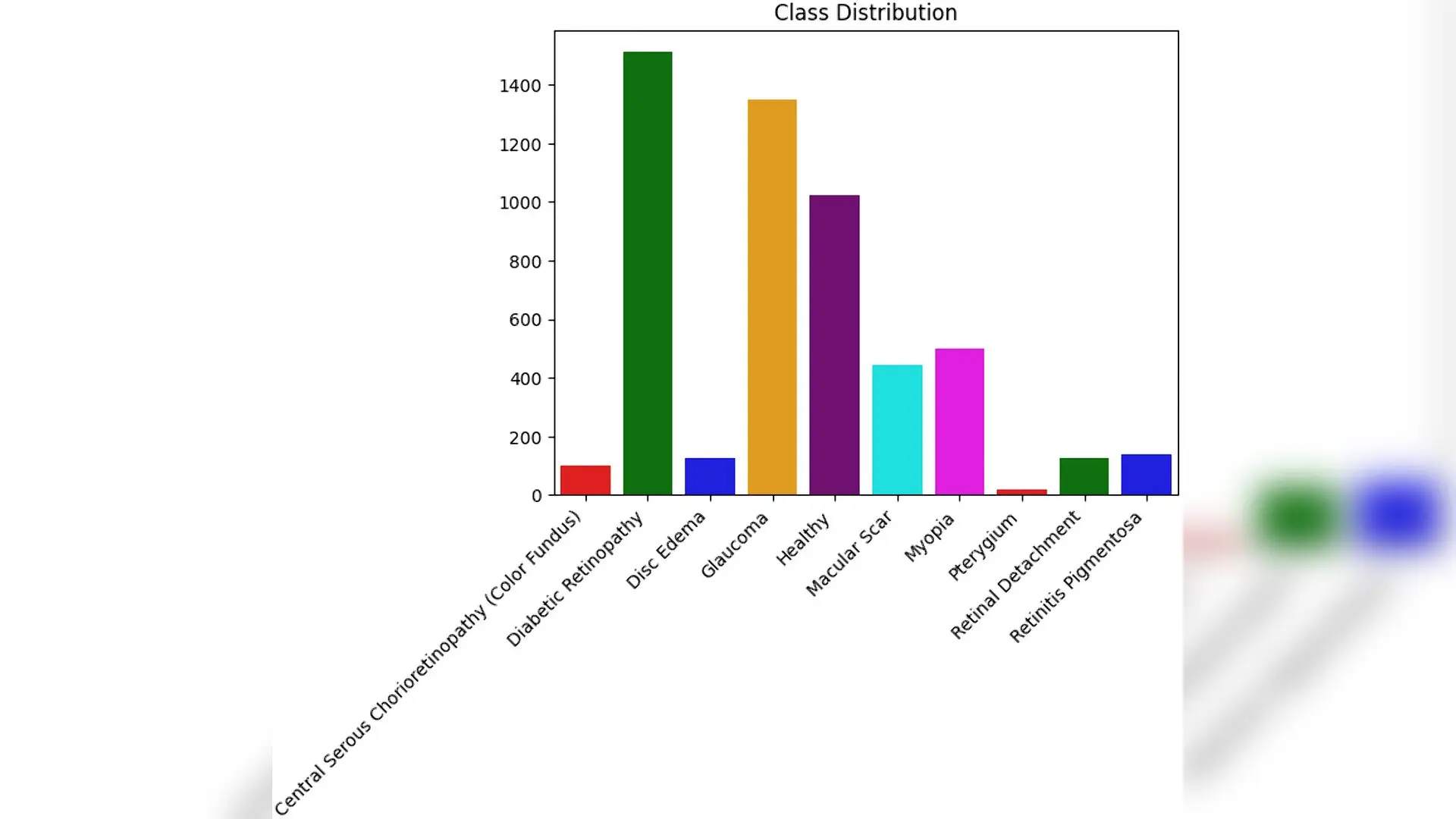
A new hybrid artificial intelligence approach successfully reaches about ninety percent accuracy in diagnosing ten different types of eye diseases from retinal images, overcoming major hurdles caused by severe data imbalances. The research, which addresses the common problem where rare medical conditions have far fewer training examples than common ones, demonstrates how combining multiple neural networks with specific learning techniques can improve automated screening.
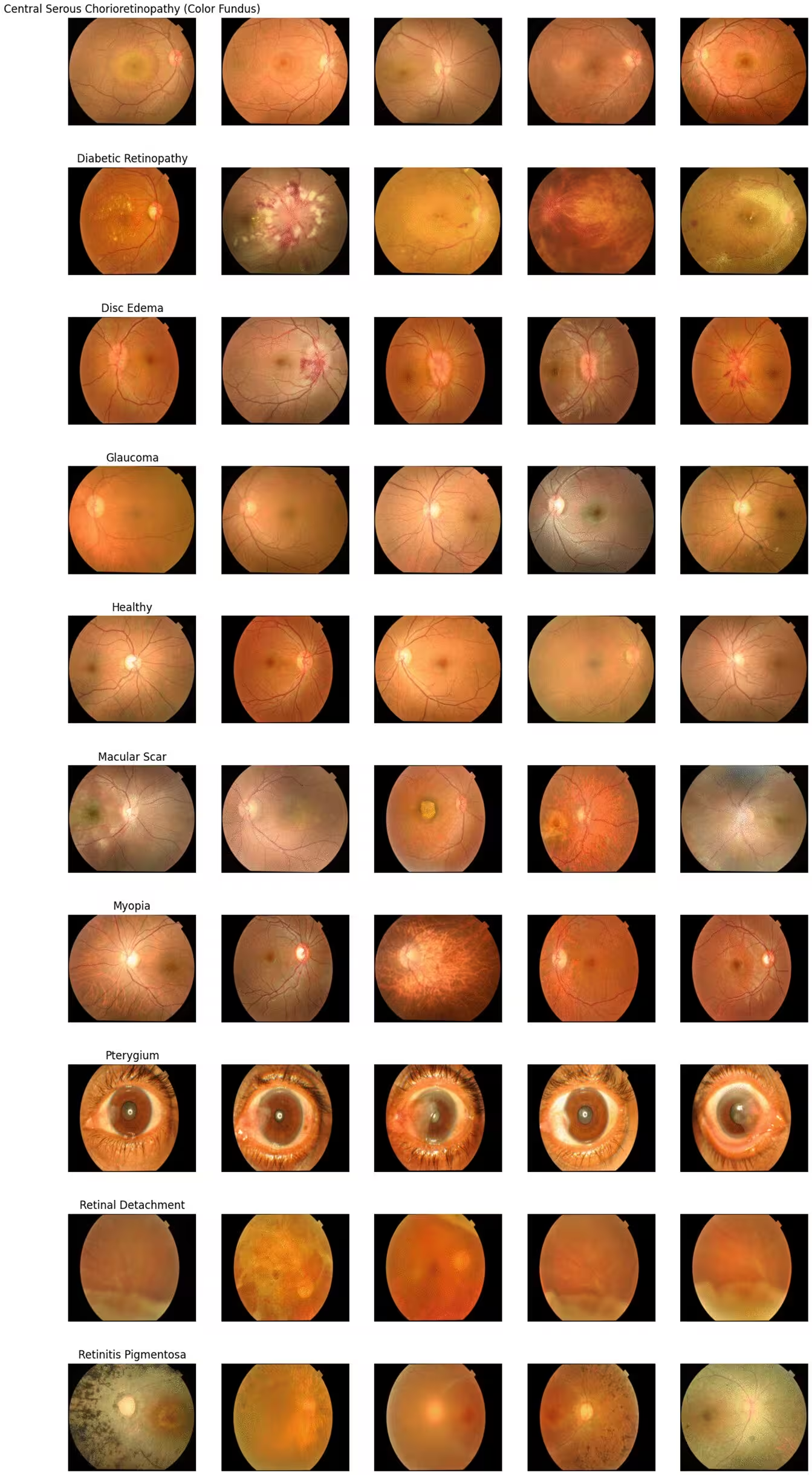
Medical image analysis often struggles when training data is unevenly distributed, because computer models tend to favor majority classes and ignore underrepresented conditions. To tackle this issue, Sabrina Jahan and colleagues from their respective institutions investigated an integrated framework that merges deep feature extraction, few-shot learning, Principal Component Analysis, and symbolic machine learning classifiers. The study is published in PLOS One, detailing how the team tested their workflow on a dataset comprising 5,335 retinal images spanning ten distinct ocular categories.
How Do Convolutional Networks and Transformers Extract Visual Features?
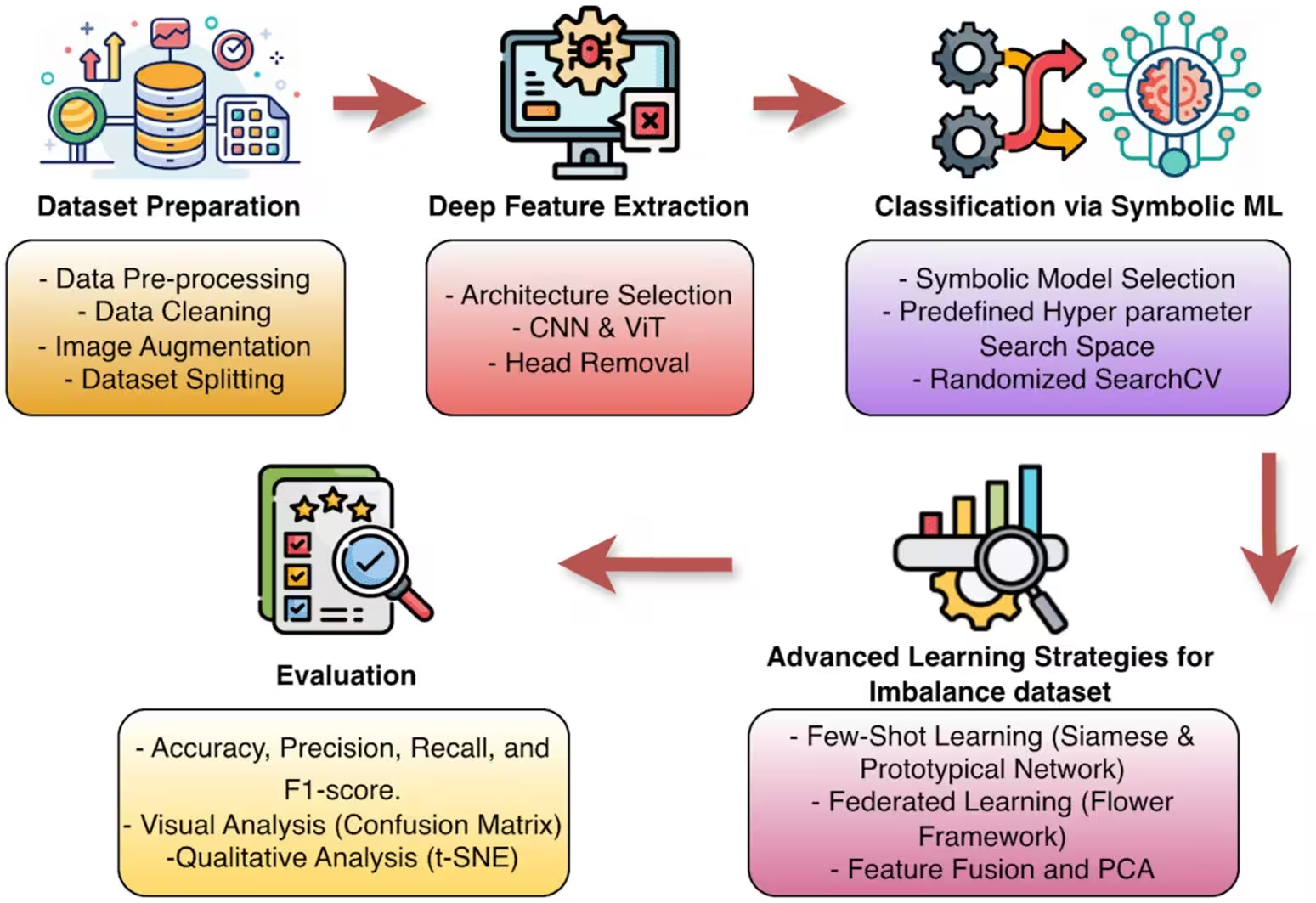
The research team evaluated five convolutional neural network architectures and three vision transformer architectures purely as feature extractors by removing their final classification layers. The convolutional models included ResNet50, DenseNet121, VGG16, MobileNetv2, and EfficientNet-B0, which excel at capturing local texture and structural patterns. Meanwhile, the vision transformers, consisting of ConViT-Small, MobileViT-S, and EfficientViT-B0, were utilized for their ability to model global contextual relationships across images.
When these feature extractors were initially paired directly with symbolic classifiers without specialized balancing strategies, validation accuracy remained relatively low, ranging between thirty-eight and sixty-five percent. This performance gap highlighted the severe difficulty posed by the class imbalance within the dataset, where conditions like pterygium had only seventeen samples while diabetic retinopathy had over one thousand five hundred images.
Why Does Prototypical Learning Outperform Traditional Pairwise Training?
To overcome data scarcity for rare conditions, the authors tested two few-shot learning techniques known as Siamese and Prototypical Networks. While Siamese networks train on pairs of images to learn similarity metrics, Prototypical Networks represent each disease category by a prototype vector computed as the mean of embedded support examples during episodic training tasks.
Experimental results showed that Prototypical Networks consistently structured the feature space better than Siamese setups, helping the models achieve higher validation accuracy. Building upon this, the researchers applied Principal Component Analysis to reduce feature dimensionality and eliminate redundant information before fusing the representations extracted from multiple backbones.
What Happens When Federated Learning and Symbolic Classifiers Are Combined?
The final stage of the pipeline incorporated a Flower-based federated training workflow using one simulated client over ten communication rounds as a proof of concept. Extracted embeddings were fused and classified using symbolic machine learning models including Random Forest, AdaBoost, CatBoost, XGBoost, and LightGBM, whose hyperparameters were optimized through RandomizedSearchCV.
Among all tested combinations, integrating vision transformer feature fusion, Prototypical Network training, Principal Component Analysis, and a CatBoost classifier yielded the highest overall performance. This best-performing configuration reached an accuracy of eighty-nine point seventy-five percent, a precision of ninety-two point eleven percent, a recall of ninety-one point seventeen percent, and an F1-score of ninety-one point fifty-two percent.
What Are the Limitations of the Current Approach?
Despite the strong classification metrics, the authors note several limitations that need addressing in future research. The federated learning workflow was tested as a proof of concept using only one simulated client, meaning genuine multi-client aggregation, non-identical data handling, and scalability across diverse institutions remain to be explored. Furthermore, the evaluation was restricted to a single retinal image dataset, and broader clinical validation across external multi-institutional databases is necessary to confirm real-world generalizability.
The research was published in PLOS One on November 25, 2026.
This article has been fact checked for accuracy, with information verified against reputable sources. Learn more about us and our editorial process.
Last reviewed on .
Article history
- Latest version
Reference(s)
- Jahan, Sabrina., et al. “A unified hybrid framework for ocular diagnosis: Integrating few-shot learning with PCA-refined multi-backbone neural embedding fusion and symbolic classifiers.” PLOS One, vol. 21, no. 11, November 25, 2026, pp. e0360607 Public Library of Science (PLoS), doi: 10.1371/journal.pone.0360607. <https://doi.org/10.1371/journal.pone.0360607>.
Cite this page:
- Posted by Joseph Jackson