New Mathematical Bounds Crack Open the Hidden Structure of Kloosterman Fractions
Fresh spectral techniques and level-averaging large sieves push past thirty-year limits in analytic number theory.
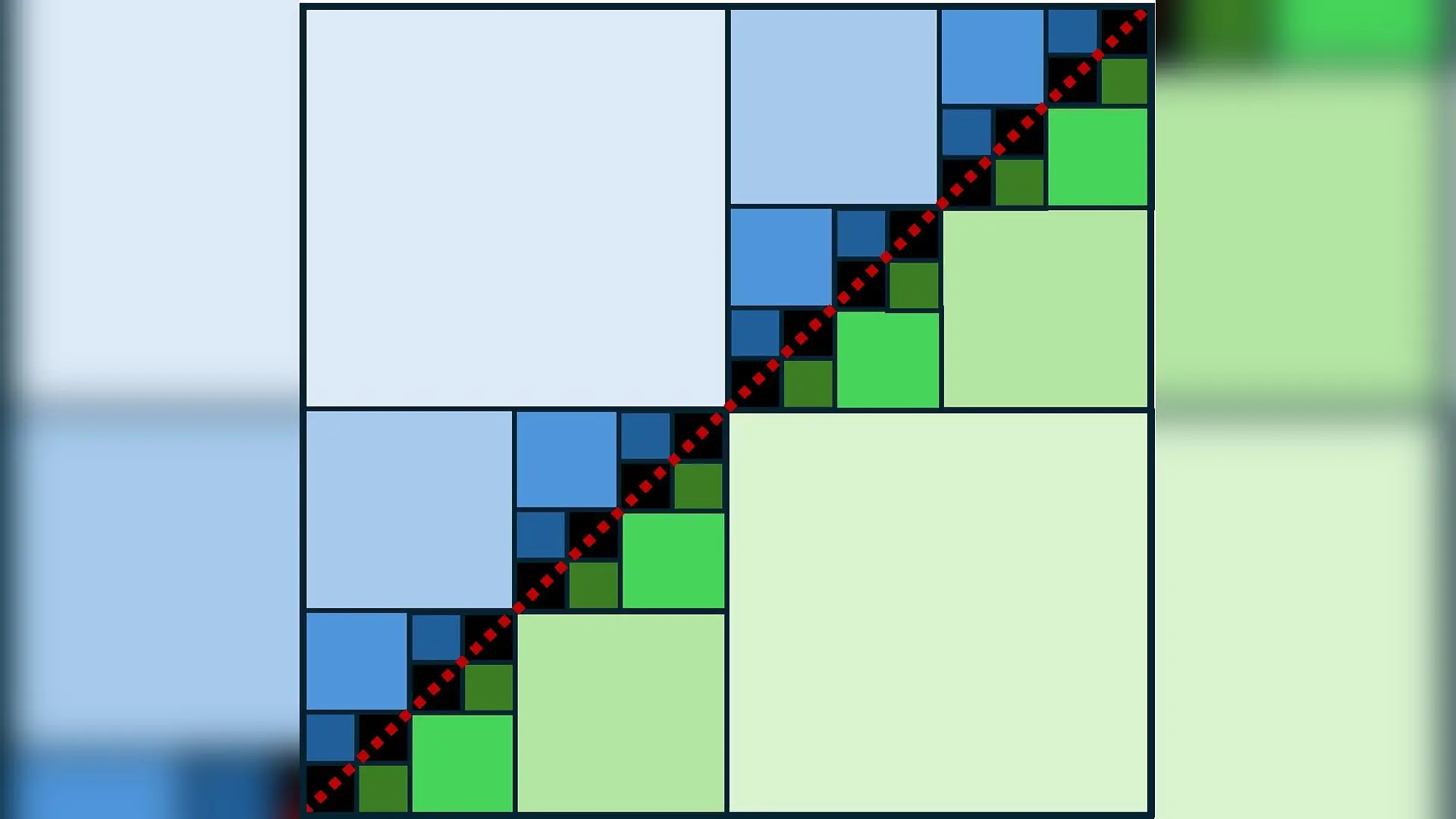
Mathematicians have cracked open a decades-old puzzle regarding fractions involving modular inverses, revealing hidden patterns that govern how these numbers scatter across the number line. When researchers look at fractions where the denominator dictates the modular inverse of the numerator, the resulting values often mimic random noise. Yet capturing that underlying randomness through rigorous mathematical bounds has stubbornly resisted attempts by number theorists for nearly thirty years.
In a study available on the arXiv preprint server, mathematician Alexandru Pascadi from the University of Bonn published in the arXiv preprint server has derived improved bounds for bilinear and trilinear forms featuring these special fractions, known as Kloosterman fractions. By pushing past longstanding barriers, the work sharpens our mathematical grip on how modular arithmetic behaves across large scales.
How Do These Fractions Defy Randomness?
To understand the challenge, picture a grid of points generated by dividing integers and mapping their modular inverses. For decades, researchers tried to prove that these fractions achieve substantial cancellation, meaning they do not clump together in predictable ways. Achieving this requires moving beyond trivial estimates and proving that sums containing these terms shrink faster than random chance would predict.
Previous efforts by prominent number theorists established initial power savings, but those boundaries left significant room for improvement. Pascadi tackled this hurdle by combining the spectral theory of automorphic forms with a sophisticated amplification technique. Instead of treating every term in isolation, the approach groups residues in a novel way that tames complex cross-terms during expansion.
Why Does Averaging Over Levels Unlock New Bounds?
A central breakthrough in the new work involves developing a large sieve inequality that averages across different modular levels. In advanced number theory, exceptional Maass forms, which are specialized wave-like functions on hyperbolic surfaces that occasionally violate standard conjectures, introduce pesky error terms. Left unchecked, these exceptional forms can ruin attempts to bound exponential sums.
To neutralize this threat, Pascadi constructed a new large sieve framework that incorporates level-dependent phases. By averaging over multiple levels simultaneously, the method absorbs the problematic loss factors that previously limited how far calculations could go. This allows mathematicians to push boundaries further than was possible using single-level analyses.
What Doors Do These New Calculations Open?
Sharpening the bounds on Kloosterman fractions is not just an abstract exercise in arithmetic symmetry. It directly feeds into major problems concerning the Riemann zeta function and the distribution of numbers within arithmetic progressions. For instance, the new estimates improve asymptotic formulas for the second moment of the zeta function twisted by Dirichlet polynomials.
Furthermore, the findings refine the known levels of distribution for unbalanced convolutions, a tool used to study prime numbers and divisors. While the research relies on advanced machinery like the Kuznetsov trace formula and intricate divisor bounds, its ripples extend across analytic number theory, offering fresh momentum for tackling deep questions about prime distribution and L-functions.
The study was posted to the arXiv preprint server on November 25, 2026.
This article has been fact checked for accuracy, with information verified against reputable sources. Learn more about us and our editorial process.
Last reviewed on .
Article history
- Latest version
Reference(s)
- Pascadi, Alexandru. “Sums of Kloosterman fractions and applications.” arXiv.org <http://arxiv.org/abs/2611.34917v1>.
Cite this page:
- Posted by Rabia Shah